Giriraj Singh hails NIFT's 3 medals at WorldSkills Shanghai 2026
Synopsis
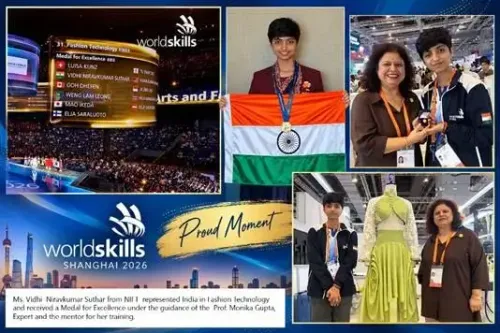
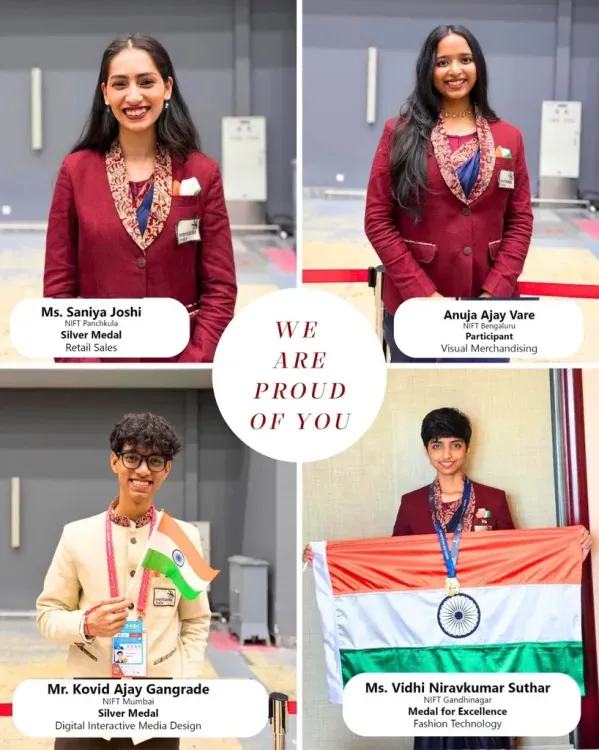
NIFT students won 2 Silver Medals and 1 Medal for Excellence at WorldSkills Shanghai 2026 in Fashion Technology, Digital Interactive Media Design, and Retail Sales. Union Textiles Minister Giriraj Singh praised the achievement as evidence of India's skills education aligning with global industry standards.
Key Takeaways
NIFT students claimed 2 Silver Medals and 1 Medal for Excellence at WorldSkills Shanghai 2026 .
Medals were won across Fashion Technology , Digital Interactive Media Design , and Retail Sales — three emerging, industry-relevant categories.
Union Textiles Minister Giriraj Singh congratulated students, experts, and trainers, and tagged the PMO India in his post.
NIFT was established in 1986 under the Ministry of Textiles to develop skilled professionals for India's fashion and textile sectors.
The achievement is framed as evidence of India's vocational and design education meeting global competitive benchmarks.
On the global stage of competitive vocational skill, India's fashion education flagship just made its mark. Union Textiles Minister Giriraj Singh on Tuesday, September 29, 2026, congratulated students of the National Institute of Fashion Technology (NIFT) for winning 2 Silver Medals and 1 Medal for Excellence at WorldSkills Shanghai 2026 — the Olympics of skills competitions.
Posting on X, Minister Singh wrote: 'WorldSkills Shanghai 2026 में NIFT के विद्यार्थियों ने वैश्विक मंच पर अपनी प्रतिभा और कौशल का शानदार प्रदर्शन किया' — ('NIFT students put on a magnificent display of talent and skill on the global stage at WorldSkills Shanghai 2026'). He tagged the Prime Minister's Office, signalling the achievement's place in the national narrative on skills and youth development.Three categories, three podium moments
The medals spanned three distinct, forward-looking disciplines: Fashion Technology, Digital Interactive Media Design, and Retail Sales. That range matters. These are not legacy trades — they sit at the intersection of design, digital commerce, and consumer experience, precisely the zones where India's textile and creative economy is racing to build global competitiveness. A sweep across three emerging categories is not luck. It signals a curriculum that has caught up with where the world is heading.
NIFT's four-decade runway to this moment
NIFT was established in 1986 by the Ministry of Textiles to professionalise India's fashion and textile sectors at a time when design education barely existed as a formal discipline in the country. It now operates as an autonomous institution under the same ministry that Giriraj Singh leads today. Over four decades, it has evolved from a single campus experiment into a multi-city network producing designers, technologists, and managers for an industry that is a pillar of Indian exports and employment.
WorldSkills International runs its flagship competition biennially, drawing competitors from over 80 countries across skills ranging from engineering to culinary arts to creative media. A podium finish here — judged by internationally standardised benchmarks — carries genuine weight. It is not a domestic ranking; it is a global peer assessment.
Why the Textiles Ministry is watching this closely
Minister Singh framed the wins explicitly as proof that India's training institutions are 'aligning with global standards and the changing needs of skill, education, and industry.' That framing is deliberate. The Ministry of Textiles has a direct stake in NIFT's output quality — the institute's graduates feed into a sector that employs millions and competes with Bangladesh, Vietnam, and China for global orders. Skilled designers and digital media professionals are no longer a soft add-on to that supply chain; they are increasingly its differentiator.
Three medals in Shanghai will not transform the sector overnight. But they put a number — and a podium — on the argument that India's design and vocational education is ready to compete where it counts.
Point of View
Internationally benchmarked data point to justify continued investment in NIFT and skills-aligned design education. For a ministry whose credibility is tied to the global competitiveness of India's textile and apparel exports, that data point has real policy utility. The spread across Fashion Technology, Digital Media, and Retail Sales also signals a deliberate curriculum pivot away from purely production-side skills toward the design, digital, and commerce layers where higher margins — and global differentiation — actually live. Giriraj Singh's decision to tag the PMO places the achievement within the broader 'Skill India' narrative, suggesting the government intends to amplify it well beyond the textiles sector.
NationPress
29 Sept 2026
Frequently Asked Questions
What medals did NIFT win at WorldSkills Shanghai 2026?
NIFT students won 2 Silver Medals and 1 Medal for Excellence at WorldSkills Shanghai 2026 , across the categories of Fashion Technology, Digital Interactive Media Design, and Retail Sales.
What is WorldSkills and why does it matter for India?
WorldSkills International organises a biennial competition — often called the 'Olympics of Skills' — that benchmarks vocational and technical talent across more than 80 countries using standardised global criteria. A podium finish indicates that India's training meets world-class standards.
What is NIFT and which ministry controls it?
NIFT (National Institute of Fashion Technology) is an autonomous institution established in 1986 under India's Ministry of Textiles to provide specialised education in fashion, design, and technology for the country's textile and apparel sectors.
Who is Giriraj Singh and what did he say about NIFT's medals?
Giriraj Singh is India's Union Minister of Textiles and a senior BJP leader. He praised the NIFT students' performance as a 'magnificent display of talent and skill,' calling the wins an inspiring result of continuous efforts to provide youth with world-standard opportunities and training.
Which skill categories did India compete in at WorldSkills Shanghai 2026?
India's NIFT students competed and won medals in Fashion Technology , Digital Interactive Media Design , and Retail Sales — all identified as emerging sectors aligned with the changing needs of industry.