Is the PM's Ceremonial Offering at Ajmer Dargah Justiciable?
Click to start listening
Synopsis
The Supreme Court has dismissed a PIL challenging the PM's ceremonial offering at the Ajmer Dargah. This decision raises intriguing questions about state patronage and constitutional principles. Amidst ongoing debates about secularism and heritage, what does this mean for the future of state-sponsored religious practices in India?
Key Takeaways
- The Supreme Court upheld the practice of state-sponsored ceremonial offerings at the Ajmer Dargah.
- The PIL was deemed not justiciable under Article 32 of the Constitution.
- The court encouraged the petitioners to pursue their civil suit regarding unauthorized temple occupation.
- The historical context surrounding Khwaja Moinuddin Chishti was challenged in the PIL.
- The case highlights ongoing tensions between secularism and religious practices in India.
New Delhi, Jan 4 (NationPress) The Supreme Court on Monday rejected a public interest litigation (PIL) that contested the "ongoing state-sponsored accolades, official support, and symbolic acknowledgment" accorded to Sufi saint Khwaja Moinuddin Chishti and the Ajmer Dargah.
Stating that the reliefs requested were not justiciable, a Bench comprising Chief Justice of India (CJI) Surya Kant and Justice Joymalya Bagchi remarked that such matters could not be adjudicated under Article 32 of the Constitution.
Encouraging the petitioners to continue their pending civil suit, the CJI Surya Kant-led Bench emphasized that the remarks made by the apex court would not influence the active civil suit in Ajmer regarding the alleged "unauthorized occupation of the Shankat Mochan Mahadev Temple by the Dargah".
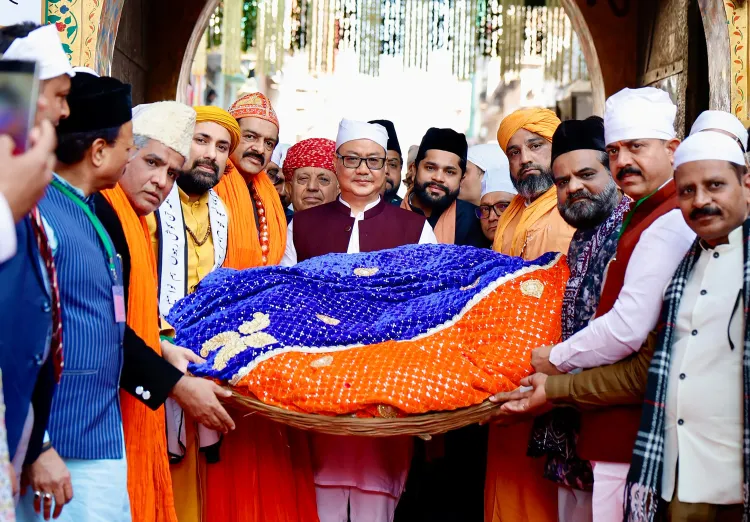
The PIL challenged the Prime Minister and other constitutional authorities' practice of offering a ceremonial chadar at the Ajmer Dargah, labeling it unconstitutional, arbitrary, and inconsistent with India’s constitutional principles.
Filed by Jitender Singh and Vishnu Gupta, the plea argued that there was no constitutional or statutory authority allowing the Union government or its entities to provide official support to the shrine. It claimed that such practices erode constitutional morality, secular governance, and national dignity.
The PIL asserted that the tradition of the Prime Minister offering a ceremonial chadar at the Ajmer Dargah has been in practice since 1947 without any legal foundation.
"This practice lacks any legal grounding and is strictly religious, while the office of the Prime Minister is a secular constitutional role embodying the sovereignty, dignity, and neutrality of the Republic of India,” the plea contended.
The petitioners have raised concerns about the historical rationale for granting state support, alleging that Moinuddin Chishti was "historically linked to foreign invasions led by Shahabuddin Ghori" in the 12th century.
The plea asserted that historical accounts reveal he "actively aided the invading forces of Shahabuddin Ghori during the siege of Ajmer", which culminated in the capture and execution of Maharaja Prithviraj Chauhan.
The PIL requested that the apex court declare the practice of state-sponsored ceremonial honor and symbolic acknowledgment to Khwaja Moinuddin Chishti and the Ajmer Dargah as unconstitutional. It further sought directives to establish appropriate guidelines that align with constitutional morality, secular governance, and the historical dignity of the nation, to prevent such state-sponsored ceremonial glorification in the future.
On the occasion of the 814th Urs of Khwaja Moinuddin Chishti, Union Minister for Parliamentary Affairs Kiren Rijiju, on December 22, presented a ‘chadar’ and flowers at the Ajmer Dargah on behalf of Prime Minister Modi and the Union government. Celebrating this significant occasion, the Union Minister offered the sacred chadar at the esteemed shrine as a sign of respect from the Prime Minister and the Union government. A separate chadar was also presented at the Ajmer Dargah by Lok Janshakti Party-Ram Vilas chief and Union Minister Chirag Paswan on behalf of the Central government and Prime Minister Modi.
Point of View
I affirm that while the dismissal of this PIL reflects the judiciary's stance on the separation of state and religious practices, it also ignites a crucial dialogue about the essence of secularism in India. The nation must navigate these complex intersections with care, ensuring respect for both heritage and constitutional values.
NationPress
06/01/2026
Frequently Asked Questions
What was the Supreme Court's ruling regarding the PIL?
The Supreme Court dismissed the public interest litigation challenging the state-sponsored honours at the Ajmer Dargah, ruling that the requested reliefs were not justiciable.
Who filed the PIL against the ceremonial offering?
The PIL was filed by Jitender Singh and Vishnu Gupta.
What was the basis of the PIL's argument?
The petitioners argued that there was no constitutional authority for state patronage to the shrine and that it undermined constitutional morality.
What historical claims were made in the PIL?
The PIL claimed that Khwaja Moinuddin Chishti was historically associated with foreign invasions, particularly with Shahabuddin Ghori.
What is the significance of the ceremonial chadar offering?
The ceremonial chadar offering is viewed as a gesture of respect and is a longstanding tradition since 1947, raising questions about its legal and constitutional foundation.