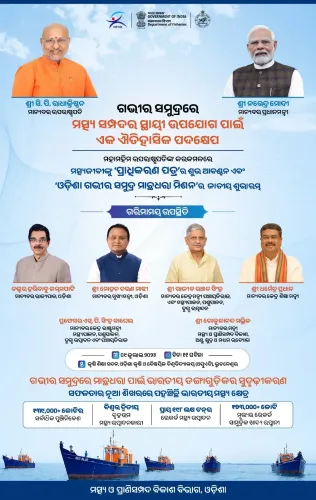
Odisha Deep Sea Fishing Mission 2026–2036 approved, targets ₹5,000 crore exports
Synopsis
Odisha has cleared a ₹2,295 crore decade-long deep-sea fishing mission that goes far beyond a policy statement — it commits to 2 lakh metric tonnes of annual marine output, 50,000 jobs, and ₹5,000 crore in exports by 2036, while shifting the state's entire fishing economy from crowded near-shore waters to high-value offshore species like tuna and oceanic squid.
Key Takeaways
The Odisha Cabinet approved the Odisha Deep Sea Fishing Mission (2026–2036) on 1 July 2026 , with an investment of ₹2,295.45 crore .
The mission targets annual marine fish production of 2 lakh metric tonnes , creation of 50,000 jobs , and marine exports of ₹5,000 crore by 2036 .
High-value offshore species — tuna , billfish , and oceanic squid — are key targets, moving beyond over-fished near-shore waters.
A dedicated Blue Economy Hub (B-Hub) will anchor knowledge, innovation, and coordination for the mission.
Odisha's 575 km coastline supports over five lakh marine fisher population currently dependent on near-shore activity.
The mission is aligned with Odisha Vision 2036 , Viksit Bharat 2047 , and SDG-14 (Life Below Water) .
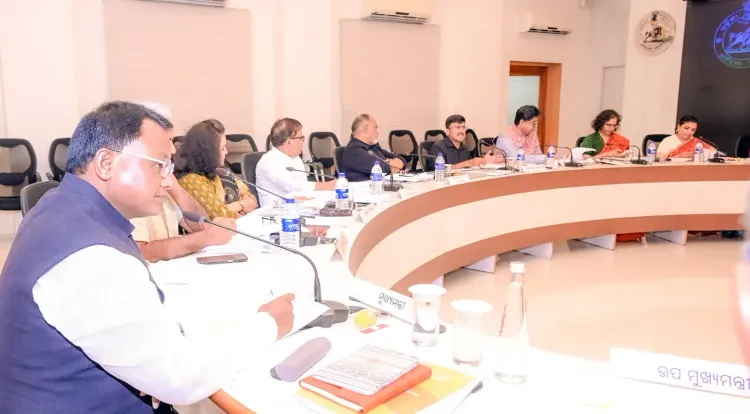
The Odisha Cabinet on Wednesday, 1 July 2026 approved the Odisha Deep Sea Fishing Mission (2026–2036), a decade-long initiative proposed by the state's Fisheries & Animal Resources Development (F&ARD) Department, with an estimated investment of ₹2,295.45 crore. The mission aims to position Odisha as a leading deep-sea fishing and marine export hub in Eastern India, targeting annual marine fish production of 2 lakh metric tonnes, 50,000 new jobs, and marine exports of ₹5,000 crore by 2036.
What the Mission Covers
The mission is designed to shift Odisha's marine fisheries beyond near-shore waters, which have come under increasing pressure from over-concentration of fishing activity. It will target high-value offshore species including tuna, billfish, and oceanic squid, using scientific management and modern fishing technologies.
Infrastructure envisioned under the mission includes modern deep-sea fishing vessels, upgraded mechanised boats, mother vessels, new fishing harbours and landing centres, seafood parks, and cold-chain and processing facilities. A dedicated Blue Economy Hub (B-Hub) will be established to serve as the mission's knowledge, innovation, and coordination centre.
Digital Governance and Marine Conservation
The mission also envisages a significant digital push — encompassing vessel monitoring systems, traceability infrastructure, and digital fisheries governance. On the conservation side, it includes plans for artificial reefs, sea ranching, and ecosystem-based fisheries management. Marine safety, disaster preparedness, and fisher welfare are also stated priorities.
Odisha has a coastline of approximately 575 km and a marine fisher population of over five lakh, the majority of whom currently depend on near-shore fishing and allied activities.
Policy Alignment and Investment Model
According to the government, the mission is aligned with Odisha Vision 2036, Viksit Bharat 2047, the National Blue Economy framework, and Sustainable Development Goal-14 (Life Below Water). It will be implemented in phases between 2026 and 2036 under the administrative control of the F&ARD Department.
The mission will actively promote Public-Private Partnerships (PPP), private investment, entrepreneurship, and adoption of advanced technologies across the fisheries value chain.
What This Means for Coastal Communities
For Odisha's coastal fishing communities, the mission represents a structural shift — from subsistence near-shore fishing to a technology-driven, export-oriented industry. The government stated that the mission is 'expected to transform Odisha's marine fisheries sector into a modern, technology-driven, export-oriented and environmentally sustainable industry, while ensuring long-term prosperity and livelihood security for the state's coastal fishing communities.'
With phased implementation now formally approved, the focus will shift to execution timelines, vessel procurement, and the operationalisation of the B-Hub in the months ahead.
Point of View
295 crore outlay and 2036 horizon are credible on paper, but the real test lies in vessel procurement, cold-chain buildout, and whether PPP structures attract serious private capital — or remain aspirational. Critically, the shift from near-shore to offshore fishing must be managed carefully: without robust resource assessment and vessel monitoring, it risks replicating the same overexploitation pressure in deeper waters. The B-Hub concept is promising, but its governance model and funding continuity across political cycles will determine whether this becomes a genuine Blue Economy anchor or another phased plan that stalls mid-implementation.
NationPress
30 Sept 2026
Frequently Asked Questions
What is the Odisha Deep Sea Fishing Mission?
The Odisha Deep Sea Fishing Mission (2026–2036) is a decade-long state initiative approved by the Odisha Cabinet on 1 July 2026, with an investment of ₹2,295.45 crore. It aims to develop offshore and deep-sea fisheries, modernise marine infrastructure, create 50,000 jobs, and boost marine exports to ₹5,000 crore by 2036.
What are the key targets of the Odisha Deep Sea Fishing Mission?
The mission targets annual marine fish production of 2 lakh metric tonnes, the creation of 50,000 employment opportunities, and marine exports worth ₹5,000 crore — all by 2036. It also aims to establish Odisha as the leading deep-sea fishing and marine export hub in Eastern India.
Which fish species will the mission focus on?
The mission will target high-value offshore species including tuna, billfish, and oceanic squid, which are currently underexploited. This is a deliberate shift from near-shore fishing, which has put growing pressure on Odisha's coastal fishery resources.
What is the Blue Economy Hub (B-Hub) announced under the mission?
The Blue Economy Hub (B-Hub) is a dedicated centre to be established as the mission's knowledge, innovation, and coordination hub. It will support scientific fisheries management, digital governance, and technology adoption across the marine fisheries value chain.
How does the mission align with national and global policy frameworks?
The mission is aligned with Odisha Vision 2036, Viksit Bharat 2047, the National Blue Economy framework, and the United Nations' Sustainable Development Goal-14 (Life Below Water). It will be implemented in phases under the Fisheries & Animal Resources Development Department.