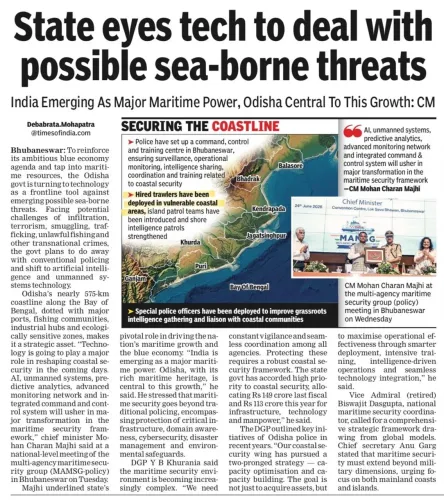
Odisha CM Majhi Pushes AI-Powered Maritime Security

Synopsis
Chief Minister Mohan Charan Majhi has called for artificial intelligence to be integrated into Odisha's maritime security framework, targeting the state's 485-km Bay of Bengal coastline. The move aligns with India's post-2008 coastal security overhaul and national AI-in-defence push, with operational details yet to be announced.
Key Takeaways
CM Mohan Charan Majhi has formally advocated AI-powered surveillance for Odisha's 485-km Bay of Bengal coastline.
The proposal aligns with India's Coastal Security Scheme (2009) and the Defence AI Council (2022) framework promoting AI in maritime domain awareness.
Odisha joins Gujarat , Tamil Nadu and Maharashtra in pursuing AI and drone-assisted coastal surveillance tools.
The Indian Coast Guard and potentially DRDO would need to coordinate with the state on any AI deployment.
Coastal fishing communities and maritime security agencies are the primary stakeholders affected by the proposed framework.
Specific pilot projects, budget allocations and technology partnerships have not yet been publicly announced.
The Chief Minister's Office of Odisha announced on 25 June 2026 that Chief Minister Mohan Charan Majhi has called for the integration of artificial intelligence into the state's maritime and coastline security framework, signalling a push to modernise surveillance along Odisha's 485-kilometre Bay of Bengal coastline.
Context
CM Majhi has advocated an AI-led approach to address persistent vulnerabilities along Odisha's coastline, which faces threats ranging from cyclonic weather events to smuggling and illegal fishing. The call positions Odisha alongside coastal states such as Gujarat, Tamil Nadu and Maharashtra that have already begun piloting data-fusion and drone-assisted maritime surveillance tools. The Chief Minister's push reflects a broader national momentum toward embedding emerging technologies into India's maritime domain awareness architecture.
Policy Backdrop
India's coastal security infrastructure was substantially overhauled following the 2008 Mumbai attacks, when the Coastal Security Scheme was launched in 2009 to install radar chains, Automatic Identification System stations and patrol infrastructure across coastal states. Subsequent programmes, including the Sagarmala initiative (2015), wove port-led development together with community-level coastal monitoring, with Odisha included as a beneficiary state. At the national level, the Defence AI Council (2022), building on India's National AI Strategy (2018), formally promoted artificial intelligence integration into maritime surveillance and border management.
The Indian Coast Guard remains the primary central agency responsible for coastal enforcement, search-and-rescue and maritime law along Odisha's shores, and any AI-powered state initiative would need to be coordinated with this federal structure. Analysts note that effective deployment would likely involve data-sharing agreements and interoperability protocols between state agencies and central bodies including the Coast Guard and potentially the Defence Research and Development Organisation (DRDO).
Stakeholders and Impact
Odisha's coastal fishing communities — numbering in the lakhs — stand at the intersection of this security push, as enhanced surveillance could simultaneously protect fishermen from maritime threats and raise concerns about monitoring of traditional fishing grounds. Security agencies at both state and central levels would need to coordinate deployment of AI tools, whether through indigenous systems aligned with the Atmanirbhar Bharat framework or partnerships with private technology firms. Non-traditional threats including trafficking and illegal fishing are expected to be primary targets of any AI-assisted surveillance grid.
What's Next
Concrete details — including pilot project locations, budget allocations and potential memoranda of understanding with defence or technology partners — are yet to be publicly announced. Observers will watch Odisha's next fiscal statement for specific line items tied to AI-enabled coastal infrastructure. The proposal's translation into operational capacity will depend on coordination between the state government, central maritime agencies and technology providers, making the coming months a critical window for policy specifics to emerge.
Point of View
Championing such technology-forward security positions also carries political salience, signalling governance ambition on a national-security theme the party prioritises. The real test will be whether Odisha moves from advocacy to funded, operational pilots — a gap that has slowed similar announcements in other coastal states. Until budget lines and agency MoUs are published, the proposal remains directional rather than programmatic.
NationPress
24 Sept 2026
Frequently Asked Questions
What did Odisha CM Mohan Charan Majhi say about AI and maritime security?
CM Majhi called for the integration of artificial intelligence into Odisha's maritime and coastline security, aiming to modernise surveillance along the state's 485-km Bay of Bengal coastline.
Why does Odisha need stronger coastal security?
Odisha's 485-km coastline on the Bay of Bengal is exposed to cyclones, smuggling routes and illegal fishing, making layered, technology-assisted surveillance a long-standing policy priority.
What is India's Coastal Security Scheme?
The Coastal Security Scheme was launched in 2009 following the 2008 Mumbai attacks to install radar chains, AIS stations and patrol infrastructure across Indian coastal states, including Odisha.
Which agency is responsible for coastal security in Odisha?
The Indian Coast Guard is the primary central agency responsible for coastal enforcement, search-and-rescue and maritime law along Odisha's coastline.
What are the next steps for Odisha's AI maritime security plan?
Specific pilot projects, budget allocations and potential MoUs with DRDO or private AI firms have not yet been announced; Odisha's next fiscal statement is expected to provide more details.