Odisha CMO Highlights Coastal Security Push Along 575-km Coastline

Synopsis
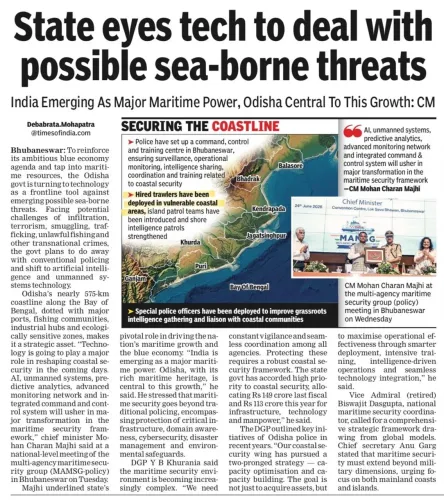
The Chief Minister's Office of Odisha has highlighted the state's reinforced maritime security posture, citing a 1,200-strong Coastal Security Wing, advanced surveillance technologies, and inter-agency coordination along its 575-km coastline — all framed as enablers of Odisha's Blue Economy vision.
Key Takeaways
Odisha's coastline stretches 575 kilometres along the Bay of Bengal , making it one of India's significant maritime frontiers.
The state's Coastal Security Wing comprises over 1,200 trained Marine Police personnel engaged in patrolling and maritime law enforcement.
The announcement emphasises advanced maritime technologies and inter-agency coordination as pillars of the security framework.
Odisha's coastal security build-up is rooted in the national Coastal Security Scheme launched in 2005 and expanded under Phase-II from 2011 after the 2008 Mumbai attacks .
The state explicitly links maritime security to its Blue Economy objectives, covering fisheries, port development, and coastal tourism.
Key ports such as Paradip and Gopalpur and coastal fishing communities are among the primary stakeholders in a more secure maritime environment.
The Chief Minister's Office of Odisha on Friday, June 26, 2026, highlighted the state's stepped-up maritime security posture, citing a Coastal Security Wing of over 1,200 Marine Police personnel and advanced surveillance technologies deployed along Odisha's 575-kilometre Bay of Bengal coastline.
Context
The official post stated that Odisha is 'reinforcing coastal security through advanced maritime technologies and a robust Coastal Security Wing comprising over 1,200 well-trained Marine Police personnel.' The announcement frames these measures as part of the state's broader ambition to build a 'resilient Blue Economy' anchored in secure coastal waters. The emphasis on 'seamless inter-agency coordination' signals active engagement with central agencies responsible for maritime domain awareness.Policy Backdrop
Odisha's coastal security architecture did not emerge in isolation. Following the November 2008 Mumbai attacks, the Government of India expanded the Coastal Security Scheme — first launched in 2005 and extended under Phase-II from 2011 — mandating all coastal states to establish marine police stations, procure patrol vessels, and train dedicated personnel. Odisha began operationalising marine police stations and inducting trained officers in the early 2010s as part of this national architecture. The state's Marine Police operates in inshore waters and coordinates with the Indian Coast Guard on surveillance and interdiction tasks. The current announcement reflects a continuation and deepening of that multi-decade policy lineage rather than an entirely new initiative.Stakeholders and Impact
The most immediate beneficiaries of a strengthened coastal security framework are Odisha's coastal fishing communities, who depend on safe inshore and offshore waters for their livelihoods. Enhanced surveillance and faster response capability can deter illegal fishing, smuggling, and other maritime crimes that directly affect their income and safety. The maritime trade sector — including the ports of Paradip and Gopalpur — also stands to gain from a more secure operating environment, which is a prerequisite for attracting investment under any Blue Economy strategy. At the same time, over 1,200 Marine Police personnel now form the frontline human layer of this security net, supported by technology platforms and inter-agency protocols.What's Next
The reference to a 'future-ready security framework' suggests ongoing investment in surveillance infrastructure, potentially including vessel tracking systems, coastal radar, and drone-based monitoring. Analysts watching Odisha's maritime policy will track state budget allocations for coastal security equipment in upcoming fiscal cycles, as well as any joint exercises between the Odisha Marine Police and the Indian Coast Guard. The explicit linkage between security and the Blue Economy — encompassing fisheries, port development, and coastal tourism — indicates that Odisha intends to position maritime safety as an economic enabler, not merely a law-enforcement function. How that integration translates into concrete schemes and investment pipelines will define the next chapter of the state's coastal strategy.Point of View
As it positions the state government as an active partner in India's layered national maritime architecture rather than a passive recipient of central mandates. This framing aligns with a broader pattern among Bay of Bengal states that are increasingly treating coastal security not as a cost centre but as infrastructure for ocean-based economic growth. Whether the announcement is followed by verifiable budget commitments or joint operational exercises will determine whether it marks a policy inflection point or remains a communications exercise.
NationPress
25 Sept 2026
Frequently Asked Questions
How long is Odisha's coastline?
Odisha's coastline is 575 kilometres long, running along the Bay of Bengal in eastern India, as cited by the Chief Minister's Office.
What is the Odisha Coastal Security Wing?
The Coastal Security Wing is a specialised unit of the Odisha Police comprising over 1,200 trained Marine Police personnel responsible for patrolling inshore waters, enforcing maritime law, and coordinating with central agencies such as the Indian Coast Guard .
What is India's Coastal Security Scheme?
The Coastal Security Scheme was launched by the Government of India in 2005 and expanded under Phase-II from 2011 following the 2008 Mumbai attacks . It mandates coastal states to build marine police stations, procure patrol vessels, and train dedicated personnel as part of a national maritime security architecture.
What is Odisha's Blue Economy vision?
Odisha's Blue Economy vision focuses on sustainably harnessing ocean-based resources — including fisheries, port infrastructure, and coastal tourism — while maintaining a secure maritime environment. The state treats coastal security as a foundational enabler of this economic strategy.
Which agencies coordinate on coastal security in Odisha?
Odisha Marine Police works in coordination with the Indian Coast Guard and the Indian Navy under a layered national framework for maritime domain awareness, surveillance, and interdiction along the state's coastline.