Odisha CM flags Blue Economy, maritime security as national priorities

Synopsis
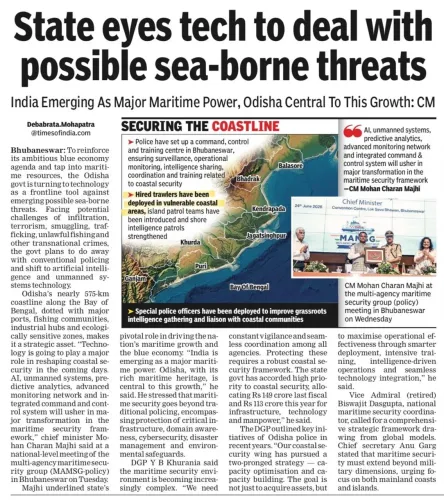
The Chief Minister's Office of Odisha shared remarks by the Chief Minister on 24 June 2026 calling the state's seas, ports, fisheries, and Blue Economy critical national assets, and expanding the definition of maritime security to include cyber threats, disaster management, and environmental protection.
Key Takeaways
The Chief Minister of Odisha described oceans, ports, fisheries, and the Blue Economy as important national wealth on 24 June 2026 .
He stated maritime security now extends beyond traditional law and order to cover critical infrastructure protection, cyber security, disaster management, and environmental protection .
Odisha has a 480-kilometre coastline and hosts major ports including Paradip , making maritime policy central to the state's economy.
The remarks align with national frameworks such as the Sagarmala Project (2015) and the Coastal Security Scheme introduced after 2008.
Coastal fishermen, port operators, and littoral communities are the primary stakeholders of this expanded maritime security vision.
Policy watchers will track whether these priorities are reflected in upcoming Odisha state budget allocations and inter-agency coordination plans.
The Chief Minister's Office of Odisha shared remarks by the Chief Minister on Wednesday, 24 June 2026, underlining that the state's oceans, ports, fisheries, and Blue Economy represent critical national assets whose protection is essential for both security and the livelihoods of millions of coastal communities.
Speaking on the evolving nature of maritime security, the Chief Minister stated that 'our seas, ports, fishery resources, and Blue Economy are our important national wealth.' He emphasised that safeguarding these assets is 'not only necessary for the country's security, but also extremely necessary for economic development and the welfare of lakhs of coastal residents who depend on the sea.'
Context
Odisha's 480-kilometre coastline along the Bay of Bengal makes it one of India's most strategically significant maritime states. Major ports including Paradip Port handle substantial cargo volumes, while the state's fisheries sector supports the livelihoods of hundreds of thousands of fishing families. The Chief Minister's remarks signal a broadening of the state's maritime policy lens beyond conventional law enforcement. The Chief Minister explicitly noted that maritime security today 'is not limited to traditional law and order alone,' but now encompasses critical infrastructure protection, cyber security, disaster management, and environmental protection. This multi-dimensional framing reflects a growing consensus within Indian coastal governance.Policy Backdrop
At the national level, the Sagarmala Project, launched in 2015, has been the central government's flagship initiative for port-led development, directly benefiting coastal states such as Odisha through infrastructure investment and Blue Economy integration. Separately, the Coastal Security Scheme, rolled out in the aftermath of the 2008 Mumbai attacks, strengthened surveillance infrastructure along India's coastline, including in Odisha. India's broader Indo-Pacific strategy has increasingly framed maritime security as inseparable from economic development — a position the Chief Minister's remarks now echo at the state level. The convergence of port modernisation, fisheries management, and cyber resilience under a single policy umbrella marks a maturation of this approach.Stakeholders and Impact
The communities most directly affected by this policy direction are coastal fishermen, port operators, and residents of Odisha's littoral districts. For fishing communities, maritime security directly translates into safe operating zones, disaster preparedness, and protection of fishing grounds from encroachment or environmental degradation. Port operators and logistics players stand to benefit from enhanced infrastructure security and cyber resilience measures, which reduce operational risks. Environmental protection, cited by the Chief Minister as a pillar of modern maritime security, also has direct implications for the sustainability of marine biodiversity that underpins the fishing economy.What's Next
Attention will now turn to whether Odisha translates these stated priorities into concrete action plans — including dedicated allocations in upcoming state budgets, coordination with central agencies on Bay of Bengal maritime issues, and integration of cyber and disaster-management frameworks into coastal administration. The articulation of Blue Economy as a 'national asset' also positions Odisha to seek greater central funding and inter-ministerial collaboration on maritime infrastructure. How swiftly these policy signals convert into operational frameworks will determine their real impact on coastal communities.Point of View
Odisha is moving beyond the traditional port-and-fisheries conversation toward a more comprehensive security doctrine. This signals that state governments are no longer passive recipients of central maritime policy but active articulators of their own strategic visions. The statement also sets the stage for Odisha to make stronger claims on central funding and inter-ministerial attention as competition among coastal states for Blue Economy investment intensifies.
NationPress
22 Sept 2026
Frequently Asked Questions
What did the Odisha Chief Minister say about Blue Economy?
The Odisha Chief Minister stated that the state's seas, ports, fisheries, and Blue Economy are critical national assets, and that protecting them is essential for both national security and the economic welfare of lakhs of coastal residents.
What is the Blue Economy in the context of Odisha?
In Odisha's context, the Blue Economy refers to the sustainable use of ocean resources — including ports, fisheries, shipping, and marine tourism — for economic growth, particularly along the state's 480-kilometre Bay of Bengal coastline.
What is the Sagarmala Project and how does it relate to Odisha?
The Sagarmala Project is a central government initiative launched in 2015 to promote port-led development across India's coastal states. Odisha, home to Paradip Port, is among the key beneficiaries of this programme.
Why is maritime security important for Odisha's coastal communities?
Odisha's coastal communities, including hundreds of thousands of fishermen, depend on safe and sustainable seas for their livelihoods. Maritime security measures covering disaster management, environmental protection, and infrastructure safety directly affect their daily lives and income.
What are the new dimensions of maritime security mentioned by the Odisha CM?
The Chief Minister highlighted that modern maritime security goes beyond traditional law and order to include critical infrastructure protection, awareness of maritime domain importance, cyber security, disaster management, and environmental protection.