Odisha CMO: 1.6 Lakh Evacuated Ahead of Cyclone Murasu

Synopsis
The Chief Minister's Office of Odisha reports over 1,60,000 people evacuated across Gajapati, Ganjam, Malkangiri, Koraput and Kandhamal ahead of Cyclone Murasu, with 552 shelters active, 1,068 pregnant women shifted to hospitals, and schools ordered shut across affected districts.
Key Takeaways
Over 1,60,000 people have been evacuated to safe shelters across five southern Odisha districts ahead of Cyclone Murasu.
Ganjam district accounts for the largest share — 1,51,400+ of the total evacuees.
552 of 2,441 prepared shelters are fully operational; more may be activated as the situation evolves.
1,068 pregnant women identified and moved to nearby hospitals and safe centres as a special precautionary measure.
Schools, colleges and Anganwadi centres across affected districts have been ordered closed .
Senior administrative officers are stationed in emergency control rooms operating 24/7 across all affected districts.
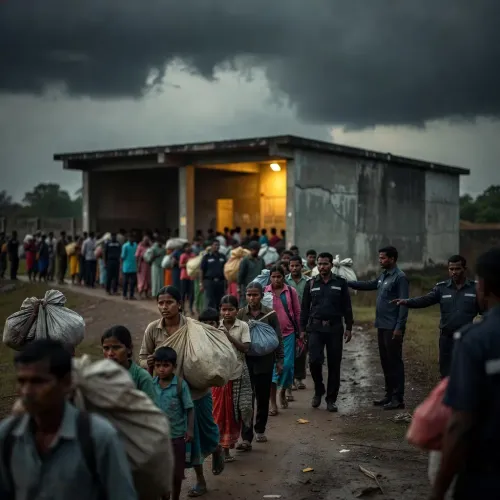
With Cyclone 'Murasu' bearing down on the southern Odisha coastline, the state government has launched a war-footing evacuation operation — moving more than 1,60,000 people to safety and activating 552 shelters across five of its most vulnerable districts. The Chief Minister's Office of Odisha confirmed the scale of preparedness in a post on Tuesday, 3 November 2026, as heavy rain threatened to compound the cyclone's impact.
1,60,000 moved — Ganjam leads the numbers
The sheer scale of the evacuation tells the story. Of the 1,60,000-plus residents shifted to safe shelters across Gajapati, Ganjam, Malkangiri, Koraput and Kandhamal districts, Ganjam alone accounts for 1,51,400+ — a figure that reflects how exposed this densely populated coastal district is to Bay of Bengal weather systems. Evacuation operations remain 'ongoing with defined targets,' the CMO stated, signalling that the final numbers could climb higher before the storm makes landfall.
Of 2,441 shelters readied across the region, 552 are now fully operational, absorbing evacuees as the weather worsens. Schools, colleges and Anganwadi centres across the affected districts have been ordered shut.
1,068 pregnant women shifted to medical facilities
Perhaps the sharpest signal of how seriously the administration is treating this event: 1,068 pregnant women have been individually identified across the affected districts and pre-emptively moved to nearby hospitals and safe centres. It is the kind of granular, vulnerable-population targeting that has come to define Odisha's disaster protocol — and a direct lesson drawn from the institutional memory of two decades of cyclone response.
Emergency control rooms in all affected districts are operating round-the-clock, with senior administrative officers assigned to maintain close oversight. The CMO urged residents to stay alert and follow instructions from local authorities.
Odisha's zero-casualty doctrine, tested again
The state's cyclone-response architecture did not emerge overnight. After the catastrophic 1999 Super Cyclone — which killed nearly 10,000 people — Odisha rebuilt its disaster management framework from the ground up: early-warning networks, community-level evacuation drills, an expanding network of cyclone shelters. When Cyclone Phailin struck in 2013, the state evacuated over one million people ahead of landfall, turning near-certain mass casualties into a remarkably low death toll. That model is now second nature.
Cyclone Murasu, threatening the same southern coastal corridor, is the latest test of that institutional muscle memory. The numbers being reported — 1.6 lakh people evacuated before the storm arrives — suggest the machinery is functioning exactly as designed.
The administration's message to residents is direct: stay alert, follow local instructions, and trust the shelter network. As the cyclone approaches, the next 24-48 hours will determine how well those preparations hold.
Point of View
Expensive failure. The 1999 Super Cyclone forced the state to invest in physical infrastructure (shelters, early-warning systems) and administrative muscle (evacuation protocols, vulnerable-population tracking) that most Indian states still lack. The pre-emptive evacuation of over 1,000 pregnant women is a particularly telling detail: it signals a shift from reactive rescue to proactive, disaggregated risk management. For national policymakers watching, the Odisha model continues to set the benchmark for how coastal states should handle the Bay of Bengal's increasingly volatile cyclone seasons.
NationPress
3 Nov 2026
Frequently Asked Questions
What is Cyclone Murasu and which areas of Odisha does it affect?
Cyclone Murasu is a Bay of Bengal weather system threatening southern Odisha. The districts most affected are Gajapati, Ganjam, Malkangiri, Koraput and Kandhamal, all of which are considered sensitive due to their coastal or hilly terrain.
How many people have been evacuated in Odisha due to Cyclone Murasu?
As of 3 November 2026, more than 1,60,000 people have been evacuated to safe shelters, with Ganjam district alone accounting for over 1,51,400 of that total.
How many cyclone shelters are open in Odisha for Cyclone Murasu?
Of 2,441 shelters prepared across the region, 552 are currently fully operational. More can be activated depending on how the situation develops.
Are schools closed in Odisha due to the cyclone?
Yes. The government has ordered all schools, colleges and Anganwadi centres across the affected districts to remain closed as a precautionary measure.
What special steps has Odisha taken for pregnant women during Cyclone Murasu?
The administration has identified 1,068 pregnant women across the affected districts and shifted them to nearby hospitals and safe centres ahead of the cyclone's arrival.