Odisha CMO: NW-5 to Reshape State's Industrial Connectivity
Synopsis
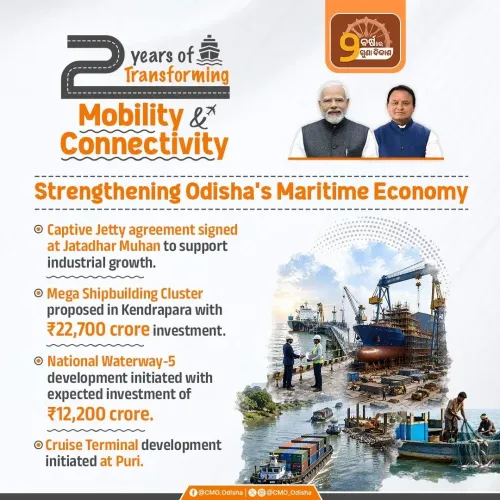
The Chief Minister's Office of Odisha has spotlighted National Waterway-5 — the Brahmani-Kharsua-Dhamra corridor — as a transformative route for cutting transport costs, strengthening port connectivity, and accelerating industrial and tourism growth in the state.
Key Takeaways
National Waterway-5 runs along the Brahmani-Kharsua-Dhamra river system from Talcher to Dhamra in Odisha.
It was declared a national waterway under the National Waterways Act, 2016 , covering 106 waterways across India.
Development is mandated to the Inland Waterways Authority of India (IWAI) under the Ministry of Ports, Shipping and Waterways.
NW-5 is designed to lower logistics costs for mineral-heavy industries and improve connectivity to Odisha's major ports at Paradip and Dhamra .
The corridor links into the broader Sagarmala project framework and connects to the national waterway network via NW-1 on the Ganga.
The CMO explicitly named tourism expansion alongside industrial growth as a beneficiary of waterway development.
A river corridor stretching from the coal heartland of Talcher to the deep-water port at Dhamra is at the centre of Odisha's next logistics bet. The Chief Minister's Office of Odisha declared on 5 November 2026 that the development of National Waterway-5 (NW-5) will open a new chapter in the state's industrial and commercial connectivity.
The CMO's post, written in Odia with an English summary, states that strengthening waterway infrastructure, reducing transportation costs, and improving port connectivity will give 'new direction' — ନୂଆ ଦିଗ — to both industrial growth and tourism expansion in Odisha.
What NW-5 Actually Is — and Why It Matters for Odisha
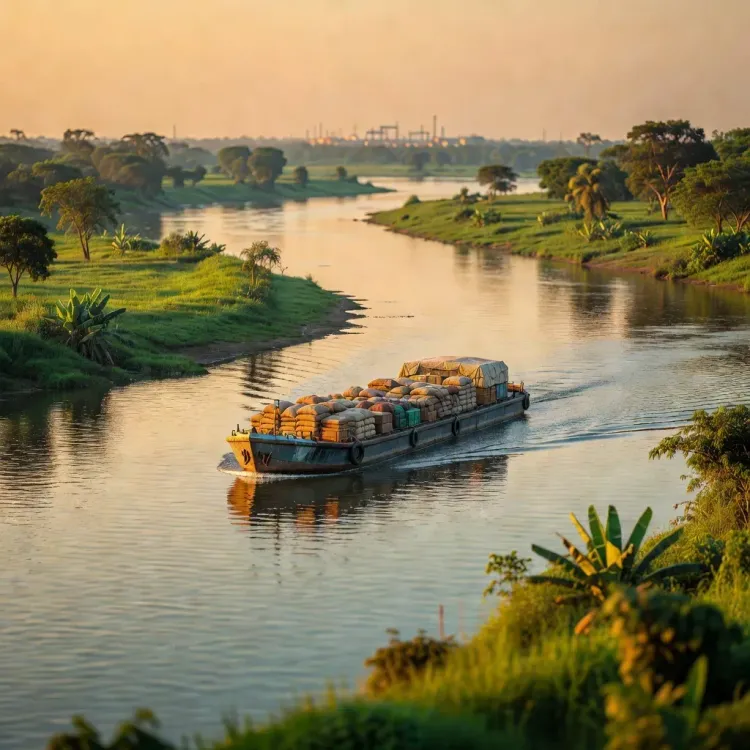
National Waterway-5 runs along the Brahmani-Kharsua-Dhamra river system, connecting the mineral-rich interior of Odisha to its coastline. It was declared a national waterway under the National Waterways Act, 2016, which brought 106 waterways under the development mandate of the Inland Waterways Authority of India (IWAI). The corridor is a natural fit for bulk cargo — coal, iron ore, bauxite — that currently moves by road or rail at significantly higher cost.
Odisha sits atop some of India's densest mineral deposits and operates major ports at Paradip and Dhamra. Moving freight by water typically costs a fraction of road transport per tonne-kilometre. For industries that ship millions of tonnes of raw materials annually, that differential compounds quickly into competitive advantage.
The Sagarmala Thread Running Through This
NW-5 does not stand alone. It plugs into a larger federal architecture built around the Sagarmala project, launched in 2015, which identified port-led industrial development and inland waterway integration as twin pillars of India's logistics transformation. The broader vision connects NW-5 to the National Waterway-1 on the Ganga, creating an eastern coastal and riverine freight network that could rebalance how goods move across the country's eastern seaboard.
Successive governments have pushed this modal shift — road and rail to water — as a way to simultaneously cut logistics costs and lower emissions. Odisha's CMO invoking NW-5 as a 'people's government' priority signals that the state intends to accelerate its role in that national play.
Tourism and Industry: The Twin Levers
Beyond freight, the CMO's statement specifically calls out tourism as a beneficiary. River terminals and improved waterway access can anchor heritage tourism, river cruises, and eco-tourism circuits along Odisha's river systems — a segment still largely underdeveloped relative to the state's coastline. The dual framing — industrial logistics and tourism — broadens the political and economic case for investment in waterway infrastructure.
Key developments to track: progress on dredging operations, construction of multi-modal terminals at critical nodes along the Brahmani-Dhamra axis, and any formal agreements between IWAI, port authorities, and private operators. Those are the milestones that will turn policy framing into freight movement.
Odisha has the geography, the mineral base, and now the political declaration. The question is how fast the dredging barges follow the announcement.
Point of View
The Odisha government is aligning itself with a decade-long central policy thrust to shift freight modal mix toward waterways — a move that doubles as both fiscal prudence and green optics. For a state whose economic identity is built on mineral extraction and export, cheaper bulk cargo movement via water directly improves industrial competitiveness, making this more than symbolic infrastructure boosterism. The tourism add-on is a smart political widening of the constituency for the project, pulling in a sector that rarely features in heavy-infrastructure narratives. The real test, however, is execution: NW-5 has been 'in development' under IWAI since 2016, and what distinguishes rhetoric from results will be the pace of dredging, terminal construction, and commercial freight traffic data.
NationPress
5 Nov 2026
Frequently Asked Questions
What is National Waterway-5 in Odisha?
National Waterway-5 (NW-5) covers the Brahmani-Kharsua-Dhamra river system running from Talcher to Dhamra in Odisha. It was declared a national waterway under the National Waterways Act, 2016 and is being developed by the Inland Waterways Authority of India.
How will NW-5 reduce transportation costs in Odisha?
Water transport typically costs significantly less per tonne-kilometre than road or rail. By enabling bulk cargo — especially minerals like coal and iron ore — to move via the Brahmani-Dhamra waterway instead of roads, NW-5 is designed to cut logistics expenses for industries operating in Odisha's mineral belt.
What is the Sagarmala project and how does it relate to NW-5?
Sagarmala is a central government initiative launched in 2015 to promote port-led industrial development and integrate inland waterways with ports. NW-5 is part of this framework, connecting Odisha's river system to its coast and linking eventually to National Waterway-1 on the Ganga.
Which ports in Odisha will benefit from National Waterway-5?
Odisha's major ports at Paradip and Dhamra are expected to benefit directly from improved inland waterway connectivity via NW-5, enabling more efficient movement of freight between the state's interior and its coastline.
Will NW-5 help Odisha's tourism sector?
Yes, the Odisha Chief Minister's Office specifically cited tourism expansion as one of the expected benefits. Better waterway infrastructure can support river-based tourism circuits, heritage routes, and eco-tourism along the Brahmani-Dhamra corridor, complementing the industrial logistics case for the project.