Odisha CMO Declares Zero Tolerance on Corruption
Synopsis
The Chief Minister's Office of Odisha on 27 October 2026 publicly committed to zero tolerance for corruption, framing intelligence-driven enforcement and strict punishment as the foundation of good governance — and linking the pledge directly to PM Modi's corruption-free India vision.
Key Takeaways
The Chief Minister's Office of Odisha declared a zero-tolerance policy on corruption on 27 October 2026 .
The government pledged impartial legal action driven by intelligence inputs and strict punishment for the guilty.
The declaration explicitly aligns with Prime Minister Narendra Modi 's vision of a corruption-free India, a framework established since 2014 .
Protection of public funds and maintaining public trust in administration are stated as twin objectives.
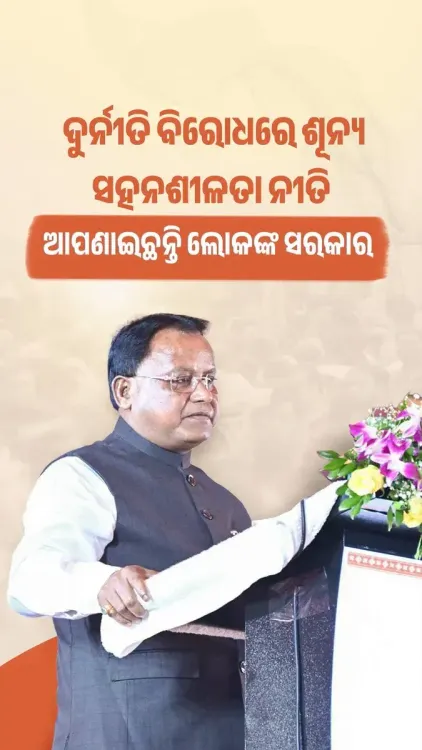
The message was published in both Odia and English , accompanied by a video, signalling a deliberate public outreach effort.
Zero tolerance. Two words that the Chief Minister's Office of Odisha placed at the centre of a governance declaration on Tuesday, 27 October 2026 — a public reaffirmation that the state will pursue impartial legal action, protect public funds, and punish the guilty without exception.
The post, shared in both Odia and English, frames the commitment as a direct extension of Prime Minister Narendra Modi's vision of a corruption-free India. In its own words: 'ଦୁର୍ନୀତିମୁକ୍ତ ଶାସନ, ସ୍ୱଚ୍ଛ ପ୍ରଶାସନ ଓ ଜନସାଧାରଣଙ୍କ ପ୍ରତି ଉତ୍ତରଦାୟିତ୍ୱ ହେଉଛି ସୁଶାସନର ମୂଳମନ୍ତ୍ର' — 'Corruption-free governance, transparent administration, and accountability to the people is the fundamental mantra of good governance.'
Odisha's Zero-Tolerance Stand and Its National Anchor
The Odisha government's position is explicitly anchored to the Prime Minister's anti-corruption framework, which has been a defining plank of central governance since 2014 — the 'minimum government, maximum governance' doctrine that reshaped how Indian states present their administrative priorities. By invoking Modi's vision directly, the CMO signals alignment with that national framework, presenting Odisha as an active participant rather than a passive recipient of the Centre's anti-graft emphasis.
The CMO states that action will be driven by intelligence inputs — 'ଗୁଇନ୍ଦା ସୂଚନା ଆଧାରରେ', meaning 'on the basis of intelligence information' — with impartial legal proceedings and strict punishment for those found guilty. The emphasis on both intelligence-driven action and impartiality is significant: it signals a proactive, not merely reactive, enforcement posture.
Why Public-Fund Protection Remains the Heart of the Argument
At the core of the declaration is a simple, powerful idea: public money belongs to the public. The Odisha government frames its vigilance machinery not as an instrument of political discipline but as a shield for ordinary citizens whose tax contributions and welfare entitlements flow through state coffers. Maintaining public trust in administration — 'ଜନଆସ୍ଥା ବଜାଇ ରଖିବା' — is listed as an explicit goal alongside fund protection.
Across India, state governments have adopted similar vigilance postures since 2014, deploying digital tools and dedicated enforcement departments to curb misuse of public funds. Odisha's declaration mirrors that national pattern, raising the immediate question of what specific procedural or institutional steps will follow the statement.
The CMO has put its anti-corruption commitment on the record, in two languages, with a video. The state's vigilance machinery now carries the weight of that promise.
Point of View
Reinforcing BJP's administrative brand in a state it won in 2024. The bilingual, video-backed format suggests this is as much a public-trust communication exercise as a policy signal. What will determine its credibility is whether Odisha's vigilance department follows with measurable enforcement actions — specific cases, conviction data, or institutional reforms. Without that, the declaration risks joining a long queue of similar statements from Indian states that have not always translated intent into accountability.
NationPress
27 Oct 2026
Frequently Asked Questions
What did the Odisha CMO announce on 27 October 2026?
The Chief Minister's Office of Odisha declared a zero-tolerance policy against corruption, committing to intelligence-driven, impartial legal action and strict punishment for the guilty to protect public funds and maintain public trust.
How does Odisha's anti-corruption policy connect to PM Modi's vision?
The CMO explicitly stated it is advancing PM Narendra Modi's vision of a corruption-free India, aligning the state's governance framework with the Centre's anti-corruption priorities established since 2014.
What does 'zero tolerance for corruption' mean in Odisha's governance policy?
It means the government commits to taking impartial legal action based on intelligence inputs and imposing strict penalties on those found guilty of corruption, with no exceptions regardless of position.
What language was the Odisha CMO anti-corruption post written in?
The post was published in both Odia and English, making the message accessible to a wide audience within and beyond the state.
What should Odisha citizens watch for after this anti-corruption declaration?
Concrete follow-up from Odisha's vigilance department — such as specific case announcements, new enforcement procedures, or institutional reforms — will indicate whether the declaration translates into measurable accountability.