Odisha CMO Highlights Urban Sanitation Push via Waste Management
Synopsis
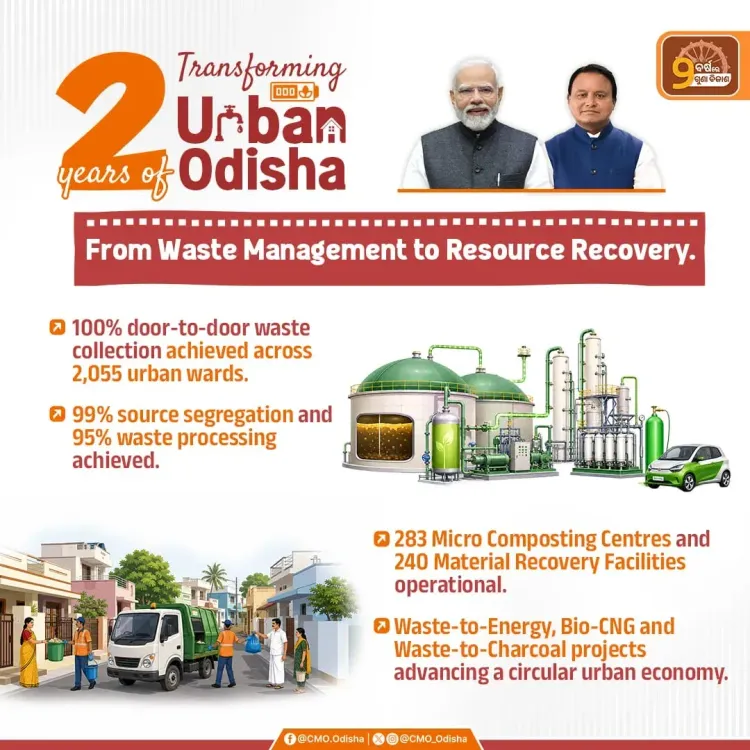
The Chief Minister's Office of Odisha on 21 July 2026 flagged the state's urban sanitation transformation, citing high waste segregation, modern processing infrastructure, and circular economy initiatives under national schemes including Swachh Bharat Mission and Smart Cities Mission.
Key Takeaways
The Chief Minister's Office of Odisha on 21 July 2026 highlighted the state's urban sanitation transformation through scientific waste management and resource recovery.
Odisha has aligned its solid waste management framework with the Swachh Bharat Mission (Urban) , which mandates 100% processing and source segregation across urban local bodies.
Bhubaneswar , the state capital, has received infrastructure investment under the Smart Cities Mission (active since 2015 ) for integrated waste management.
The state's approach incorporates 5R circular economy practices — Reduce, Reuse, Recycle, Recover, Refuse — notified through state rules between 2016 and 2018 .
The next Swachh Survekshan rankings and Extended Producer Responsibility compliance reports will serve as key indicators of Odisha's actual performance.
Urban households and municipal corporations across cities including Bhubaneswar , Cuttack , and Rourkela are the primary stakeholders of these sanitation reforms.
The Chief Minister's Office of Odisha on Tuesday, 21 July 2026 highlighted the state's ongoing transformation of urban sanitation through scientific waste management, resource recovery, and circular economy initiatives aimed at building cleaner and more sustainable cities.
Context
The post from the Chief Minister's Office of Odisha stated that the state is achieving 'high levels of waste segregation and processing, supported by modern infrastructure and circular economy initiatives.' The communication underscores Odisha's positioning of urban sanitation reform as a governance priority, framing the effort around outcomes — cleaner cities, greener environments, and long-term sustainability — rather than a single scheme or project.
Urban waste management has become a key metric by which Indian states are assessed nationally, with annual rankings placing scientific processing and source segregation at the centre of evaluation. Odisha's public communication on this front signals continued administrative attention to these benchmarks.
Policy Backdrop
Odisha's urban sanitation drive is anchored in the national framework established by the Swachh Bharat Mission (Urban), launched in 2014, which mandates 100% waste processing and source segregation across urban local bodies. States were required to align their own solid waste management rules accordingly, and Odisha notified rules consistent with the central framework between 2016 and 2018, promoting 5R circular economy practices — Reduce, Reuse, Recycle, Recover, and Refuse.
The Smart Cities Mission, active since 2015, has further channelled infrastructure investment into cities such as Bhubaneswar, the state capital, which has been cited in national sanitation assessments for its segregation and processing efforts. Together, these two central schemes have provided both the regulatory mandate and the capital outlay that underpin the state's current urban sanitation architecture.
Circular economy principles — converting waste into recoverable resources and reducing landfill dependence — have increasingly defined the direction of Indian urban waste policy, aligning with UN Sustainable Development Goals 11 and 12 on sustainable cities and responsible consumption.
Stakeholders and Impact
The primary beneficiaries of improved urban waste management are urban households and the municipal corporations that bear the operational burden of collection, processing, and disposal. Higher segregation rates at source reduce the cost and complexity of downstream processing and lower the volume of mixed waste reaching landfills.
Resource recovery facilities, when operating at scale, also create economic value from waste streams — generating compost, recyclable materials, and in some cases energy — while reducing the environmental burden on cities. For residents, the visible outcome is cleaner public spaces and reduced health risks associated with unscientific waste disposal.
Odisha's urban population, concentrated in cities like Bhubaneswar, Cuttack, and Rourkela, stands to benefit directly as municipal systems scale up processing capacity and enforce source segregation norms more rigorously.
What's Next
The next edition of the Swachh Survekshan — India's annual urban cleanliness survey — will be a key moment of reckoning for Odisha's claims of high segregation and processing performance. Rankings in this survey carry political and administrative weight, and states with demonstrable infrastructure investments and processing data typically fare better.
Compliance with Extended Producer Responsibility norms, which require manufacturers to manage end-of-life disposal of their products, is another emerging frontier that will test the robustness of Odisha's material recovery systems. Progress on both fronts will determine whether the state's circular economy ambitions translate into measurable, sustained improvements in urban sanitation outcomes.
Point of View
Where state rankings carry significant political visibility. By foregrounding 'circular economy' language alongside infrastructure and segregation metrics, Odisha is aligning its public messaging with the more sophisticated, resource-recovery-oriented phase of national sanitation policy — moving beyond the original open-defecation-free narrative. This reflects a broader pattern among Indian states of using sanitation communication to demonstrate developmental competence to both central government evaluators and urban voters. The real test, however, will be in verified processing data and Extended Producer Responsibility compliance, not official communications.
NationPress
21 Jul 2026
Frequently Asked Questions
What is Odisha doing to improve urban sanitation in 2026?
The Chief Minister's Office of Odisha stated on 21 July 2026 that the state is transforming urban sanitation through scientific waste management, high levels of waste segregation and processing, modern infrastructure, and circular economy initiatives aimed at building cleaner and greener cities.
What is the Swachh Bharat Mission and how does it apply to Odisha?
The Swachh Bharat Mission (Urban), launched in 2014, is a national programme that mandates 100% waste processing and source segregation across urban local bodies. Odisha aligned its solid waste management rules with this framework between 2016 and 2018, incorporating 5R circular economy practices.
How is Bhubaneswar involved in Odisha's waste management efforts?
Bhubaneswar, Odisha's capital, was selected under the Smart Cities Mission (active since 2015), which has channelled infrastructure investment into integrated waste management and resource recovery systems in the city.
What is the Swachh Survekshan and why does it matter for Odisha?
The Swachh Survekshan is India's annual urban cleanliness survey that ranks cities and states on sanitation metrics including waste segregation and processing. It is a key benchmark for assessing whether Odisha's stated improvements translate into verified performance outcomes.
What is a circular economy in the context of urban waste management in India?
In the context of Indian urban waste policy, a circular economy refers to practices that recover value from waste — through composting, recycling, and material recovery — rather than sending it to landfills. Odisha's rules promote 5R practices: Reduce, Reuse, Recycle, Recover, and Refuse.