Odisha CMO: State Strengthens Public Transport Over Two Years
Synopsis
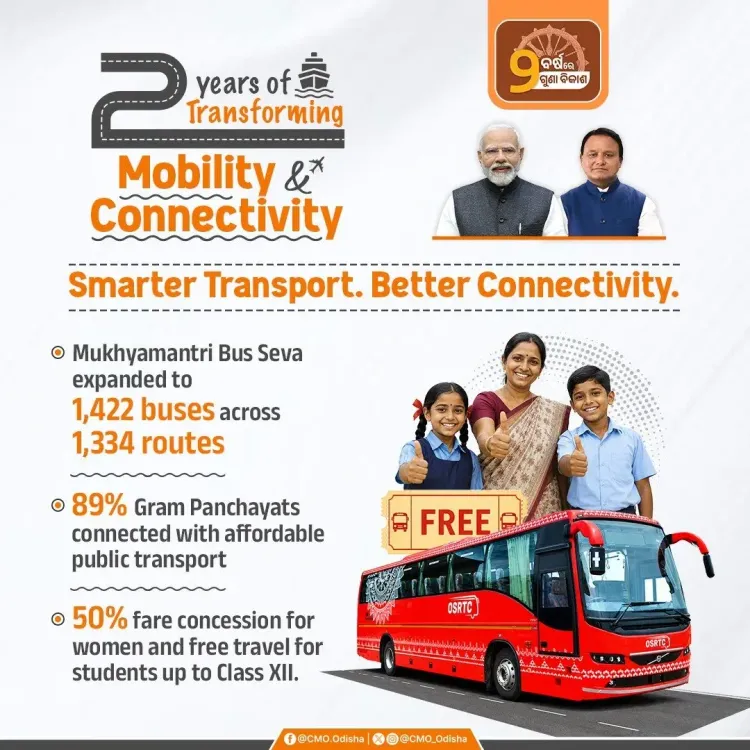
The Chief Minister's Office of Odisha on 17 July 2026 highlighted two years of expanded bus connectivity, improved last-mile access, and dedicated support for women and students, framing the transport push as a driver of balanced regional development and inclusive growth.
Key Takeaways
The CMO Odisha on 17 July 2026 highlighted two years of public transport expansion across the state.
Expanded bus connectivity and improved last-mile access are central to the initiative.
Dedicated support for women and students is a stated policy priority of the transport push.
The Mo Bus service, launched in Bhubaneswar in 2018 , forms part of the foundational policy lineage.
The Odisha State Road Transport Corporation (OSRTC) is the primary agency executing these improvements.
The government frames the transport network as laying the foundation for balanced regional development and inclusive growth.
The Chief Minister's Office of Odisha on Friday, 17 July 2026 highlighted the state's efforts over the past two years to expand its public transport network, emphasising affordability, accessibility, and inclusion for all citizens — particularly women, students, and rural commuters.
Context
The post, shared by the official CMO Odisha handle and addressed to PMO India, states that Odisha has 'significantly strengthened its public transport network to make mobility more affordable, accessible and inclusive.' The government cited expanded bus connectivity, improved last-mile access, and dedicated support for women and students as key achievements of this two-year push.
The communication signals the state's intent to align its transport agenda with central government priorities, a common practice among state administrations seeking visibility for development work at the national level.
Policy Backdrop
Odisha has been building its public transport credentials for nearly a decade. The state launched the Mo Bus service in Bhubaneswar in 2018 as part of an effort to modernise urban mobility, which was later expanded to cover additional urban and semi-urban corridors. The 2017 Odisha State Transport Policy had earlier set formal targets for fleet expansion and rural connectivity.
Under the 2021-22 state budget, additional allocations were directed toward women- and student-friendly bus services, establishing a policy lineage that the current administration appears to be building upon. The Odisha State Road Transport Corporation (OSRTC) has been the primary agency executing fleet operations and last-mile connectivity improvements across the state.
Odisha's approach mirrors broader trends across India, where states such as Tamil Nadu and Kerala have similarly invested in gender-sensitive, affordable public transport to meet urbanisation demands and sustainable development goals.
Stakeholders and Impact
The CMO's post specifically identifies women and students as beneficiaries of dedicated transport support, a policy choice that addresses longstanding equity gaps in rural and semi-urban mobility. Improved bus connectivity directly affects access to schools, colleges, hospitals, and employment hubs — particularly in districts where private transport options remain scarce or unaffordable.
Rural commuters stand to benefit from last-mile access improvements, which reduce the 'first and last mile' gap that has historically made formal public transport impractical for a large share of Odisha's population. The government frames these gains as foundational to 'balanced regional development and inclusive growth,' language that echoes both state and central planning priorities for eastern India.
What's Next
Attention will now turn to the 2026-27 state budget and whether it includes fresh fleet-addition tenders, route expansions, or enhanced concession schemes for women and students. Integration of the state bus network with upcoming national highway projects in Odisha could further deepen connectivity gains.
Policymakers and civil society groups will also watch whether the concession and accessibility models piloted in select districts are extended statewide, and whether the state publishes verifiable ridership and coverage data to substantiate the progress claimed in the post.
Point of View
Tagging PMO India to signal alignment with the Centre's development narrative for eastern India ahead of potential budget or policy cycles. The emphasis on women and students as named beneficiaries is politically significant — it positions the state government as responsive to equity concerns that resonate strongly with voters in semi-urban and rural constituencies. Odisha's sustained investment in public transport, traceable from the 2017 State Transport Policy through the Mo Bus rollout and successive budget allocations, reflects a long-arc strategy rather than a one-off announcement. The broader pattern of eastern Indian states leveraging transport infrastructure to attract central scheme funds and private investment makes this communication as much an economic signal as a social one.
NationPress
17 Jul 2026
Frequently Asked Questions
What has Odisha done to improve public transport in the last two years?
The Chief Minister's Office of Odisha stated on 17 July 2026 that the state has expanded bus connectivity, improved last-mile access, and introduced dedicated support for women and students to make mobility more affordable and inclusive.
What is Mo Bus in Odisha?
Mo Bus is an urban bus service launched in Bhubaneswar in 2018 to modernise public transport; it has since been expanded to additional corridors across Odisha as part of the state's broader connectivity push.
Which agency runs Odisha's public bus network?
The Odisha State Road Transport Corporation (OSRTC) is the primary state agency responsible for bus operations and last-mile connectivity enhancements across Odisha.
How does Odisha's transport policy support women and students?
Under allocations traceable to the 2021-22 state budget, Odisha introduced women- and student-friendly bus services, including concession schemes, to improve access to education, healthcare, and employment.
Why did the CMO Odisha tag PMO India in the transport post?
Tagging PMO India is a common practice among state administrations to signal alignment with central government development priorities and to seek visibility for state-level achievements at the national level.