Odisha CMO: PMAY and Antyodaya Gruha Yojana deliver pucca homes
Synopsis
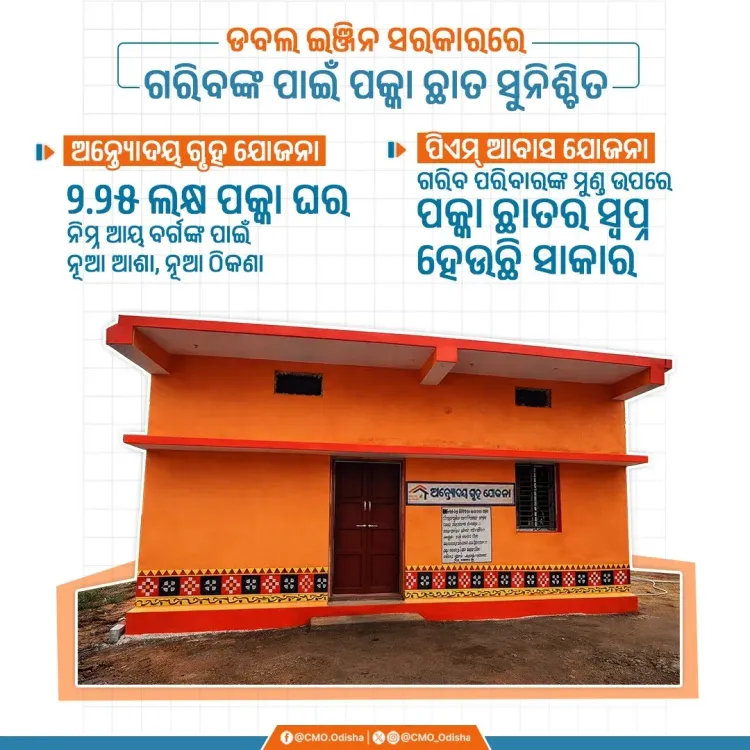
The Chief Minister's Office of Odisha on 17 June 2026 spotlighted the convergence of the Antyodaya Gruha Yojana and PM Awas Yojana, saying the twin schemes are delivering pucca homes to low-income families and fulfilling the dream of a secure roof as the administration marks two years in office.
Key Takeaways
The Chief Minister's Office of Odisha highlighted the Antyodaya Gruha Yojana and Pradhan Mantri Awas Yojana on 17 June 2026 as twin vehicles for pucca housing delivery.
The post was part of a campaign marking two years of the current Odisha state government under the hashtag #2YearsofLokankaSarakar .
Low-income families are the stated beneficiaries, receiving permanent pucca dwellings through the converged scheme framework.
Odisha has a history of state-level housing complements to PMAY, including the earlier Biju Pucca Ghar Yojana launched in 2014 .
The Pradhan Mantri Awas Yojana was launched nationally in June 2015 and has been extended beyond its original 2022 completion target.
Housing is positioned by the state as a gateway to broader welfare entitlements, including formal address, banking access, and identity documentation.
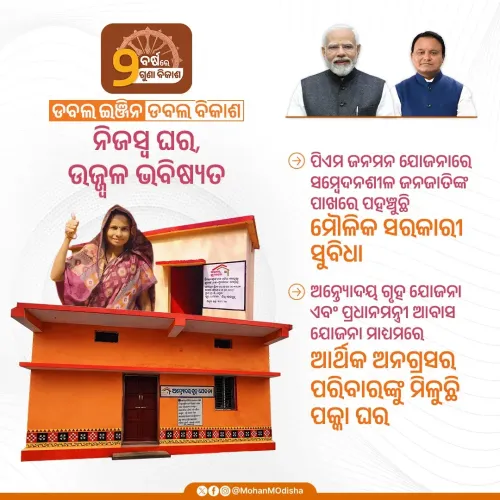
The Chief Minister's Office of Odisha on Wednesday, 17 June 2026, highlighted the state government's convergence of the Antyodaya Gruha Yojana and the Pradhan Mantri Awas Yojana (PMAY) to provide pucca houses to low-income families, marking the occasion under the hashtag #2YearsofLokankaSarakar — meaning 'two years of the people's government'.
Context
The post, written in Odia, states: 'Lokanka Sarakara ra preranare Antyodaya Gruha Yojana ebam PM Awas Yojana madhyamare nimna aya bargara paribara ku miluchhi nijara pucca ghara' — 'Inspired by the people's government, low-income families are receiving their own pucca houses through the Antyodaya Gruha Yojana and PM Awas Yojana.' The CMO described these homes not merely as structures but as 'a realisation of the dream of a secure roof over the heads of poor families, giving them new hope and a new address.'
The post was accompanied by one image and was shared as part of a broader communication campaign celebrating two years of the current state administration, also flagged under #BikasharaDharaOdishaSara ('development flowing across all of Odisha') and #2YearsofSwasthyaSurakhya ('two years of health protection').
Policy Backdrop
The Pradhan Mantri Awas Yojana was launched by the Government of India in June 2015 with the objective of ensuring pucca housing for all eligible urban and rural poor, a deadline later extended beyond the original 2022 target. Odisha had previously run the Biju Pucca Ghar Yojana (launched 2014) as a state-level complement to central housing programmes before introducing the Antyodaya Gruha Yojana, which specifically targets the poorest households.
The convergence of PMAY with state-specific schemes is a pattern seen across multiple Indian states since 2015, designed to plug coverage gaps for families who may fall outside central eligibility criteria but remain among the most economically vulnerable. Housing is treated by policymakers as both a welfare instrument and a tool for asset creation and dignity for below-poverty-line (BPL) families.
Stakeholders and Impact
Low-income and rural poor households in Odisha are the direct beneficiaries of the twin-scheme approach. A pucca house — a permanent structure with brick or concrete walls and a durable roof — represents a significant asset for families who previously lived in kutcha or semi-permanent dwellings, offering protection from cyclones and floods that periodically affect the state's coastal and interior districts.
The state government's framing of these homes as 'a new hope and a new address' signals an intent to link housing delivery to broader social outcomes, including access to formal addresses required for banking, identity documents, and other welfare entitlements.
What's Next
Observers will watch for periodic progress disclosures on house sanction and completion numbers under the converged scheme framework, as well as any supplementary budget allocations in the next Odisha state budget directed at accelerating construction timelines. The two-year anniversary communication campaign suggests the administration intends to use housing delivery as a flagship welfare metric heading into the next political cycle.
Point of View
Anchoring housing delivery to the emotional register of 'new hope and a new address' rather than citing raw construction figures — a rhetorical choice that allows the administration to claim credit without committing to auditable targets. The two-year anniversary framing bundles housing with health protection under a single political narrative, signalling that welfare convergence will be the ruling party's core re-election argument in Odisha. The state's long-running practice of layering its own housing schemes atop PMAY also reflects a structural reality: central allocations alone have historically been insufficient for Odisha's large BPL population. How the administration substantiates these claims with verifiable completion data will determine whether the campaign translates into durable political capital.
NationPress
19 Sept 2026
Frequently Asked Questions
What is the Antyodaya Gruha Yojana in Odisha?
The Antyodaya Gruha Yojana is an Odisha state-specific housing programme that targets the poorest households with pucca (permanent) dwelling units, running in convergence with the central Pradhan Mantri Awas Yojana to cover families who may fall outside standard central eligibility criteria.
What is Pradhan Mantri Awas Yojana and how does it work in Odisha?
Pradhan Mantri Awas Yojana (PMAY) is a central government flagship scheme launched in June 2015 to provide pucca houses to eligible urban and rural poor across India. In Odisha, it is implemented alongside the state's own Antyodaya Gruha Yojana to maximise coverage for low-income families.
What does 'Lokanka Sarakar' mean in the Odisha CMO post?
'Lokanka Sarakar' is an Odia phrase meaning 'the people's government,' used by the Chief Minister's Office of Odisha to describe the current state administration. The hashtag '#2YearsofLokankaSarakar' marks two years of the government in office.
Who benefits from the Odisha housing schemes mentioned by the CMO?
Low-income and below-poverty-line families in Odisha are the primary beneficiaries. They receive pucca houses — permanent structures with durable walls and roofs — which also provide access to a formal address needed for banking, identity documents, and other welfare entitlements.
What was Odisha's housing scheme before Antyodaya Gruha Yojana?
Before the Antyodaya Gruha Yojana, Odisha ran the Biju Pucca Ghar Yojana, launched in 2014, as a state-level complement to central housing programmes. The state has a consistent history of supplementing central schemes with its own housing initiatives.