Odisha CM's Office: Rail Infrastructure Getting Stronger

Synopsis
The Chief Minister's Office of Odisha announced on 30 September 2026 that new rail line construction and network capacity upgrades are strengthening the state's railway infrastructure, promising better connectivity for travel, trade, education, health, and market access.
Key Takeaways
The Chief Minister's Office of Odisha announced on 30 September 2026 that the state's rail infrastructure is being reinforced under the current government.
New railway line construction and network capacity upgrades are the primary instruments cited for the improvement.
The expansion is expected to benefit travel, trade, education, healthcare, and market access across Odisha.
Indian Railways has historically pursued new line and route-doubling projects in Odisha, particularly targeting mineral-rich interior regions.
The push aligns with a broader national strategy to integrate eastern Indian states into national supply chains and reduce logistics costs.
Progress on sanctioned rail projects and future railway budget allocations will determine the pace of delivery.
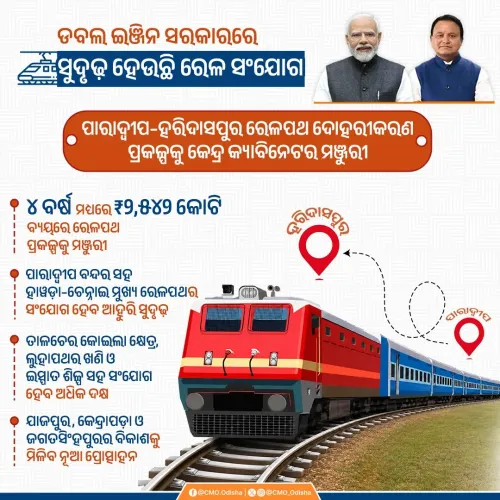
Steel tracks and stronger supply chains — Odisha's Chief Minister's Office declared on Wednesday, 30 September 2026 that the state's rail infrastructure is being significantly reinforced under the current government, with new line construction and network capacity upgrades set to ease travel, trade, education, healthcare access, and market connectivity across the state.
The post, written in Odia, stated: 'ଲୋକଙ୍କ ସରକାରରେ ଓଡ଼ିଶାର ରେଳ ଭିତ୍ତିଭୂମି ଆହୁରି ସୁଦୃଢ଼ ହେଉଛି' — 'Under the people's government, Odisha's rail infrastructure is becoming even more robust.' The message frames railway expansion not merely as a logistics upgrade but as a multi-sector enabler touching everyday life from school commutes to hospital visits to market access.
New Lines, Greater Reach: What the Expansion Targets
Indian Railways has pursued new line construction and route-doubling projects across Odisha through successive plan periods, prioritising the state's mineral-rich interior regions that have historically been underserved by rail connectivity. Freight corridors for minerals and goods, alongside passenger services, form the twin pillars of this push. Reduced logistics costs and faster movement of raw materials stand to benefit both local traders and larger industrial supply chains.
The CMO's framing is deliberate: by listing travel, trade, education, health, and market access in a single breath, it signals that rail expansion is being positioned as a social-infrastructure project, not just an economic one. For a state where interior districts still depend on road transport for essential services, a denser rail network can meaningfully compress distances to hospitals and colleges.
Eastern India's Rail Push and Odisha's Place in It
Odisha sits at the centre of a broader national effort to integrate eastern Indian states into national supply chains. Central and state governments have coordinated on rail projects to unlock the region's industrial potential — particularly for steel, aluminium, and coal — while simultaneously improving passenger connectivity for millions of residents. Upcoming railway budget allocations and the pace of sanctioned project completions will determine how quickly these ambitions translate into operational tracks.
The momentum is real, and the stakes are high. A more connected Odisha means lower freight costs, more competitive local produce reaching distant markets, and students and patients spending hours less on the road. Whether the timelines hold is the question every district is watching.
Point of View
Health, and education alongside freight — reflects a calculated political narrative that connects infrastructure investment directly to citizen welfare. This mirrors a wider BJP-led state government strategy of presenting development spending as tangible, life-changing outcomes rather than abstract capital expenditure. With Odisha's interior districts still underserved, rail connectivity doubles as both an economic accelerant and an electoral asset. The real test will come when specific project timelines and budget allocations are made public.
NationPress
30 Sept 2026
Frequently Asked Questions
What railway projects are being developed in Odisha?
The Chief Minister's Office has announced new railway line construction and network capacity upgrades across Odisha, though specific project names and timelines were not detailed in the announcement. Indian Railways has historically pursued new line and route-doubling projects in the state, particularly in mineral-rich interior regions.
How will Odisha's rail expansion help ordinary residents?
According to the CMO, improved rail connectivity will ease travel, trade, education, healthcare access, and market linkages, helping residents in interior districts reach hospitals, colleges, and markets faster and at lower cost.
What is the role of Indian Railways in Odisha's infrastructure growth?
Indian Railways is the national agency responsible for sanctioning and executing rail projects in Odisha, including new line construction and capacity upgrades that form the backbone of the state's connectivity push.
Why is rail infrastructure important for Odisha's economy?
Odisha is rich in minerals including coal, iron ore, and bauxite. Better rail connectivity reduces logistics costs for freight, makes local produce more competitive in distant markets, and supports broader regional economic integration.
What should we watch for next in Odisha's railway development?
Key indicators to watch include the progress of sanctioned rail projects in Odisha and the allocations made to the state in upcoming central railway budgets, which will determine how quickly the announced expansion becomes operational.