Giriraj Singh flags 8% IIP growth, cites Atmanirbhar push
Synopsis
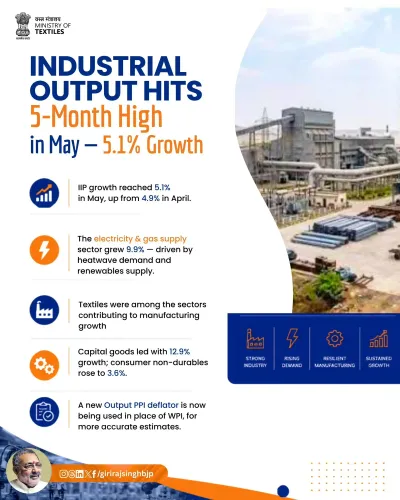
Union Textiles Minister Giriraj Singh has cited August 2026 IIP growth of 8%, with manufacturing, electricity, and capital goods all posting strong gains. He linked the data to Atmanirbhar Bharat policies and the Make in India programme, framing it as evidence of accelerating industrial momentum.
Key Takeaways
Union Textiles Minister Giriraj Singh posted on 30 September 2026 highlighting 8% IIP growth for August 2026 .
Growth was recorded across manufacturing, electricity, and capital goods — broad-based rather than sector-specific.
Capital goods expansion is a leading indicator of fresh industrial investment and sustained production cycles.
The data is framed within the Atmanirbhar Bharat initiative launched in May 2020 to reduce import dependence and strengthen domestic supply chains.
Make in India (launched September 2014 ) and PLI schemes (from 2020 ) form the long policy chain the government credits for the momentum.
The next test will be the September IIP reading and any industrial policy signals in the forthcoming Economic Survey or Union Budget .
India's industrial engine is accelerating. Union Textiles Minister Giriraj Singh on Wednesday, 30 September 2026 pointed to an 8% rise in the Index of Industrial Production (IIP) for August, flagging simultaneous gains in manufacturing, electricity, and capital goods as proof that the government's industrial policy is delivering.
Posting in Hindi, the senior BJP leader wrote: 'भारत की औद्योगिक शक्ति अब नई रफ्तार से आगे बढ़ रही है' — 'India's industrial strength is now moving forward at a new pace.' He described the August data as 'a picture of the industrial environment being built by government policies,' and invoked the Atmanirbhar Bharat resolve as the animating force behind the surge.
What the August IIP numbers signal
The IIP is India's primary monthly gauge of factory output, covering manufacturing, mining, and electricity. An 8% expansion across all three headline verticals — manufacturing, power, and capital goods — in a single month signals broad-based momentum rather than a spike in one isolated sector. Capital goods growth carries particular weight: it reflects fresh investment in machinery and equipment, the kind of spending that typically precedes a sustained production cycle, not just a seasonal blip.Make in India, PLI schemes, and the policy chain behind the number
The reading lands against a policy backdrop more than a decade in the making. The Make in India programme, launched in September 2014, set out to raise manufacturing's share of GDP and position India as a global production hub. From 2020 onwards, Production Linked Incentive (PLI) schemes layered targeted cash incentives across sectors — electronics, pharmaceuticals, textiles, auto components — to pull investment into domestic supply chains that global disruptions had exposed as dangerously thin. The Atmanirbhar Bharat initiative, announced in May 2020, wove these threads into a single national-resilience narrative: produce at home, depend less on imports, build buffers. Ministers across portfolios now routinely cite monthly IIP prints as a live scorecard for that ambition — and an 8% August reading, if it holds on revision, gives them a strong data point to lean on.Why a Textiles Minister is watching industrial output
Giriraj Singh's portfolio sits squarely inside the broader industrial story. Textiles and apparel are among the sectors covered under PLI incentives, and the sector's upstream links to synthetic fibre, machinery, and power consumption mean that a rising IIP — especially in manufacturing and electricity — feeds directly into his brief. A stronger industrial base also supports the export competitiveness argument that the Textiles Ministry has been pressing in trade negotiations. The numbers will face their next test when the September IIP data arrives, and when the forthcoming Economic Survey or Union Budget frames whether August's momentum is a trend or an outlier. For now, the government reads it as confirmation that the industrial wager placed over twelve years is paying off.Point of View
Lending the claim durability. As a Textiles Minister amplifying industrial output data beyond his narrow portfolio, he is also signalling that the government sees sectoral stories as inseparable from the aggregate growth story. The real credibility test arrives when revised IIP figures and the next Economic Survey either confirm or complicate the trend.
NationPress
30 Sept 2026
Frequently Asked Questions
What is the IIP and why does it matter for India?
The Index of Industrial Production (IIP) is the government's monthly measure of output across manufacturing, mining, and electricity sectors. It is a key leading indicator of economic health — a sustained rise signals expanding factory activity, more jobs, and stronger investment.
What did Giriraj Singh say about India's industrial growth?
Union Textiles Minister Giriraj Singh posted on 30 September 2026 that India's August IIP grew 8%, with manufacturing, electricity, and capital goods all recording strong gains. He attributed the performance to government policies under the Atmanirbhar Bharat initiative.
What is Atmanirbhar Bharat and how is it linked to IIP growth?
Atmanirbhar Bharat — meaning 'self-reliant India' — was launched in May 2020 to boost domestic manufacturing and reduce dependence on imports. PLI schemes and Make in India are its key instruments, designed to raise industrial output, which is what the IIP measures.
What are PLI schemes and which sectors do they cover?
Production Linked Incentive (PLI) schemes, rolled out from 2020 onwards, offer cash incentives to manufacturers for incremental production above a baseline. They cover sectors including electronics, pharmaceuticals, textiles, auto components, and food processing.
What should we watch next for India's industrial momentum?
The September 2026 IIP release will be the next key data point. Any updates to PLI schemes or industrial targets announced in the forthcoming Economic Survey or Union Budget will indicate whether the government plans to press further on the manufacturing push.