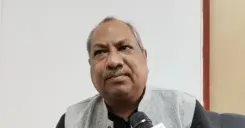
Giriraj Singh Hails India's May Exports at $45.2 Bn Six-Month High
Synopsis
Union Textiles Minister Giriraj Singh on 16 June 2026 highlighted India's May exports surging 18 per cent to a six-month peak of $45.2 billion, attributing the milestone to PM Modi's reform agenda, PLI schemes, and the Atmanirbhar Bharat initiative.
Key Takeaways
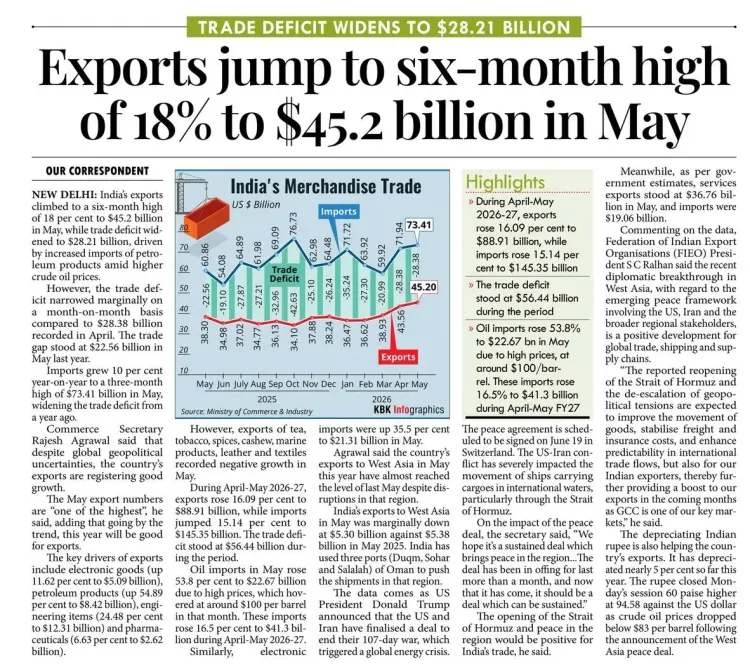
India's merchandise exports in May 2026 rose 18 per cent year-on-year to $45.2 billion , the highest in six months, according to Giriraj Singh's post.
Union Textiles Minister Giriraj Singh credited PM Narendra Modi's 'continuous reforms and industry-friendly policies' for the export surge.
The performance is being linked to the Atmanirbhar Bharat self-reliance framework and the broader Viksit Bharat 2047 development vision.
Production Linked Incentive (PLI) schemes across 14 sectors , introduced from 2020 , form a key pillar of India's export strategy.
The Foreign Trade Policy 2023-28 targets $2 trillion in exports by 2030 , providing the medium-term benchmark against which monthly data is measured.
MSMEs , textile exporters, and large manufacturers are among the primary stakeholders benefiting from sustained export momentum.
Union Textiles Minister Giriraj Singh on Tuesday, 16 June 2026, cited India's merchandise exports for May 2026 as evidence that reforms under Prime Minister Narendra Modi are delivering measurable results, pointing to an 18 per cent year-on-year rise that pushed outbound shipments to a six-month peak of $45.2 billion.
Context
Posting in Hindi on X, Giriraj Singh wrote: 'मई माह में भारत का निर्यात 18% की वृद्धि के साथ 45.2 बिलियन डॉलर के छह माह के उच्चतम स्तर पर पहुंचा है' — ('In the month of May, India's exports have reached a six-month high of $45.2 billion, registering an 18 per cent increase.'). He attributed the performance to 'continuous reforms and industry-friendly policies' under PM Modi's leadership, calling it proof of the country's growing global credibility, stronger manufacturing capacity, and the success of the Atmanirbhar Bharat resolve.
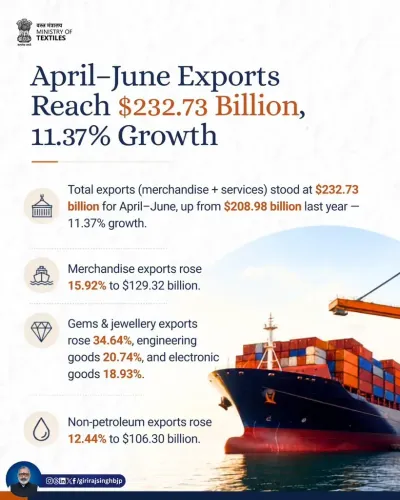
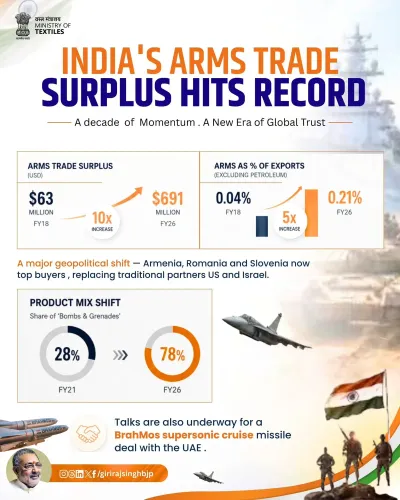
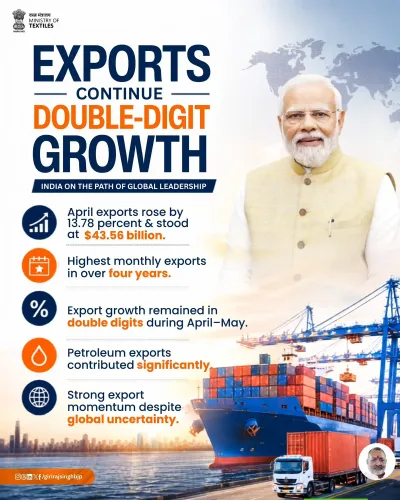
The post was accompanied by a single image and carried hashtags including #ExportGrowth, #ViksitBharat2047, and #AtmanirbharBharat, signalling the government's intent to frame the trade data within its long-term economic vision.
Policy Backdrop
India's export push has been shaped by a layered policy architecture built since 2014. The Make in India initiative, launched in September 2014, sought to raise manufacturing's share of GDP and position India as a global supply-chain hub. It was followed by Production Linked Incentive (PLI) schemes introduced from 2020 across 14 sectors, designed to attract investment and directly stimulate export volumes.
The Atmanirbhar Bharat package, announced in May 2020, added a self-reliance dimension — reducing import dependence while scaling domestic capacity. The Foreign Trade Policy 2023-28, notified in March 2023, set an ambitious target of $2 trillion in exports by 2030, providing the medium-term roadmap within which monthly data points like May's figure are now being assessed.
The Viksit Bharat 2047 vision — making India a fully developed economy by the centenary of independence — serves as the overarching political and policy frame that ministers like Singh regularly invoke when highlighting economic milestones.
Stakeholders and Impact
The sectors most directly affected by export momentum are MSMEs, large manufacturing firms, and exporters in labour-intensive industries such as textiles — a domain Giriraj Singh oversees directly as Textiles Minister. A sustained uptick in export orders typically translates into higher factory utilisation rates, job creation on the shop floor, and improved foreign-exchange earnings for the economy.
Global supply-chain realignments — accelerated by geopolitical shifts and companies seeking alternatives to concentrated manufacturing bases — have created structural openings for Indian exporters. Sustained policy incentives through PLI schemes have been central to helping domestic firms capture a larger share of that redirected demand.
What's Next
Analysts and trade bodies will watch subsequent monthly trade releases from the Ministry of Commerce and Industry to determine whether May 2026's performance marks the start of a durable upward trend or a single-month spike. Any fresh export incentives or PLI expansions announced in the forthcoming Union Budget will be closely tracked as signals of the government's next policy move. For the textiles sector specifically, Singh's ministry is expected to remain a focal point for export-linked incentive discussions given the sector's scale and employment intensity.
Point of View
Giriraj Singh is doing more than communicating trade statistics — he is sustaining a policy legitimacy argument that the BJP has cultivated since 2014. As Textiles Minister, his amplification of export data carries added weight because textiles remain one of India's most export-intensive and employment-generating sectors. The move also signals that the government intends to keep the export growth story at the centre of its economic communication strategy in the months ahead.
NationPress
16 Sept 2026
Frequently Asked Questions
What was India's export figure for May 2026?
According to Union Textiles Minister Giriraj Singh , India's exports in May 2026 reached $45.2 billion , an 18 per cent increase year-on-year and the highest level in six months.
Why did Giriraj Singh comment on India's export data?
Giriraj Singh posted on X to credit PM Modi's reform agenda — including Atmanirbhar Bharat and industry-friendly policies — for the strong May export performance, framing it as validation of the government's economic direction.
What is the Atmanirbhar Bharat initiative?
Atmanirbhar Bharat is a self-reliance initiative launched in May 2020 that combines economic stimulus with structural reforms aimed at boosting domestic manufacturing, reducing import dependence, and expanding India's export footprint.
What is India's export target under the Foreign Trade Policy?
The Foreign Trade Policy 2023-28 , notified in March 2023 , sets a target of $2 trillion in exports by 2030 , covering both merchandise and services.
How do PLI schemes help India's exports?
Production Linked Incentive (PLI) schemes , rolled out from 2020 across 14 sectors , provide financial incentives tied to incremental production, attracting investment and helping manufacturers scale up capacity to meet export demand.