Giriraj Singh Cites 27% Tractor Sales Rise as Rural Growth Sign
Synopsis
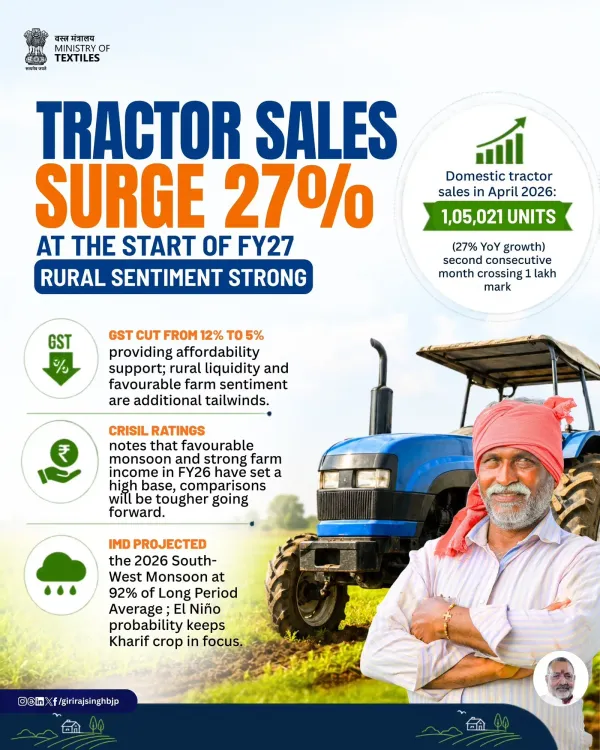
Union Textiles Minister Giriraj Singh highlighted a 27 per cent surge in domestic tractor sales to over 1.05 lakh units in April 2026, attributing the milestone to PM Modi's farmer welfare and rural development policies and describing it as a sign of growing confidence in India's agriculture sector.
Key Takeaways
Union Textiles Minister Giriraj Singh posted on 29 May 2026 citing domestic tractor sales data as a rural growth indicator.
Domestic tractor sales in April 2026 crossed 1.05 lakh units , a 27 per cent year-on-year increase.
Singh linked the figure to PM Modi 's farmer empowerment and rural development policies, including Atmanirbhar Bharat .
The government's agricultural welfare framework includes the PM-KISAN income-support scheme (launched 2019 ) and a target to double farmers' income set in 2016 .
Tractor sales are a widely used proxy for rural income sentiment and farm-sector confidence in India.
Upcoming monthly sales data and Union Budget allocations will be key indicators of whether the trend is sustained.
Union Textiles Minister Giriraj Singh on Friday, 29 May 2026, pointed to a sharp surge in domestic tractor sales as evidence that government policies under Prime Minister Narendra Modi are strengthening the rural economy and farmer prosperity.
Posting on X in Hindi, the senior BJP leader and Lok Sabha MP from Begusarai, Bihar, stated that domestic tractor sales in April 2026 crossed 1.05 lakh units, registering a 27 per cent year-on-year growth. He described the figure as 'मजबूत ग्रामीण मांग और कृषि क्षेत्र में बढ़ते विश्वास का प्रतीक' ['a symbol of strong rural demand and growing confidence in the agriculture sector'].
Context
Tractor sales are widely tracked as a proxy indicator of rural income levels and farm-sector sentiment in India. When farmers have access to credit, income support, and confidence in future earnings, demand for mechanised equipment tends to rise. A crossing of the 1-lakh-unit mark in a single month is considered a significant milestone by the domestic farm-equipment industry.
Singh framed the data as a direct outcome of the Modi government's commitment to farmer empowerment and rural development, citing the broader Atmanirbhar Bharat and Viksit Bharat policy frameworks in his post's hashtags.
Policy Backdrop
The government has pursued a multi-pronged approach to agricultural welfare since 2014, including the PM-KISAN direct income-support scheme launched in 2019, which provides financial assistance to landholding farmer families. The Atmanirbhar Bharat package announced in 2020 included dedicated measures for agricultural infrastructure and rural self-reliance.
A target to double farmers' income was announced in the 2016 Union Budget and has remained a stated policy objective. Agricultural mechanisation — increasing the use of tractors, harvesters, and other equipment — has been a consistent pillar of the government's strategy to raise farm productivity and reduce dependence on manual labour.
Stakeholders and Impact
Tractor manufacturers operating in India stand to benefit directly from sustained rural demand, with the domestic industry being one of the largest in the world by volume. For farmers, increased mechanisation is linked to lower input costs, faster cultivation cycles, and higher yields over time.
Rural credit availability, monsoon expectations, and government procurement prices for crops are among the factors that typically influence equipment purchasing decisions. Singh's post suggests the government views the April sales number as validation of its income-support and infrastructure investments in the farm sector.
What's Next
Industry associations are expected to release further monthly and quarterly tractor sales data in the coming weeks, which will indicate whether the April 2026 surge represents a sustained trend or a seasonal spike. Any agriculture-related allocations or announcements in the forthcoming Union Budget will also be closely watched by farmers, equipment makers, and rural-economy analysts for signals on the government's next steps toward its rural development goals.
Point of View
Giriraj Singh is deploying a well-established BJP communication strategy: translating macroeconomic policy into tangible, ground-level metrics that resonate with rural voters. The choice of a minister from the Textiles portfolio — rather than Agriculture — to highlight farm-sector data underscores how broadly the party distributes its rural-economy messaging across its leadership. The 1-lakh-unit threshold carries symbolic weight as a round-number milestone, making it effective as political communication even as independent verification of the exact figures remains pending. This fits a broader pattern ahead of budget season, where positive rural indicators are foregrounded to reinforce the government's 'farmers-first' narrative.
NationPress
19 Sept 2026
Frequently Asked Questions
What did Giriraj Singh say about tractor sales in April 2026?
Giriraj Singh stated that domestic tractor sales in April 2026 crossed 1.05 lakh units, recording a 27 per cent year-on-year growth, which he described as a sign of strong rural demand and growing confidence in the agriculture sector.
Why are tractor sales considered an indicator of rural economy health in India?
Tractor sales reflect farmers' purchasing power, access to credit, and confidence in future income. A sustained rise in sales typically signals that rural households feel financially secure enough to invest in mechanised equipment.
What is the PM-KISAN scheme and how does it relate to rural demand?
PM-KISAN, launched in 2019, provides direct income support to landholding farmer families. By supplementing farm incomes, the scheme is intended to boost rural consumption, including demand for agricultural equipment like tractors.
What is Atmanirbhar Bharat's role in agricultural development?
The Atmanirbhar Bharat package announced in 2020 included specific measures for agricultural infrastructure, supply-chain resilience, and rural self-reliance, aimed at reducing dependence on imports and strengthening domestic farm productivity.
Who is Giriraj Singh and why is he commenting on tractor sales?
Giriraj Singh is the Union Textiles Minister and a senior BJP leader representing Begusarai in the Lok Sabha. Senior ministers across portfolios routinely amplify positive rural and economic data as part of the government's broader communications on farmer welfare.