Cabinet Clears Green Energy Corridor Phase-III, ₹1.32 Lakh Crore Grid Push
Synopsis
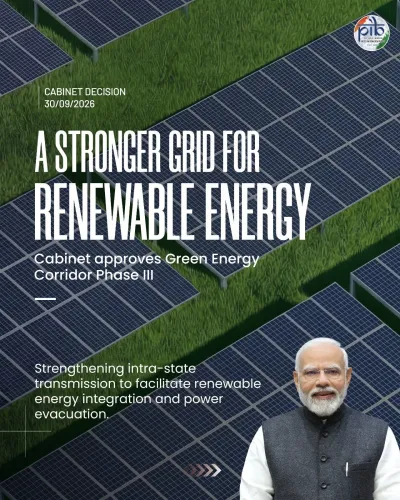
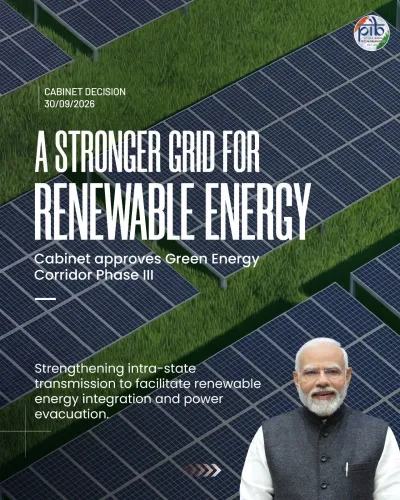
The Union Cabinet approved Green Energy Corridor Phase-III on 30 September 2026, committing ₹1.32 lakh crore to build 51,126 ckm of transmission lines, 2,28,903 MVA of substations, and 50 GWh of battery storage to evacuate up to 135 GW of renewable power across India.
Key Takeaways
The Union Cabinet approved Green Energy Corridor Phase-III on 30 September 2026 under PM Narendra Modi's chairmanship.
Total investment outlay: ₹1.32 lakh crore , one of India's largest single-project clean-energy infrastructure commitments.
The project will add 51,126 ckm of transmission lines and 2,28,903 MVA of substation capacity to evacuate up to 135 GW of renewable energy.
A 50 GWh battery energy storage component is embedded in the approval — a landmark grid-stability measure for India.
Phase-I of the Green Energy Corridor, approved in 2015 , had targeted integration of approximately 43 GW of renewable capacity.
Next milestones include transmission and storage tenders, land acquisition, and coordination with state transmission utilities.
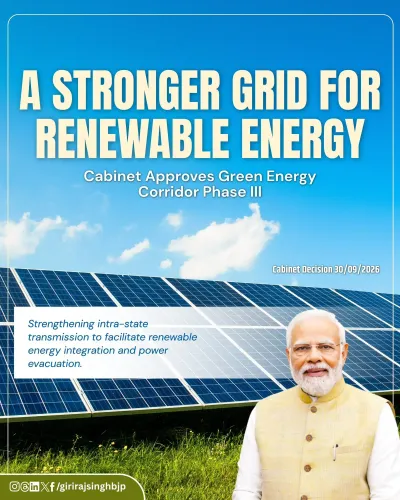
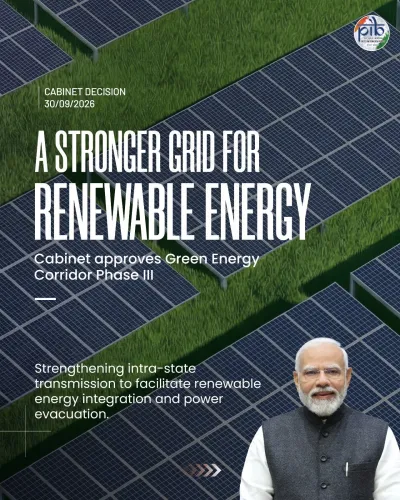
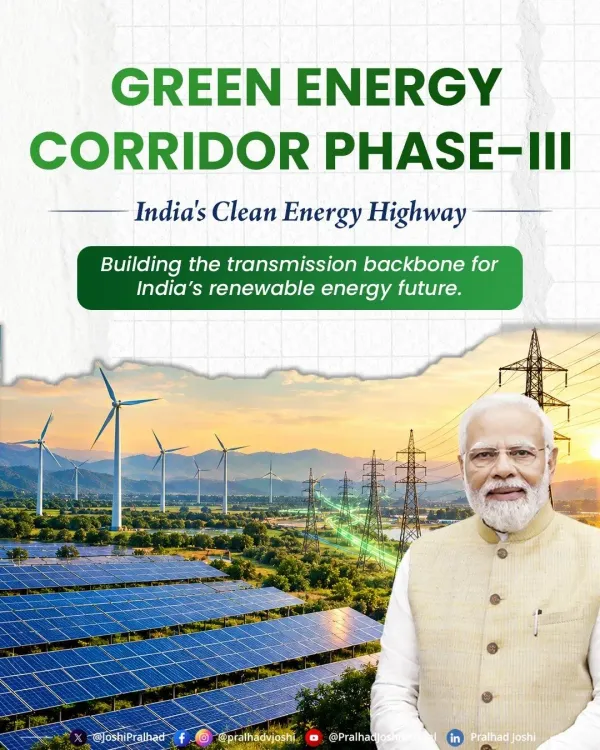
India's renewable energy ambitions just got a transmission backbone to match. The Union Cabinet, chaired by Prime Minister Narendra Modi, on Wednesday, 30 September 2026, approved the Green Energy Corridor Phase-III — a ₹1.32 lakh crore infrastructure push designed to carry up to 135 GW of clean power across states and union territories.
Union Minister for New and Renewable Energy Pralhad Joshi announced the Cabinet decision on X, calling it a step toward 'a stronger grid for India's clean energy future and a Viksit Bharat.' The scale is staggering: the project will lay 51,126 circuit kilometres (ckm) of new transmission lines, install 2,28,903 MVA of substation capacity, and add 50 GWh of battery energy storage — the last of these being among the largest grid-scale storage mandates ever embedded in an Indian infrastructure approval.
Why the Grid Had to Catch Up
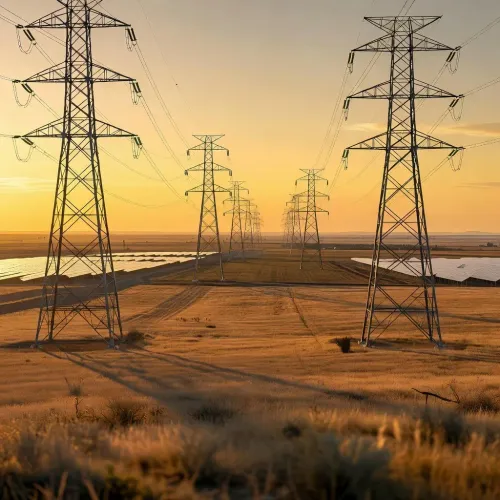
India's renewable energy build-out has long outpaced the transmission infrastructure meant to carry that power to consumers. Wind farms in Rajasthan and solar parks in Gujarat and Tamil Nadu have repeatedly faced curtailment — power generated but unable to move — because the evacuation lines simply weren't there. The Green Energy Corridor programme was launched precisely to close that gap.
Phase-I, approved in 2015, targeted the integration of approximately 43 GW of renewable capacity across high-potential states, building the first dedicated transmission arteries for clean power. Phase-III now multiplies that ambition several times over, aiming to handle more than three times the evacuation capacity and knitting together states and union territories into a more unified, resilient grid.
The 50 GWh Storage Clause: A Grid-Management Game Changer
The inclusion of 50 GWh of battery energy storage within the project is the detail that energy-sector watchers will study most closely. Storage is the missing variable in renewable integration: solar generates at noon, demand peaks at evening, and without storage the mismatch creates instability. Embedding large-scale batteries directly into the transmission upgrade signals a maturing approach — one that treats storage not as an add-on but as load-bearing infrastructure.
For developers who have struggled with grid instability discouraging investment, a government-backed storage mandate at this scale sends a direct signal: the grid will be reliable enough to justify committing capital.
What Comes Next: Tenders, Land, and State Coordination
Cabinet approval is the start, not the finish. The critical near-term milestones will be the issuance of transmission-line and battery-storage tenders, followed by the complex work of securing land and right-of-way clearances — historically the single biggest source of delay in linear infrastructure projects in India. Coordination with state transmission utilities, each operating under different regulatory regimes and financial conditions, will test the project's execution machinery.
Minister Joshi, who holds both the New and Renewable Energy and the Consumer Affairs portfolios, will be the political face of this rollout. Progress reports flowing to the Ministry of Power will be the early scorecard. If the pipeline holds, Phase-III positions India to absorb the renewable capacity additions already in the planning queue — and to credibly defend its clean-energy targets on the global stage.
The grid is no longer the afterthought. It is the policy.
Point of View
Who bridges both the energy and consumer portfolios, this is also a politically salient move: stable, affordable clean power is ultimately a consumer-welfare story. The real test will be execution speed against India's history of right-of-way and inter-agency delays on linear infrastructure.
NationPress
30 Sept 2026
Frequently Asked Questions
What is Green Energy Corridor Phase-III?
Green Energy Corridor Phase-III is a Union Cabinet-approved project worth ₹1.32 lakh crore that will build 51,126 ckm of transmission lines, 2,28,903 MVA of substation capacity, and 50 GWh of battery storage to evacuate up to 135 GW of renewable energy across India's states and union territories.
How much will Green Energy Corridor Phase-III cost?
The approved investment outlay for Green Energy Corridor Phase-III is ₹1.32 lakh crore, making it one of India's largest single clean-energy infrastructure commitments.
What is the difference between Green Energy Corridor Phase-I and Phase-III?
Green Energy Corridor Phase-I, approved in 2015, targeted integration of approximately 43 GW of renewable capacity in states like Rajasthan, Gujarat, and Tamil Nadu. Phase-III is substantially larger, designed to handle up to 135 GW of evacuation capacity and includes 50 GWh of battery storage.
Why is battery storage included in the Green Energy Corridor?
Battery storage of 50 GWh has been included to address the mismatch between when renewable power is generated (e.g. solar at midday) and when demand peaks (evenings), improving grid stability and making the network reliable enough to integrate large volumes of clean power.
Who announced Green Energy Corridor Phase-III approval?
Union Minister for New and Renewable Energy Pralhad Joshi announced the Cabinet approval on X on 30 September 2026, crediting Prime Minister Narendra Modi's leadership for the decision.