Rijiju: Cabinet clears ₹1.86 lakh crore Green Energy Corridor Phase-III
Synopsis
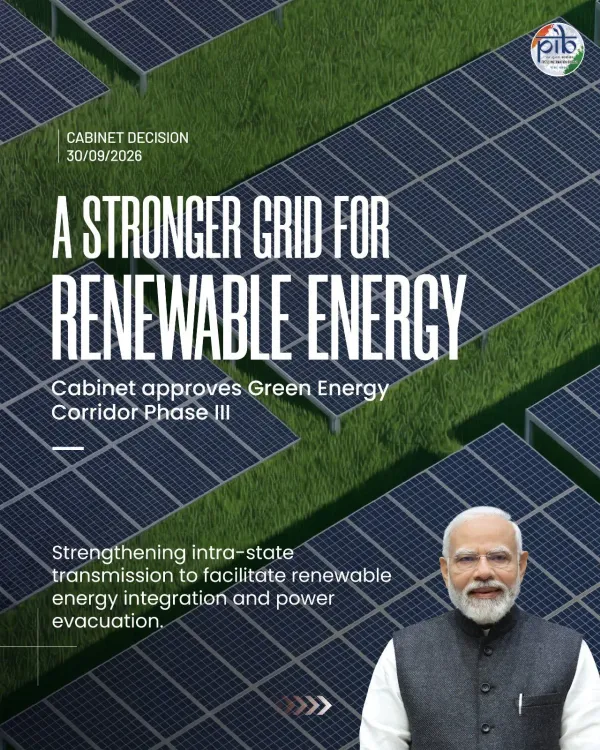
The Union Cabinet chaired by PM Narendra Modi approved the ₹1.86 lakh crore Green Energy Corridor Phase-III on 30 September 2026, enabling integration of up to 135 GW of renewable energy and 50 GWh of battery storage into India's national grid, advancing the country's 900 GW non-fossil capacity goal by 2035.
Key Takeaways
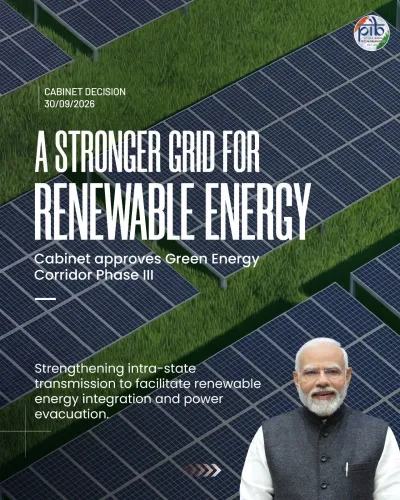
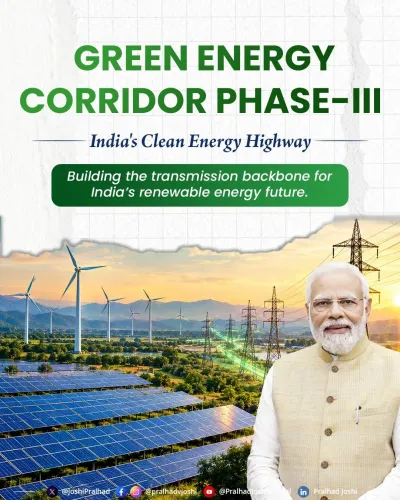
The Union Cabinet approved the Green Energy Corridor Phase-III on 30 September 2026 , with an outlay of ₹1.86 lakh crore .
The project will enable integration of up to 135 GW of renewable energy into India's national transmission grid.
A 50 GWh battery storage component is included to address grid intermittency and stability.
The approval advances India's stated goal of achieving 900 GW of non-fossil fuel capacity by 2035 .
India's COP26 commitment of 500 GW non-fossil capacity by 2030 underpins the broader policy trajectory that Phase-III builds upon.
Key implementation milestones will include tendering for transmission lines, land acquisition, and coordination with state power utilities .
India's clean energy ambitions just got a massive infrastructure backbone. The Union Cabinet, chaired by Prime Minister Narendra Modi, on Wednesday, 30 September 2026, approved the ₹1.86 lakh crore Green Energy Corridor Phase-III — a transmission mega-project designed to plug up to 135 GW of renewable energy into the national grid, backed by 50 GWh of battery storage capacity. Union Parliamentary Affairs Minister Kiren Rijiju announced the decision on X, calling it 'a transformative step towards a stronger power grid, long-term energy security and India's goal of 900 GW non-fossil capacity by 2035.'
What the ₹1.86 lakh crore approval actually does
At its core, the Green Energy Corridor Phase-III is a grid-integration project. Renewable energy — solar and wind in particular — is generated far from where it is consumed, and without dedicated high-capacity transmission corridors, that power simply cannot reach homes, factories, or cities. Phase-III addresses exactly that bottleneck, authorising the construction of new inter-state transmission infrastructure capable of evacuating 135 GW of clean power. The 50 GWh battery storage component is equally significant: storage smooths out the intermittency problem that has long been renewables' Achilles heel, ensuring supply does not collapse when the sun sets or the wind drops.
Building on Phases I and II — and a COP26 promise
This is not India's first Green Energy Corridor. The programme has evolved through successive phases, each expanding the country's capacity to move renewable power across state lines. The broader policy arc traces back to COP26 in 2021, where India committed to achieving 500 GW of non-fossil fuel capacity by 2030 — a target that itself demanded a dramatic upgrade of transmission and storage infrastructure. Phase-III now pushes the horizon further, anchoring a national ambition of 900 GW non-fossil capacity by 2035. Each phase has required deeper coordination between the central government, state power utilities, and private renewable energy developers — the same coalition that will have to execute Phase-III on the ground.
The grid-stability stakes
India's renewable energy generation capacity has grown sharply over the past decade, but transmission has often lagged behind — leaving new solar and wind projects 'stranded,' unable to dispatch power because the wires simply are not there. Phase-III directly targets that gap. The battery storage mandate is a policy signal too: the government is acknowledging that grid stability in a high-renewables future requires dispatchable storage, not just generation. For state power utilities — which manage last-mile distribution — a more stable, storage-backed grid means fewer frequency fluctuations and lower dependence on expensive peaking power from fossil sources.
What comes next: tenders, land, and state buy-in
Cabinet approval is the starting gun, not the finish line. The critical path now runs through tendering for transmission lines and storage systems, securing land for substations and battery installations, and negotiating with state governments on right-of-way and evacuation infrastructure. These are the pressure points where large infrastructure projects in India have historically slowed. Renewable energy developers and grid operators will be watching the implementation timeline closely — the 900 GW target by 2035 leaves little room for the kind of delays that have dogged earlier phases.
India has set the ambition. The ₹1.86 lakh crore question is how fast the wires go up.
Point of View
Reflecting a deliberate policy shift from generation targets alone toward transmission and storage as co-equal priorities. The ₹1.86 lakh crore outlay signals that the government views grid infrastructure — not just installed capacity — as the binding constraint on India's energy transition. Politically, the announcement reinforces the Modi government's effort to frame climate action as an economic and security imperative rather than an external obligation. The 2035 horizon for 900 GW, however, sets an ambitious benchmark against which implementation performance will be measured in every subsequent budget cycle.
NationPress
30 Sept 2026
Frequently Asked Questions
What is Green Energy Corridor Phase-III?
Green Energy Corridor Phase-III is a Union Cabinet-approved infrastructure project worth ₹1.86 lakh crore that will build transmission lines and battery storage systems to integrate up to 135 GW of renewable energy into India's national power grid.
What is India's non-fossil energy target by 2035?
According to the Cabinet decision announced on 30 September 2026, India has set a goal of achieving 900 GW of non-fossil fuel capacity by 2035, with Green Energy Corridor Phase-III being a key enabling project toward that target.
Why is battery storage included in the Green Energy Corridor Phase-III?
The 50 GWh battery storage capacity is included to manage the intermittency of solar and wind power, ensuring grid stability and reliable supply even when generation fluctuates due to weather conditions.
How does Phase-III relate to India's COP26 climate commitments?
At COP26 in 2021, India committed to 500 GW of non-fossil fuel capacity by 2030. Green Energy Corridor Phase-III directly supports that commitment by building the transmission infrastructure needed to evacuate and deliver renewable power at scale.
Who will implement Green Energy Corridor Phase-III?
Implementation will involve central transmission agencies, state power utilities, and private renewable energy developers, with key steps including tendering for transmission lines, storage systems, and coordination with state governments on land and evacuation infrastructure.