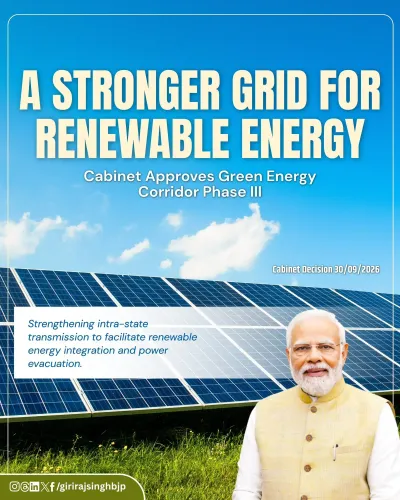
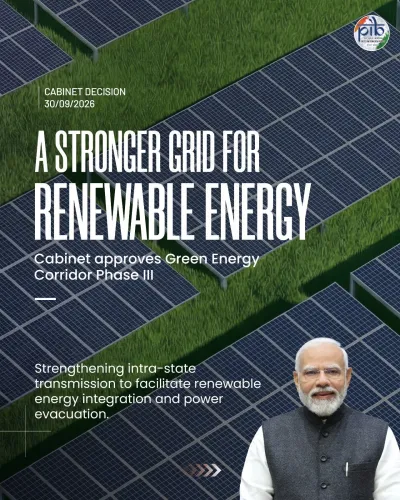
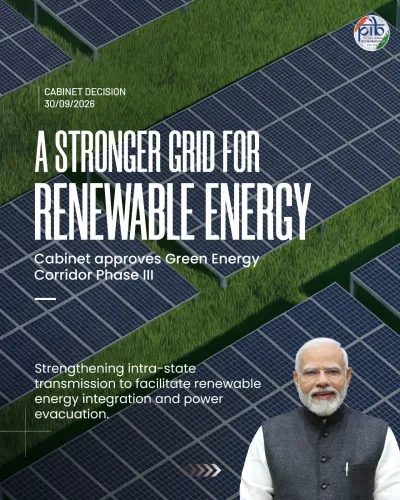
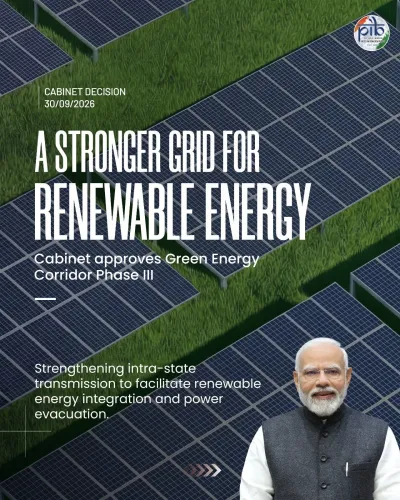
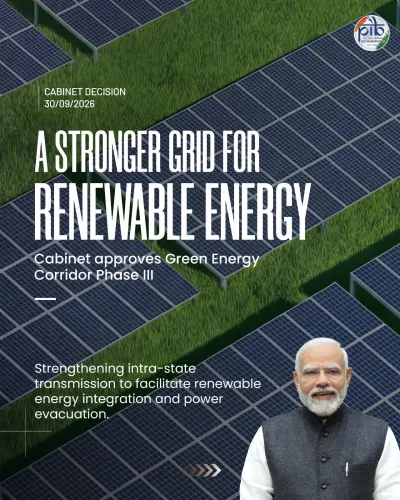
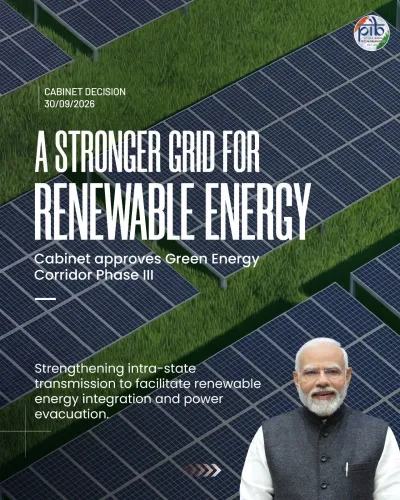
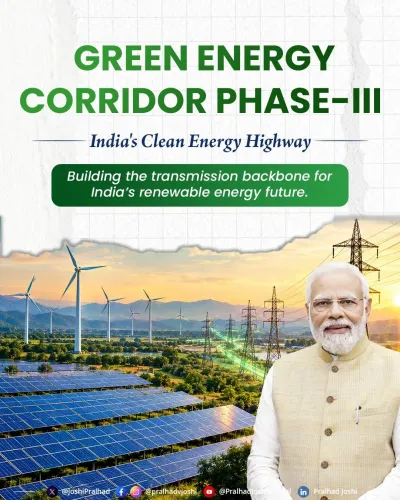
Cabinet clears ₹1.86 lakh crore Green Energy Corridor Phase-III for 135 GW
Synopsis
The Cabinet has cleared a ₹1.86 lakh crore bet on India's energy future — GEC-III will wire up 135 GW of renewable power across states by 2032-33, backed by ₹54,082 crore in central funds and a 50 GWh battery storage push. It is the most ambitious intra-state grid expansion India has attempted, targeting the chronic evacuation bottleneck that has long caused renewable energy curtailment.
Key Takeaways
The Union Cabinet approved Green Energy Corridor Phase-III (GEC-III) on 30 September with a total outlay of ₹1,86,405 crore .
The scheme will enable evacuation of up to 135 GW of renewable energy across states and Union Territories by FY 2032-33 . ₹1,36,378 crore is allocated for Intra-State Transmission Systems (InSTS); ₹50,000 crore for 50 GWh of Battery Energy Storage Systems (BESS).
Central Financial Assistance stands at ₹54,082 crore , designed to offset intra-state transmission charges and keep consumer power costs down.
Greenfield projects will use Tariff Based Competitive Bidding (TBCB) ; brownfield works on a Cost Plus Basis with State Transmission Utilities as implementing agencies.
The scheme supports India's target of 900 GW installed non-fossil capacity by 2035 .
The Union Cabinet on Wednesday, 30 September approved the Green Energy Corridor Phase-III (GEC-III) scheme, authorising a total project outlay of ₹1,86,405 crore to enable the evacuation of up to 135 gigawatts (GW) of renewable energy across states and Union Territories. The scheme, targeted for completion by FY 2032-33, is one of the largest single energy-infrastructure commitments in India's history and a direct enabler of the country's 900 GW non-fossil capacity target by 2035.
What the Scheme Covers
The ₹1,86,405 crore outlay is split into two major components. The larger portion — ₹1,36,378 crore — is earmarked for the development of Intra-State Transmission Systems (InSTS) under GEC-III. The remaining ₹50,000 crore is dedicated to the deployment of 50 gigawatt-hours (GWh) of Battery Energy Storage Systems (BESS).
According to an official statement, BESS units will be deployed at the Renewable Energy developer or generator end, or at any other strategically important location, to address grid intermittency, congestion, peak-hour curtailment, and non-solar hour demand. The Central government will provide a total financial support of ₹54,082 crore under the scheme's Central Financial Assistance (CFA) component.
How It Will Be Implemented
All greenfield projects under the InSTS component will be executed through Tariff Based Competitive Bidding (TBCB) mode, while brownfield upgradation and network strengthening works will proceed on a Cost Plus Basis (CPB). State Transmission Utilities will serve as the overall implementing agencies, with Transmission Service Providers (TSPs) participating under TBCB on a Build-Own-Operate-Maintain (BOOM) model.
The CFA component is designed to offset intra-state transmission charges, which officials say will ultimately keep power costs lower for end consumers — a key political and economic consideration as retail electricity tariffs remain a sensitive issue across states.
Energy Security and Employment Impact
Beyond grid expansion, the Cabinet statement highlighted the scheme's employment dimension. BESS manufacturing and deployment is expected to generate jobs in the domestic energy storage industry, while long-term skilled employment is projected in grid operation, maintenance, and management across participating states and Union Territories.
This comes amid India's accelerating push to reduce its carbon footprint and meet commitments made under its updated Nationally Determined Contributions (NDCs). Notably, GEC-III builds on earlier phases of the Green Energy Corridor programme, which focused on inter-state transmission infrastructure. Phase-III shifts emphasis to intra-state systems — the often-overlooked 'last mile' of renewable energy evacuation that has historically caused curtailment of solar and wind power.
Broader Significance
India's renewable energy capacity has grown rapidly, but grid infrastructure has struggled to keep pace, leading to instances where generated power cannot be evacuated efficiently. GEC-III directly targets this bottleneck. The scheme's FY 2032-33 completion timeline aligns with India's broader energy transition roadmap and is expected to contribute to ecologically sustainable growth by reducing dependence on fossil-fuel-based generation.
With disbursements and implementation guidelines expected to follow the Cabinet approval, the focus now shifts to how quickly State Transmission Utilities can mobilise and whether competitive bidding processes will attract sufficient private-sector participation.
Point of View
Causing curtailment even as solar and wind capacity additions have set records. But the scheme's success hinges entirely on execution by State Transmission Utilities, which have historically been slow-moving and financially stressed. The TBCB model for greenfield projects is a positive structural choice, yet private players will need credible state-level offtake guarantees to participate at scale. The 2032-33 deadline is ambitious; India's track record on large infrastructure timelines suggests slippage risk is real, and a delayed grid means curtailed renewable power — the very problem GEC-III is meant to solve.
NationPress
30 Sept 2026
Frequently Asked Questions
What is the Green Energy Corridor Phase-III (GEC-III) scheme?
GEC-III is a Cabinet-approved scheme with a total outlay of ₹1,86,405 crore aimed at building intra-state transmission infrastructure and battery storage to evacuate up to 135 GW of renewable energy across India by FY 2032-33. It includes ₹54,082 crore in Central Financial Assistance to keep transmission costs — and ultimately consumer tariffs — in check.
How much central funding does GEC-III receive?
The Central government will provide ₹54,082 crore as Central Financial Assistance (CFA) under GEC-III. This support is specifically designed to offset intra-state transmission charges, reducing the cost burden on end consumers.
What role does battery storage play in GEC-III?
The scheme allocates ₹50,000 crore for deploying 50 GWh of Battery Energy Storage Systems (BESS) at renewable energy generator sites or other grid-critical locations. BESS will address intermittency, congestion, peak-hour curtailment, and demand during non-solar hours.
Who will implement GEC-III and how?
State Transmission Utilities will be the primary implementing agencies. Greenfield projects will be awarded through Tariff Based Competitive Bidding (TBCB), with Transmission Service Providers operating on a Build-Own-Operate-Maintain (BOOM) model. Brownfield upgrades will proceed on a Cost Plus Basis.
How does GEC-III connect to India's 2035 clean energy target?
GEC-III directly supports India's goal of achieving 900 GW of installed non-fossil capacity by 2035 by resolving the intra-state grid bottleneck that currently prevents efficient evacuation of generated renewable power. Without adequate transmission infrastructure, capacity additions alone cannot translate into usable clean electricity.