Odisha CMO: 5,197 Medical Staff Hired in Two Years
Synopsis
The Chief Minister's Office of Odisha says the state government recruited 5,197 medical officers and paramedics in two years, citing the milestone under the 'People's Government' banner as part of its drive to strengthen public healthcare delivery.
Key Takeaways
The Chief Minister's Office of Odisha announced the recruitment figure on June 12, 2026 .
5,197 medical officers and paramedics were appointed across various categories over the past two years .
The announcement was made under the #2YearsofLokankaSarakar campaign marking two years of the current state government.
Recruitments are aligned with the National Health Mission framework for improving staffing at district and community health centres.
Rural and tribal populations in Odisha stand to benefit most from increased health worker density at block-level facilities.
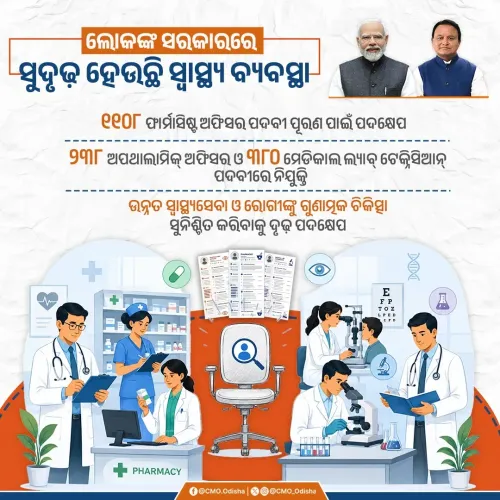
The Chief Minister's Office of Odisha announced on Friday, June 12, 2026, that the state government has recruited 5,197 medical officers and paramedics across various categories over the past two years to strengthen public healthcare delivery.
Context
The post, shared under the hashtags #2YearsofLokankaSarakar (Two Years of the People's Government) and #BikasharaDharaOdishaSara (Stream of Development for All of Odisha), marks a governance milestone for the ruling dispensation. The Odia-language announcement translates as: 'To strengthen health services, the people's government has made new appointments at various times and across various categories. In the last two years, 5,197 medical officers and paramedics have been appointed.'
Policy Backdrop
Odisha's Health and Family Welfare Department serves as the nodal body overseeing such recruitment drives, which are typically aligned with the National Health Mission (NHM) framework. The NHM provides central funding support to states for hiring contractual and regular health workers at district hospitals, community health centres, and primary health centres.
Across India, state governments have accelerated health-sector hiring since the COVID-19 pandemic exposed critical shortfalls in rural service delivery — particularly in the availability of trained doctors and paramedical staff at sub-district levels. Odisha, an eastern state with a significant tribal and rural population, has historically faced challenges in retaining medical professionals in remote postings.
Stakeholders and Impact
The primary beneficiaries of expanded recruitment are rural and semi-urban patients who depend on government facilities for primary and secondary care. A higher density of medical officers and paramedics at block-level hospitals and health sub-centres directly reduces out-of-pocket costs and travel burdens for low-income households.
For healthcare workers themselves, state-driven recruitment cycles represent stable government employment, often accompanied by postings in underserved districts. The scale of 5,197 appointments across two years suggests a sustained, phased hiring calendar rather than a single-batch drive.
What's Next
Analysts and health-sector observers will watch for district-wise deployment data to assess whether new recruits are being posted to the most underserved areas or concentrated in urban centres. Subsequent state health budgets and assembly sessions are likely to carry further notifications on vacancies in specialised cadres. The government's ability to retain these recruits through competitive pay and infrastructure support will be the longer-term test of whether the numbers translate into measurable improvements in health outcomes across Odisha.
Point of View
Framing mass health recruitment as a deliverable of the 'people's government' mandate. Across India, states have used post-pandemic healthcare hiring as a visible governance metric, and Odisha is following that pattern with a specific, auditable number. The real test will come when district-level deployment data is made public — whether appointments reach the most underserved blocks or cluster near urban centres will determine the policy's actual impact. The hashtag campaign also signals that the government intends to build a broader narrative around this milestone ahead of future electoral cycles.
NationPress
25 Sept 2026
Frequently Asked Questions
How many medical officers and paramedics were recruited in Odisha in the last two years?
According to the Chief Minister's Office of Odisha, 5,197 medical officers and paramedics were recruited across various categories over the past two years.
Which department handles health recruitment in Odisha?
The Health and Family Welfare Department of Odisha is the nodal body responsible for medical officer and paramedic hiring in the state.
What is the National Health Mission and how does it relate to Odisha's hiring?
The National Health Mission (NHM) is a central government framework that provides funding support to states for hiring health workers at district hospitals and primary health centres. Odisha's recruitment drives are typically aligned with NHM guidelines.
What is #2YearsofLokankaSarakar?
#2YearsofLokankaSarakar translates to 'Two Years of the People's Government' and is a campaign hashtag used by the Odisha government to highlight governance milestones completed in its first two years in office.
Who benefits most from increased health worker recruitment in Odisha?
Rural, tribal, and low-income populations who rely on government health facilities benefit most, as more medical officers and paramedics at block-level centres reduce travel burdens and out-of-pocket costs.