Odisha CMO: JSW Captive Jetty Pact to Anchor ₹1L Cr Paradip Steel Hub
Synopsis
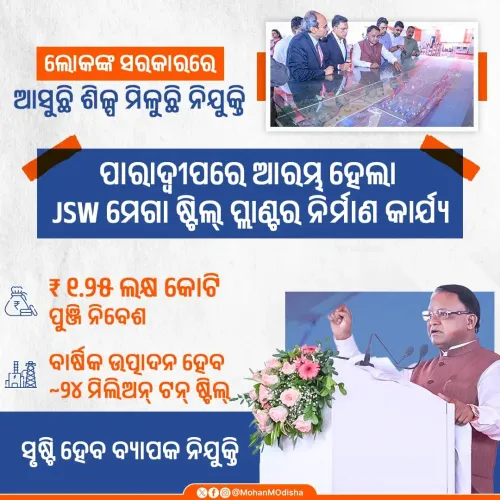
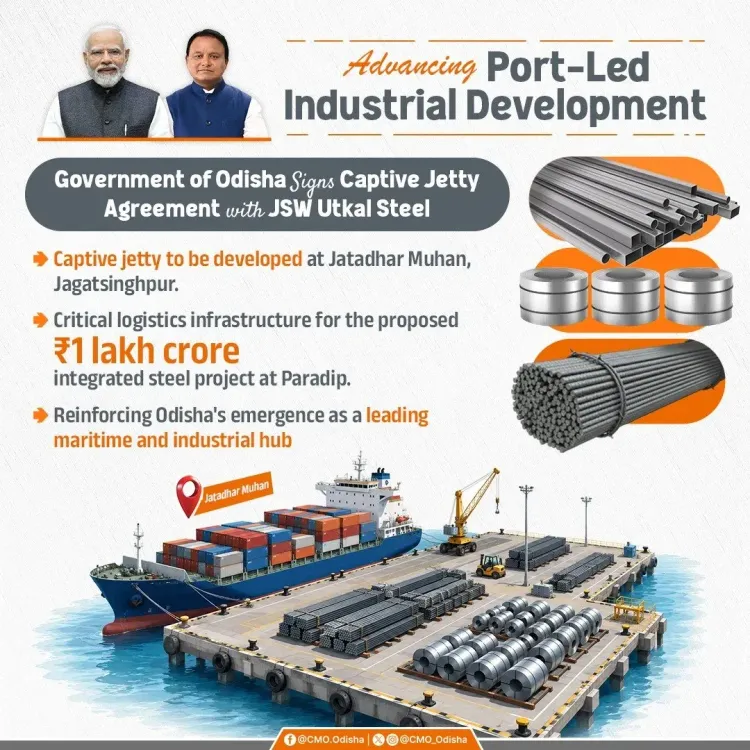
The Chief Minister's Office of Odisha announced a Captive Jetty Agreement with JSW Utkal Steel for a proposed facility at Jatadhar Muhan, intended to support a ₹1 lakh crore integrated steel project at Paradip and strengthen Odisha's maritime and industrial profile.
Key Takeaways
The Government of Odisha and JSW Utkal Steel have signed a Captive Jetty Agreement for a dedicated facility at Jatadhar Muhan .
The jetty will serve as logistics infrastructure for a proposed ₹1 lakh crore integrated steel project at Paradip .
The announcement was made by the Chief Minister's Office of Odisha on 11 July 2026 , with the post tagging PMOIndia .
The agreement aligns with India's Sagarmala programme promoting port-led industrial development along the coastline.
Paradip in Jagatsinghpur district is one of India's largest bulk cargo ports, handling iron ore and coal.
Key next steps include environmental clearances, land acquisition, and construction commencement at Jatadhar Muhan .
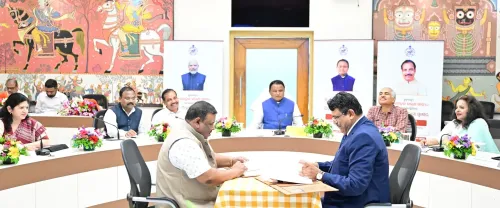
The Chief Minister's Office of Odisha announced on Saturday, 11 July 2026 that the Government of Odisha and JSW Utkal Steel have signed a Captive Jetty Agreement, marking a pivotal move to advance port-led industrial development in the state. The proposed captive jetty at Jatadhar Muhan is designed to serve as dedicated logistics infrastructure for a proposed ₹1 lakh crore integrated steel project at Paradip.
Context
The CMO described the agreement as 'a significant step in accelerating port-led industrial development,' positioning the captive jetty as critical to the broader industrial ambitions centred on Paradip. Paradip, located in Jagatsinghpur district, is one of India's largest ports for bulk cargo handling — including iron ore and coal — making it a natural anchor for a large-scale steel manufacturing cluster.
JSW Utkal Steel, a subsidiary of JSW Steel, one of India's largest private steel producers, is the industrial partner for the proposed integrated facility. The captive jetty at Jatadhar Muhan would allow the plant to manage its own raw material imports and finished-product exports, reducing dependence on shared port infrastructure.
Policy Backdrop
The agreement aligns with India's Sagarmala programme, launched in 2015, which promotes port-led industrialisation along the country's coastline by encouraging captive port facilities for steel, power, and manufacturing clusters. Odisha's long eastern coastline and abundant iron ore reserves have made it a recurring focus for such investment.
Eastern coastal states have increasingly pursued large integrated steel projects paired with dedicated port infrastructure to exploit local mineral wealth and cut logistics costs. This model — mine-to-port-to-plant — is central to India's push for domestic steel capacity expansion and export competitiveness. The CMO's post tagging @PMOIndia signals an intent to draw central government attention and potential support for the project.
Stakeholders and Impact
If executed at the projected scale, a ₹1 lakh crore integrated steel investment at Paradip would rank among the largest single industrial commitments in Odisha's history, with significant downstream effects on employment, ancillary industries, and port traffic volumes. Steel investors, maritime logistics operators, and port developers in the region are the immediate stakeholders watching the project's progress.
Local communities around Jatadhar Muhan and Paradip stand to be affected by land use, environmental conditions, and infrastructure development associated with both the jetty and the steel plant. Environmental clearances and land acquisition processes will be closely watched by civil society groups and affected residents.
What's Next
Key milestones ahead include environmental clearances for the Jatadhar Muhan captive jetty site, land acquisition proceedings, and the commencement of construction activity. Any updates shared through central government channels — particularly the PMO — will indicate the degree of national-level backing the project receives.
Odisha's positioning of this agreement as evidence of its emergence as 'a premier maritime, manufacturing and investment destination' suggests the state government will use the pact actively in its investor outreach. The pace at which regulatory approvals move will determine whether the ₹1 lakh crore Paradip steel project transitions from commitment to ground-level reality.
Point of View
The state government is signalling that it seeks central partnership — whether in regulatory fast-tracking, Sagarmala funding, or political visibility — for what would be one of the country's largest greenfield steel commitments. The ₹1 lakh crore headline figure is a powerful investor-attraction signal, but the real test will come at the environmental clearance and land acquisition stages, where large coastal industrial projects in Odisha have historically faced delays and community pushback. If the project clears those hurdles at pace, it could cement Odisha's repositioning from a raw-material supplier to a value-added manufacturing hub.
NationPress
10 Oct 2026
Frequently Asked Questions
What is the Captive Jetty Agreement signed by Odisha and JSW Utkal Steel?
It is an agreement between the Government of Odisha and JSW Utkal Steel to develop a dedicated captive jetty at Jatadhar Muhan near Paradip, which will provide private logistics infrastructure for JSW's proposed integrated steel plant.
Where is the proposed captive jetty located in Odisha?
The captive jetty is proposed at Jatadhar Muhan , near Paradip in Jagatsinghpur district, Odisha — a major bulk cargo port on India's eastern coast.
How big is the JSW steel project at Paradip?
The proposed integrated steel project at Paradip is valued at ₹1 lakh crore , which would make it one of the largest single industrial investments in Odisha's history.
What is India's Sagarmala programme and how does it relate to this project?
Sagarmala, launched in 2015, is a central government initiative to promote port-led industrialisation along India's coastline. The Odisha-JSW captive jetty agreement aligns with Sagarmala's model of pairing manufacturing clusters with dedicated port infrastructure.
What are the next steps for the Paradip captive jetty project?
The key milestones ahead are environmental clearances for the Jatadhar Muhan site, land acquisition, and the start of construction. Central government support through the PMO may also shape the project's timeline.