Chhattisgarh CMO highlights Kanker farmer Sonuram's organic farming success
Synopsis
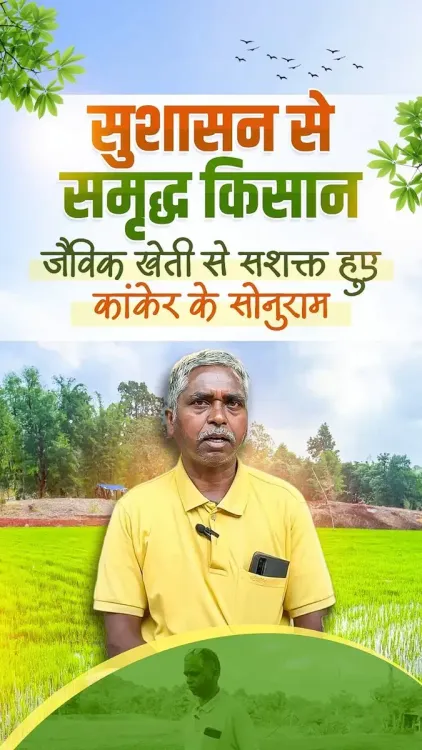
The Chief Minister's Office of Chhattisgarh on 11 July 2026 spotlighted Kanker farmer Sonuram as a model of organic farming success, citing state agricultural schemes under the Sushasan Sarkar government. The post underlines the administration's push for self-reliant, sustainable agriculture in tribal and rainfed districts.
Key Takeaways
The Chhattisgarh CMO on 11 July 2026 highlighted farmer Sonuram from Kanker district as an organic farming success story.
Sonuram adopted organic farming using benefits from state agricultural schemes under the Sushasan Sarkar administration.
The government states his farm is delivering better production and higher income through organic methods.
Kanker is a tribal-majority, predominantly rainfed district in northern Chhattisgarh, making organic adoption especially impactful for input-cost reduction.
The initiative aligns with the Central Government's Paramparagat Krishi Vikas Yojana (2015) and the National Mission for Sustainable Agriculture .
State budget allocations for organic certification and marketing infrastructure in the next season will indicate the programme's scalability.
The Chief Minister's Office of Chhattisgarh on Saturday, 11 July 2026 spotlighted Sonuram, a farmer from Kanker district, as a model of organic farming success achieved through state agricultural schemes under the Sushasan Sarkar (Good Governance Government) administration led by Chief Minister Vishnu Deo Sai.
Context
The CMO's post states that Sonuram adopted organic farming by availing benefits of government agricultural schemes, and that his farm is now yielding better production while serving as a means to increase income. The original Hindi text reads: 'सोनुराम ने जैविक खेती को अपनाया। आज उनकी खेती बेहतर उत्पादन के साथ आय बढ़ाने का माध्यम बन रही है' — meaning 'Sonuram adopted organic farming. Today his farming is becoming a medium to increase income along with better production.' The post is tagged to @KankerDistrict and carries hashtags including #OrganicFarming, #FarmersWelfare, and #Chhattisgarh.
Kanker is a northern district of Chhattisgarh with a large tribal population and predominantly rainfed agriculture, making the shift to organic and natural farming methods particularly significant for soil health and input-cost reduction in the region.
Policy Backdrop
The Central Government's Paramparagat Krishi Vikas Yojana (PKVY), launched in 2015, provides the foundational framework for organic farming clusters across Indian states, offering certification and marketing support to participating farmers. Chhattisgarh's state agriculture policy documents since 2018 have included targets for expanding area under organic and natural farming practices.
The Sai government's Sushasan Sarkar branding — in office since December 2023 — has consistently promoted natural and organic farming as part of its agricultural outreach, aligning with the National Mission for Sustainable Agriculture. Highlighting individual farmer success stories is a recurring communication strategy to demonstrate on-ground impact of scheme delivery.
Stakeholders and Impact
Small and tribal farmers in districts like Kanker stand to benefit most from organic farming transitions, as lower chemical input costs can directly improve net margins even when raw yields are comparable. Access to premium markets for certified organic produce offers an additional income lever that conventional farming does not provide.
Several Indian states have scaled similar programmes to address soil degradation and tap growing domestic and export demand for certified organic produce. Chhattisgarh's push positions the state within this broader national pattern of sustainable agriculture adoption, with Kanker serving as one of the districts being highlighted in official communications.
What's Next
Observers will watch state budget allocations for organic certification infrastructure and marketing linkages in the next agricultural season, as well as any new cluster formations under central schemes such as PKVY. The government's ability to scale individual success stories like Sonuram's into district-wide or state-wide programmes will be the real test of policy depth.
As the Chhattisgarh government continues to amplify farmer-centric narratives ahead of future policy cycles, the emphasis on self-reliant, prosperous, and sustainable agriculture — the CMO's stated goal — will hinge on how robustly certification, market access, and extension services are expanded beyond early adopters in tribal and rainfed districts.
Point of View
A tribal-majority district with rainfed agriculture, is strategically significant: it signals that the Sai government's agricultural outreach is reaching historically marginalised farming communities, not just commercially active belt farmers. However, the real policy test lies beyond storytelling — whether certification pipelines, input subsidies, and market linkages are being institutionalised at scale will determine if Chhattisgarh's organic farming push becomes a durable programme or remains a curated showcase. Analysts watching the state's next budget cycle will look for concrete allocation increases under organic farming heads as a credibility signal.
NationPress
10 Oct 2026
Frequently Asked Questions
Who is Sonuram and why is he in the news?
Sonuram is a farmer from Kanker district in Chhattisgarh who has been highlighted by the Chief Minister's Office on 11 July 2026 for successfully adopting organic farming using state government agricultural schemes, resulting in better production and increased income.
What is the Sushasan Sarkar in Chhattisgarh?
'Sushasan Sarkar' translates to 'Good Governance Government' and is the branding used by the BJP government of Chhattisgarh led by Chief Minister Vishnu Deo Sai, who has been in office since December 2023.
What schemes support organic farming in Chhattisgarh?
The Central Government's Paramparagat Krishi Vikas Yojana, launched in 2015, is a key scheme that supports organic farming clusters with certification and marketing assistance. Chhattisgarh has also included organic farming expansion targets in its state agriculture policy since 2018.
Why is organic farming important for Kanker district?
Kanker is a tribal-majority district with predominantly rainfed agriculture. Organic farming reduces dependence on costly chemical inputs, can improve soil health, and opens access to premium markets — all of which are particularly beneficial for small and tribal farmers in such regions.
What is the Paramparagat Krishi Vikas Yojana?
The Paramparagat Krishi Vikas Yojana is a Central Government scheme launched in 2015 to promote organic farming clusters across Indian states, providing participating farmers with certification support, training, and marketing linkages for their organic produce.