CM Bhupendra Patel Holds BJP Worker Meet in Banaskantha
Synopsis
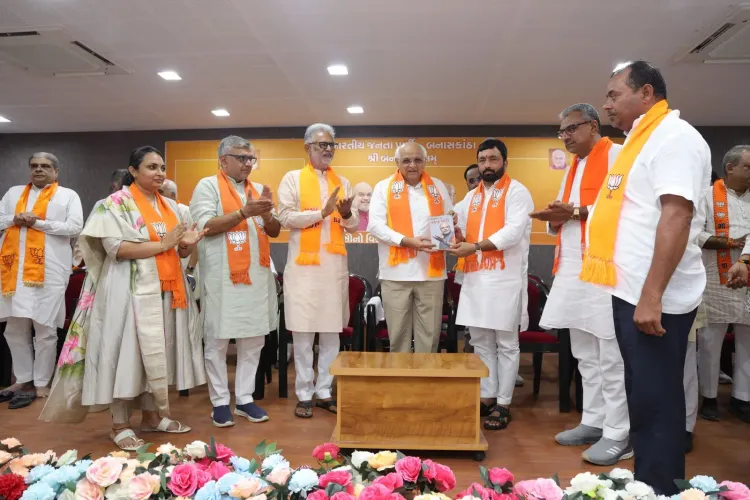
Gujarat Chief Minister Bhupendra Patel on 11 July 2026 met BJP workers at the Banas Kamlam district office in Banaskantha, urging cadres to ensure government scheme benefits reach the most marginalised citizens and strengthen the resolve of public service.
Key Takeaways
CM Bhupendra Patel visited Banaskantha district on 11 July 2026 as part of a district-level tour.
He interacted with BJP workers at the district party office Banas Kamlam in what he described as an energy-filled dialogue session.
Patel called on all karyakartas to ensure government scheme benefits reach 'chhevaḍānā mānavī' — the last-mile, most marginalised citizen.
The engagement reflects the Gujarat BJP model of integrating party cadre networks with administrative welfare delivery, a practice sustained since 2001 .
Banaskantha is a primarily agrarian district in northern Gujarat, making grassroots scheme penetration particularly significant for its rural population.
Gujarat Chief Minister Bhupendra Patel on Saturday, 11 July 2026, visited Banaskantha district and held an energetic interaction with BJP workers at the district party office 'Banas Kamlam', calling on cadres to redouble their commitment to grassroots welfare delivery.
Context
Posting in Gujarati on X, CM Patel described the gathering as 'ûrjāpūrṇ' (energy-filled), saying the meeting at Banas Kamlam was an occasion for warmth and dialogue — 'snehamilana-saṃvāda' — with dedicated party colleagues. He called on all workers to move forward with greater dedication in public-service work, with the resolve to ensure government scheme benefits reach 'chhevaḍānā mānavī' — the person at the last mile, the most marginalised citizen.
The Chief Minister added that the 'inexhaustible enthusiasm and energy' of the workers would further strengthen the resolve of public service, underscoring the party's view of its cadre network as a bridge between administration and citizen.
Policy Backdrop
Banaskantha is a primarily agrarian district in northern Gujarat, with its economy anchored in dairy, potato cultivation, and other crops, and with a large rural population that depends heavily on state and central welfare schemes. The district has historically been a focus of BJP's Antyodaya-style outreach — a model pursued since 2001 by successive Gujarat governments to ensure welfare benefits penetrate to the poorest households.
The Gujarat BJP maintains a network of district offices precisely to align party organisation with administrative implementation of schemes. Banas Kamlam serves as the organisational hub for such activities in Banaskantha, hosting party meetings and coordination exercises between elected representatives and ground-level workers.
Stakeholders and Impact
The primary audience for this engagement is the layer of BJP karyakartas — party volunteers and workers — who are tasked with ensuring rural beneficiaries are enrolled in and receive benefits from both central and state schemes. In districts like Banaskantha, where institutional access can be uneven, this cadre-driven outreach model is considered critical to scheme penetration.
Rural families, particularly those dependent on agriculture and dairy, stand to benefit if the renewed emphasis on last-mile delivery translates into faster enrolment and grievance redressal under flagship welfare programmes.
What's Next
CM Patel's Banaskantha visit is part of a broader pattern of district-level tours by the Chief Minister to maintain political connect and monitor welfare delivery on the ground. Observers will watch for subsequent district engagements across northern Gujarat and any formal review of scheme coverage in Banaskantha that may follow this organisational meeting. The cadre energy signalled at Banas Kamlam is likely to feed into the party's broader electoral and governance outreach in the region in the months ahead.
Point of View
The Chief Minister is sustaining a model that has been central to the BJP's political dominance in Gujarat since 2001. The emphasis on 'inexhaustible energy' among workers also signals an effort to keep the organisational apparatus motivated between election cycles. For northern Gujarat's agrarian belt, where scheme penetration can be uneven, such cadre mobilisation carries direct administrative — not merely political — consequence.
NationPress
10 Oct 2026
Frequently Asked Questions
Why did CM Bhupendra Patel visit Banaskantha?
CM Bhupendra Patel visited Banaskantha on 11 July 2026 to meet BJP workers at the Banas Kamlam district office and urge them to work with greater dedication to ensure government welfare scheme benefits reach the most marginalised citizens.
What is Banas Kamlam?
Banas Kamlam is the BJP's district party office in Banaskantha, Gujarat, used for organisational meetings, cadre interactions, and coordination between party workers and elected representatives.
What did CM Patel say to BJP workers in Banaskantha?
CM Patel called on all workers to advance public-service work with greater dedication, with the resolve to take government scheme benefits to the last-mile citizen, and said the workers' enthusiasm would strengthen this commitment.
What is the significance of Banaskantha for Gujarat BJP?
Banaskantha is a northern Gujarat district with a large agrarian and rural population; it is a key focus for the BJP's Antyodaya-style outreach to ensure welfare schemes reach the poorest households through grassroots cadre networks.
Does Gujarat CM Bhupendra Patel regularly visit districts?
Yes, district-level visits are an established practice for Gujarat Chief Ministers, used to interact directly with BJP workers, maintain political connect, and monitor welfare scheme delivery at the grassroots level.