CM Bhajanlal: Rajasthan builds 18,000 km of new roads
Synopsis
The Rajasthan Chief Minister's Office announced on 11 July 2026 that 18,000 kilometres of new roads have been constructed under CM Bhajan Lal Sharma, underscoring the BJP government's focus on road connectivity across India's largest state.
Key Takeaways
The Rajasthan CMO announced construction of 18,000 kilometres of new roads on 11 July 2026 .
The achievement is attributed to the government of Chief Minister Bhajan Lal Sharma , who has been in office since December 2023 .
Rajasthan is India's largest state by area, making road connectivity a critical governance priority.
Central schemes including PMGSY and Bharatmala have been key funding channels for road expansion in the state.
Key beneficiaries include rural residents , farmers, and logistics operators across remote districts.
Detailed project-wise data from the Public Works Department will be needed to verify scope and completion status.
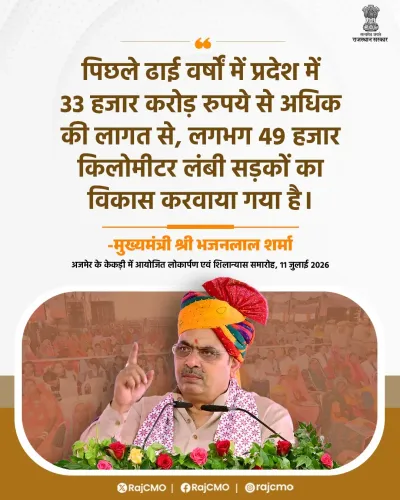
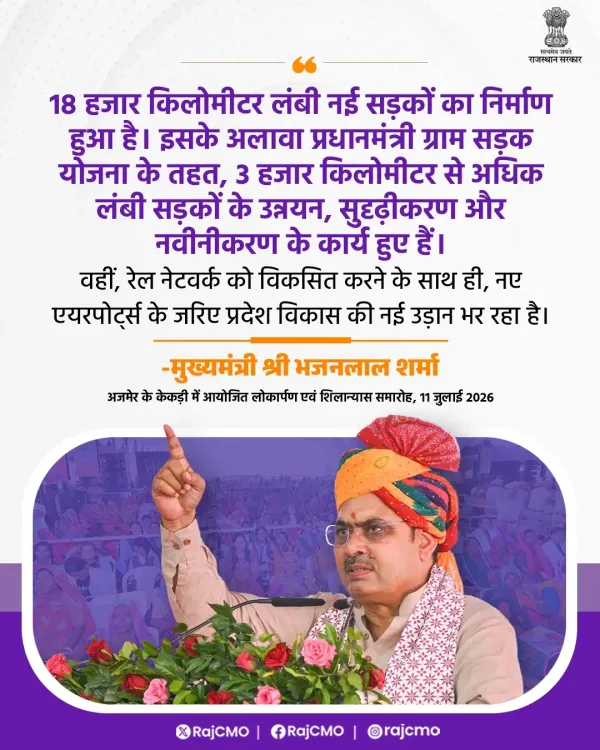
The Chief Minister's Office of Rajasthan announced on Saturday, 11 July 2026 that the state has constructed 18,000 kilometres of new roads under Chief Minister Bhajan Lal Sharma, highlighting the achievement as a marker of the BJP government's infrastructure push under the hashtag #आपणो_अग्रणी_राजस्थान ('Our Leading Rajasthan').
Context
The post, shared from the official Rajasthan CMO account and tagging Chief Minister Bhajan Lal Sharma, states plainly: '18 हजार किलोमीटर लंबी नई सड़कों का निर्माण हुआ है' — '18 thousand kilometres of new roads have been constructed.' The announcement positions road-building as a headline achievement of the current administration, which took office in December 2023 after the BJP's victory in the state assembly elections.
Rajasthan is India's largest state by area, spanning over 3.4 lakh square kilometres, which makes road connectivity a perennial governance priority. Large swathes of the state, particularly in the Thar Desert belt and tribal districts of the south, have historically suffered from poor all-weather road access.
Policy Backdrop
Road construction in Rajasthan has been channelled through a combination of central and state schemes. The Pradhan Mantri Gram Sadak Yojana (PMGSY), launched in 2000, has been a primary vehicle for funding all-weather rural roads across the state, connecting habitations that were previously cut off during monsoon months. The national Bharatmala Pariyojana has further supplemented highway and expressway construction, aiming to improve freight corridors and inter-state connectivity.
BJP-led state governments have increasingly cited road-length additions as a measurable governance metric, and Rajasthan's reported 18,000 km figure fits within the broader pattern of infrastructure spending that has characterised multiple state administrations aligned with the central government's development agenda since 2014.
Stakeholders and Impact
The primary beneficiaries of expanded road networks in Rajasthan are rural residents, who gain improved access to markets, hospitals, and schools. Logistics operators and small traders also stand to benefit from reduced transit times and lower vehicle-operating costs on better-surfaced roads.
For farmers in districts such as Barmer, Jaisalmer, and Dungarpur, all-weather connectivity can translate directly into higher realisation for agricultural produce by cutting post-harvest losses. Industrial corridors in the state, including those tied to the Delhi-Mumbai Industrial Corridor, also depend on feeder road networks to function efficiently.
What's Next
Detailed project-wise breakdowns and completion timelines are expected to emerge from Rajasthan's Public Works Department reports and state budget documents. Observers will watch whether the 18,000 km figure covers roads fully completed and handed over, or includes works at various stages of progress — a distinction that typically shapes how such announcements are assessed by auditors and opposition parties.
With assembly elections still years away, the Bhajan Lal Sharma government is likely to continue using infrastructure milestones as a central plank of its public communication, particularly as the #आपणो_अग्रणी_राजस्थान campaign frames Rajasthan as a state at the forefront of development among its peers.
Point of View
000 km of new roads is a classically calibrated infrastructure claim — large enough to signal scale, specific enough to anchor a campaign narrative. For the Bhajan Lal Sharma government, road-building serves a dual purpose: delivering tangible rural benefits while reinforcing the BJP's development-first brand ahead of future electoral cycles. The #आपणो_अग्रणी_राजस्थान hashtag suggests a deliberate effort to position Rajasthan as a model state within the BJP's national governance framework. Whether the figure withstands audit scrutiny will determine its long-term political utility.
NationPress
11 Jul 2026
Frequently Asked Questions
How many kilometres of new roads has Rajasthan built?
According to the Rajasthan Chief Minister's Office, 18,000 kilometres of new roads have been constructed in the state under Chief Minister Bhajan Lal Sharma .
Who is the Chief Minister of Rajasthan in 2026?
Bhajan Lal Sharma is the Chief Minister of Rajasthan. He took office in December 2023 after the BJP won the state assembly elections.
What schemes fund road construction in Rajasthan?
Key central schemes include the Pradhan Mantri Gram Sadak Yojana (PMGSY) , which funds all-weather rural roads, and the Bharatmala Pariyojana , which focuses on highways and freight corridors.
What does Aapno Agrani Rajasthan mean?
Aapno Agrani Rajasthan translates to 'Our Leading Rajasthan' in English. It is a campaign hashtag used by the Rajasthan government to highlight the state's development achievements.
Why is road connectivity important in Rajasthan?
Rajasthan is India's largest state by area, and large parts of it — including the Thar Desert belt and tribal districts — have historically lacked all-weather roads, making connectivity essential for rural access to markets, healthcare, and education.