Odisha Cabinet clears ₹2,200 Cr farm mechanisation push
Synopsis
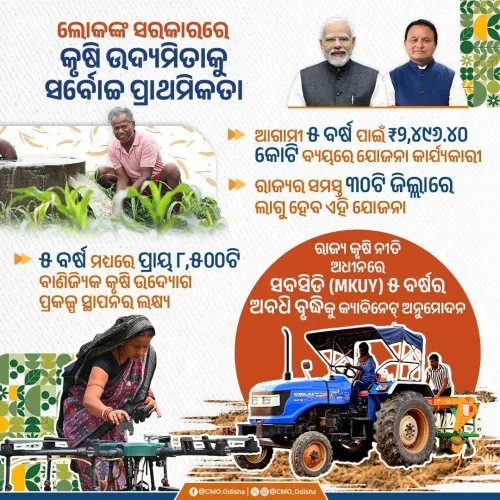
The Odisha cabinet under CM Mohan Majhi has approved a ₹2,200 crore, five-year expansion of the state Agricultural Mechanisation Scheme, aiming to provide modern farm machinery and diesel pump sets to 3.79 lakh farmers to cut costs and raise productivity.
Key Takeaways
The Odisha state cabinet approved the expansion of the Agricultural Mechanisation Scheme on 3 August 2026 .
The scheme carries a budget of ₹2,200 crore to be spent over the next five years .
An estimated 3.79 lakh farmers will receive access to subsidised modern farm machinery, implements, and diesel pump sets.
Stated goals include lower cultivation costs, higher production efficiency, timely farm operations, and increased farmer incomes.
The decision was taken under Chief Minister Mohan Charan Majhi and aligns with the Centre's Sub-Mission on Agricultural Mechanisation (SMAM) framework launched in 2014-15.
The CMO framed the move within the 'prosperous farmer, prosperous Odisha, developed India' vision.
A single cabinet decision in Bhubaneswar is set to reshape how nearly 3.79 lakh farmers in Odisha till their land. The Chief Minister's Office of Odisha announced on Monday, 3 August 2026 that the state cabinet, under Chief Minister Mohan Charan Majhi, has approved the expansion of the Agricultural Mechanisation Scheme — committing ₹2,200 crore over the next five years to put modern farm machinery, equipment, and diesel pump sets within reach of Odisha's farming households.
What the cabinet approved — and who benefits
The cabinet greenlighted two linked decisions: the continuation and expansion of the state's existing agricultural mechanisation programme, and the popularisation of farm machinery, implements, and diesel pump sets through a subsidy-backed scheme. Together, the moves target 3.79 lakh beneficiary farmers across the state. The CMO framed the initiative as a step toward making agriculture 'more modern, productive, and farmer-centric' — adhika adhunika, utpadanashila o krishakabhimukhi — in the words of the original Odia announcement.
The stated outcomes are concrete: lower cultivation costs, higher production efficiency, timely completion of farm operations, and an increase in farmer incomes. Each of those goals maps directly onto a pressure point that Odisha's predominantly small and marginal farming households face every season — the rising cost of hired labour and the narrow windows for sowing and harvesting.
Odisha's mechanisation push in national context
This is not a standalone gesture. The Government of India launched the Sub-Mission on Agricultural Mechanisation (SMAM) in 2014-15, creating a federal architecture through which states could design and fund their own machinery subsidy programmes. Odisha's cabinet decision scales an existing state scheme that already operates within that framework, adding multi-year budgetary certainty that shorter annual allocations cannot provide.
Across India, states have leaned harder on mechanisation as rural labour shortages — driven by migration to urban construction and manufacturing — push up farm-wage costs. A tractor or a transplanter no longer represents a luxury upgrade; for many smallholders it is the only way to stay economically viable. Odisha's ₹2,200 crore commitment over five years signals that the Majhi government is treating mechanisation as structural policy, not a one-budget line item.
The 'Prosperous Farmer, Prosperous Odisha' framing
The CMO explicitly anchored the decision to three nested ambitions: samriddha krishak, samriddha Odisha ebam bikashita Bharat — 'prosperous farmer, prosperous Odisha, and a developed India.' That three-tier framing — individual, state, nation — is deliberate political architecture, aligning a state welfare programme with the Centre's broader 'Viksit Bharat' narrative and signalling that Bhubaneswar intends to be counted among the states driving that agenda forward.
Watchers will track how quickly the scheme reaches the district level — beneficiary selection, utilisation certificates, and whether future state budgets supplement or merely restate the ₹2,200 crore envelope. The five-year horizon is an invitation to hold the government to account, year by year.
For Odisha's farmers, the machinery subsidy is not an abstraction. It is the difference between a hired harvester arriving on time or a crop left standing in the rain. That is the bet the Majhi cabinet has just placed.
Point of View
200 crore, five-year commitment is significant less for its size than for its duration — multi-year budgetary certainty is exactly what single-season subsidy announcements fail to deliver, and it signals that the Majhi government views mechanisation as a structural agricultural reform rather than electoral optics. By explicitly linking the scheme to 'Viksit Bharat,' Bhubaneswar is also positioning itself as a willing partner in the Centre's rural-economy narrative, which carries political dividends for a BJP-led state government. The real test will come in implementation: district-wise beneficiary selection and utilisation data will reveal whether the ₹2,200 crore flows to small and marginal farmers or concentrates among larger landholders with better institutional access. If the rollout is equitable, this could become a template other eastern Indian states replicate.
NationPress
18 Sept 2026
Frequently Asked Questions
What is the Odisha Agricultural Mechanisation Scheme?
It is an Odisha state government programme that provides subsidies on farm machinery, implements, and diesel pump sets to help farmers reduce cultivation costs and improve productivity. The cabinet approved its expansion with a ₹2,200 crore budget on 3 August 2026.
How many farmers will benefit from the Odisha farm machinery scheme?
Approximately 3.79 lakh farmers across Odisha are expected to benefit from the expanded scheme over the next five years.
What is the budget allocated for Odisha's agricultural mechanisation plan?
The Odisha cabinet approved ₹2,200 crore to be spent over five years on the expansion of the Agricultural Mechanisation Scheme.
Who is the Chief Minister of Odisha in 2026?
Mohan Charan Majhi is the Chief Minister of Odisha, having assumed office in 2024 leading the BJP-led state government.
What is India's Sub-Mission on Agricultural Mechanisation (SMAM)?
SMAM is a central government scheme launched in 2014-15 to promote farm mechanisation through state-level implementation and subsidies. Odisha's expanded state scheme operates within this national framework.