Rajnath Singh at Tarang Shakti-2026: Old world order fading, new one yet to take shape
Synopsis
At Tarang Shakti-2026 in Jodhpur, Defence Minister Rajnath Singh sounded a rare strategic alarm: the old world order is dissolving and a new one has not yet taken shape — precisely the kind of vacuum, he argued, that demands India accelerate self-reliance in defence and stay combat-ready. With Tejas, Prachand, and Dhruv stealing the aerial show, the exercise doubled as a showcase of how far India's indigenous defence ecosystem has come.
Key Takeaways
Defence Minister Rajnath Singh attended Tarang Shakti-2026 at Jodhpur airbase on 10 October 2026 .
Singh warned that the old world order is fast disappearing while the shape of a new one is yet to emerge, calling for high military alertness.
He highlighted AI, drones, unmanned systems, and long-range precision weapons as the defining forces reshaping modern warfare.
India's Atmanirbharta (self-reliance) in defence was described as a formal national policy adopted under PM Narendra Modi .
The LCA Tejas performed manoeuvres at approximately 5,000 metres ; the LCH Prachand , commanded by Group Captain Anubhav Mahendra , also demonstrated combat capabilities.
Air Chief Marshal A.P.
Singh was among the senior IAF officials present at the multinational exercise.
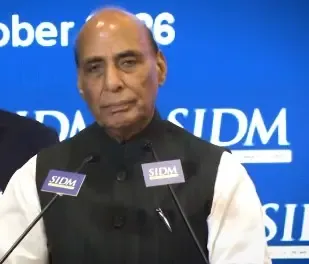
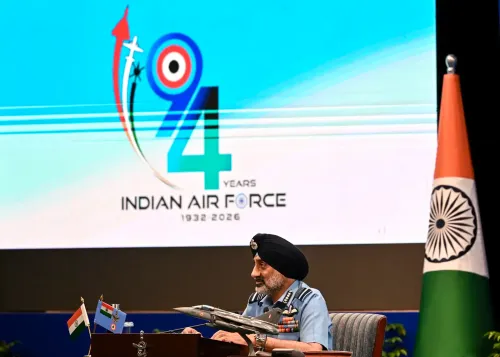
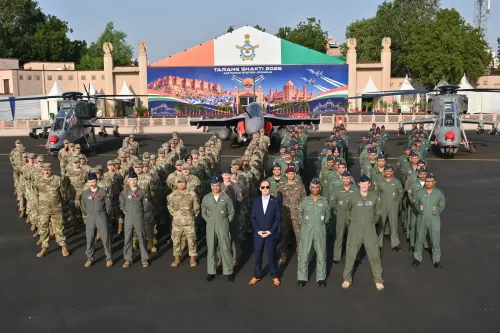
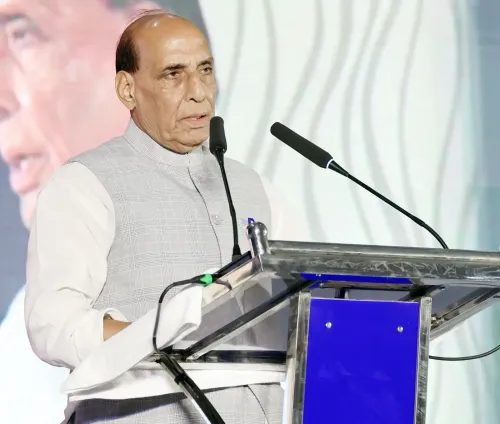
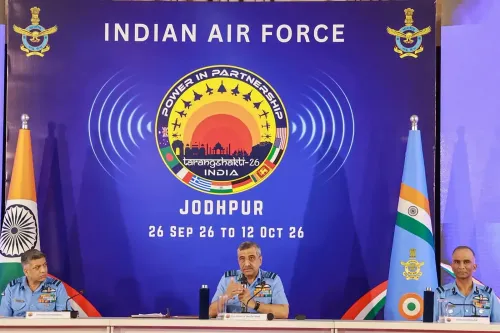
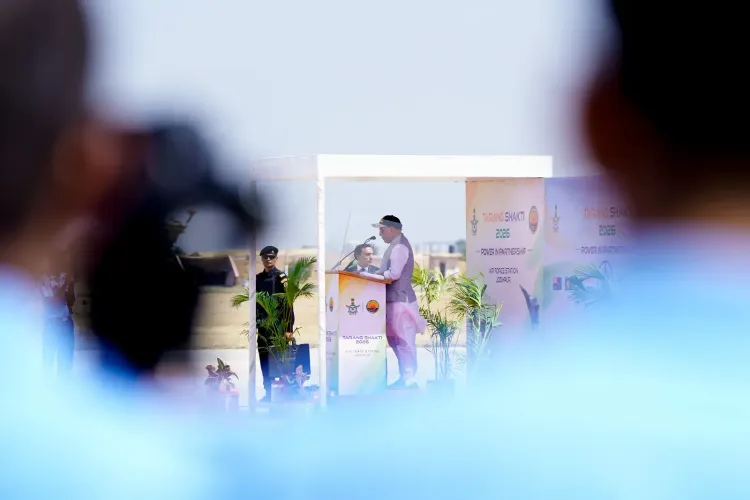
Defence Minister Rajnath Singh on Saturday, 10 October 2026, visited the airbase in Jodhpur to attend the Indian Air Force's multinational air combat exercise Tarang Shakti-2026, where he warned that the old global order was dissolving faster than a new one could take form — a signal, he said, that demands India maintain a high state of military alertness. Air Chief Marshal A.P. Singh was among the senior Indian Air Force officials present at the exercise.
On the Shifting World Order
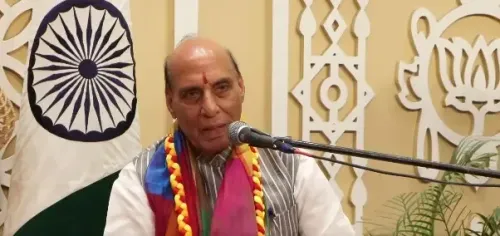
Addressing personnel from Indian and foreign military contingents at the exercise, Rajnath Singh said: "The world finds itself today facing a situation where the older established world order is fast disappearing, while the shape of the future world order is yet to emerge." He described this transitional moment as a volatile environment demanding constant vigilance. "India is monitoring developments in its region, along its borders and beyond," he added, signalling that New Delhi is keeping a close watch on the rapidly evolving geopolitical landscape.
Technology Redefining Modern Warfare
Singh stressed that emerging technologies had fundamentally altered the character of contemporary conflict. He pointed specifically to unmanned systems and drones as having transformed the speed, scale, and nature of military operations. "Artificial Intelligence is reshaping decision-making, electronic warfare requires absolute spectrum control, and long-range precision weapons have expanded the battlespace," he said. He argued that future military power would hinge less on the sheer number of platforms a nation possesses and more on "the speed of sensing, understanding, deciding and acting."
Atmanirbharta as National Policy
The Defence Minister reiterated India's commitment to self-reliance in defence manufacturing, calling it a strategic imperative rooted in a hard lesson of modern statecraft. "In times of crisis, no nation can sustain long-drawn-out wars unless it is capable of producing its own weapons and critical technologies," he said, adding that this realisation had led India to formally adopt Atmanirbharta — or self-reliance in defence — as national policy under the leadership of Prime Minister Narendra Modi.
Indigenous Platforms Take Centre Stage
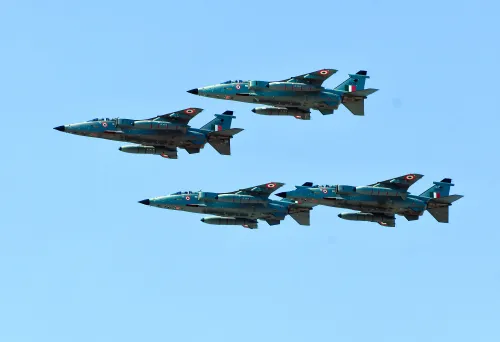
The aerial demonstrations at Jodhpur placed India's domestically developed platforms in the spotlight. The Light Combat Aircraft (LCA) Tejas performed high-altitude manoeuvres at approximately 5,000 metres, showcasing its operational agility. The Light Combat Helicopter (LCH) Prachand, commanded by Group Captain Anubhav Mahendra, also demonstrated its combat capabilities. Developed and manufactured in India under the 'Make in India' initiative, Prachand represents a key milestone in the country's indigenous defence ecosystem. The Advanced Light Helicopter (ALH) Dhruv was also among the platforms featured in the exercise.
What Tarang Shakti Signals
Tarang Shakti is designed to promote cooperation, interoperability, and strategic coordination among participating air forces. The exercise provides Indian and partner-nation personnel an opportunity to exchange operational experience and demonstrate capabilities in complex air combat scenarios. This edition notably coincides with a period of heightened regional security concerns and comes as India continues to expand its defence partnerships globally. The participation of indigenously developed platforms underlines the Indian Air Force's growing reliance on domestic technology as a cornerstone of its long-term modernisation strategy.
Point of View
Where electronic warfare and drone swarms have upended conventional advantage. The Atmanirbharta pitch, however, must be measured against execution: India's defence export targets have repeatedly undershot projections, and import dependency in critical sub-systems remains high. The indigenous platform showcase was compelling theatre; whether it translates into battlefield self-sufficiency is the harder question mainstream coverage tends to sidestep.
NationPress
10 Oct 2026
Frequently Asked Questions
What is Tarang Shakti-2026?
Tarang Shakti-2026 is a multinational air combat exercise hosted by the Indian Air Force, designed to promote interoperability, cooperation, and strategic coordination among participating nations' air forces. The 2026 edition was held at the Jodhpur airbase, featuring aerial demonstrations by Indian and foreign military contingents.
What did Rajnath Singh say about the world order at Tarang Shakti-2026?
Rajnath Singh said the older established world order is fast disappearing while the shape of a future world order is yet to emerge. He described this as a volatile environment demanding high military alertness, adding that India is closely monitoring developments along its borders and beyond.
Which indigenous platforms were showcased at Tarang Shakti-2026?
The Light Combat Aircraft (LCA) Tejas, the Light Combat Helicopter (LCH) Prachand, and the Advanced Light Helicopter (ALH) Dhruv were among the key indigenous platforms demonstrated. The Tejas performed high-altitude aerial manoeuvres at approximately 5,000 metres, while Prachand was commanded by Group Captain Anubhav Mahendra.
What is India's Atmanirbharta policy in defence?
Atmanirbharta — meaning self-reliance — is India's national policy of developing and manufacturing its own weapons and critical defence technologies. Rajnath Singh reiterated at Tarang Shakti-2026 that the policy was adopted after India recognised that no nation can sustain prolonged conflict without the ability to produce its own military equipment.
How does Tarang Shakti advance India's strategic interests?
The exercise provides a platform for India to demonstrate its air combat capabilities to partner nations and build operational interoperability. It also offers a stage for showcasing domestically developed platforms, reinforcing India's push for indigenous defence manufacturing and deepening military-to-military ties with foreign air forces.