Omar Abdullah flags IAS officer abuse, hits UT governance wall

Synopsis
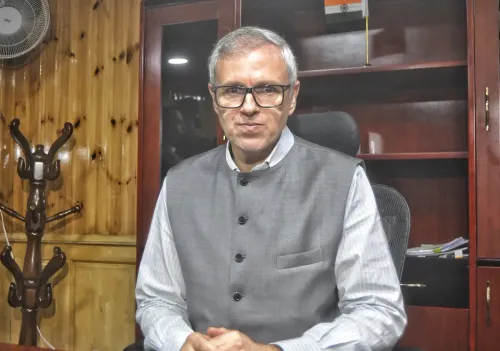
J&K Chief Minister Omar Abdullah publicly called out an IAS officer for abusing a junior JKAS officer, revealing that UT status bars his government from acting on IAS misconduct — placing the onus on central authorities and the Lieutenant Governor's office.
Key Takeaways
Omar Abdullah publicly condemned an IAS officer allegedly seen abusing a junior JKAS officer in a video.
Abdullah stated that had J&K been a state, the officer would have been attached to the General Administration Department pending inquiry.
Under the Jammu and Kashmir Reorganisation Act, 2019 , disciplinary control over IAS officers rests with the Lieutenant Governor and the Ministry of Home Affairs , not the elected Chief Minister.
The Chief Minister demanded that 'abusive, threatening behaviour is not brushed under the carpet' by authorities with control over IAS officers.
The incident highlights the structural governance gap created by J&K's Union Territory status, a recurring tension between Srinagar and New Delhi since 2019 .
A video of an IAS officer allegedly abusing a junior JKAS officer has drawn a sharp public rebuke from Jammu and Kashmir Chief Minister Omar Abdullah — and exposed, in a single post, the administrative fault-line that has defined J&K's governance since 2019.
The complaint Abdullah cannot act on alone
Abdullah was unambiguous about what he would have done in a different constitutional reality: 'Had J&K been a state, the IAS officer seen abusing a young JKAS officer would have been attached to the General Administration Department pending an inquiry into his conduct.' The GAD attachment — a standard administrative measure that sidelines an officer from active duty while misconduct is probed — is a routine tool of state governments. In a Union Territory, it is not Omar Abdullah's tool to wield over an IAS officer.
That is the nub of the problem. The Jammu and Kashmir Reorganisation Act, 2019, which bifurcated the former state into two Union Territories, transferred disciplinary control over All India Services officers — including the Indian Administrative Service (IAS) — from the elected government to the Lieutenant Governor and the Ministry of Home Affairs in New Delhi. The Chief Minister can speak. He cannot attach.
The 2019 fault-line, made visible
Post-reorganisation, this structural gap has surfaced repeatedly in the relationship between Srinagar and New Delhi. The elected government of J&K administers the territory, deploys its own Jammu and Kashmir Administrative Service (JKAS) officers, and sets policy priorities. But when an IAS officer — whose cadre answer to the centre — behaves badly, the Chief Minister is effectively a witness, not a disciplinary authority.
Abdullah's post makes this power asymmetry explicit in unusually direct language. He called on 'the authorities with control over the IAS officers to set the right example' and demanded that 'abusive, threatening behaviour is not brushed under the carpet.' That is a formal public demand directed at the Lieutenant Governor's office and the central government — not a routine administrative memo, but a political statement with institutional weight.
What the JKAS officer's humiliation reveals
The incident involves a junior officer from the JKAS — the territorial civil service that sits below the IAS in J&K's administrative hierarchy. JKAS officers work under IAS officers, and the power gradient between them is steep. An IAS officer's alleged abusive conduct toward a JKAS officer thus carries a dual charge: individual misconduct, and a broader pattern of institutional impunity that critics argue is harder to check precisely because IAS disciplinary authority sits in Delhi, not Srinagar.
The names of the officers involved have not been independently confirmed, and the specific details of the incident remain unverified. What is on the record is the Chief Minister's response — public, pointed, and aimed squarely upward.
Statehood, accountability, and the ask Abdullah is making
The subtext of Abdullah's post is one his party, the Jammu and Kashmir National Conference, has pressed since the reorganisation: that Union Territory status strips elected leaders of the accountability tools a democratic government needs. If an IAS officer can abuse a colleague and the Chief Minister's only recourse is a public tweet, the governance architecture is broken by design.
The ball is now squarely in the court of the Ministry of Home Affairs and the Lieutenant Governor's office. Whether a formal inquiry is ordered — and how fast — will signal whether central oversight of J&K's bureaucracy is a check on power or a shield for it.
Point of View
' he frames the governance deficit in concrete, procedural terms that are hard to dismiss as political rhetoric. The demand directed at central authorities also puts the Ministry of Home Affairs and the Lieutenant Governor's office on notice before a national audience, raising the political cost of inaction. This episode fits a consistent post-2019 pattern in which the elected J&K government uses specific incidents to document, publicly and on the record, the erosion of executive authority that UT status entails.
NationPress
16 Oct 2026
Frequently Asked Questions
Why can't Omar Abdullah take action against the IAS officer himself?
Under the Jammu and Kashmir Reorganisation Act, 2019, disciplinary control over IAS officers posted in J&K rests with the Lieutenant Governor and the central government's Ministry of Home Affairs, not the elected Chief Minister. This is a key difference from a full state, where the Chief Minister's government could attach or transfer an IAS officer directly.
What is the difference between IAS and JKAS officers?
IAS (Indian Administrative Service) officers belong to an All India Service and are allocated to J&K by the central government, while JKAS (Jammu and Kashmir Administrative Service) officers belong to the territory's own civil service. IAS officers generally hold senior positions, creating a hierarchical relationship in which JKAS officers work under them.
What does 'attached to GAD' mean in administrative terms?
A 'GAD attachment' means an officer is temporarily relieved of their substantive post and placed under the General Administration Department without any active assignment, effectively sidelining them pending an inquiry into alleged misconduct. It is a standard accountability measure used in state governments.
What changed for J&K's governance after the 2019 reorganisation?
The Jammu and Kashmir Reorganisation Act, 2019 converted the former state into two Union Territories and transferred control over All India Services officers to the Lieutenant Governor and the central government. This significantly reduced the elected government's authority over bureaucratic conduct, transfers, and discipline compared to the pre-2019 arrangement.
What action is Omar Abdullah asking for?
Abdullah is asking the authorities who hold disciplinary control over IAS officers — the Lieutenant Governor's office and the Ministry of Home Affairs — to initiate a formal inquiry into the officer's conduct and ensure the alleged abusive and threatening behaviour is not overlooked.