Kishan Reddy Hits Out at 'Regime Change' Rhetoric After Poll Losses
Synopsis
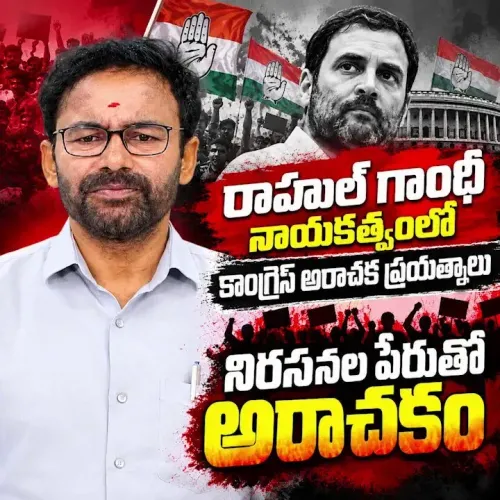
Union Coal Minister G. Kishan Reddy accused unspecified opposition figures of conspiring to spread anarchy under the guise of 'Regime Change' rhetoric after election losses, invoking PM Modi's principle that democratic power is won only through public mandate — not shortcuts.
Key Takeaways
Kishan Reddy , Union Minister of Coal and Mines and BJP Telangana president, posted the attack on October 16, 2026 .
He accused unnamed opposition leaders of using 'Regime Change' language to spread anarchy and seize power after electoral defeats.
Reddy directly cited PM Narendra Modi's position that power in a democracy must be earned by winning public hearts, not through shortcuts.
The post characterises the opposition's post-poll conduct as a 'hollow mentality' aimed at destroying the country rather than engaging in genuine reform.
The rhetoric fits a broader BJP pattern of delegitimising extra-parliamentary opposition movements by framing them as anti-democratic.
As BJP Telangana state president, Reddy's statement also carries significance for the party's ongoing political consolidation in a key southern state.
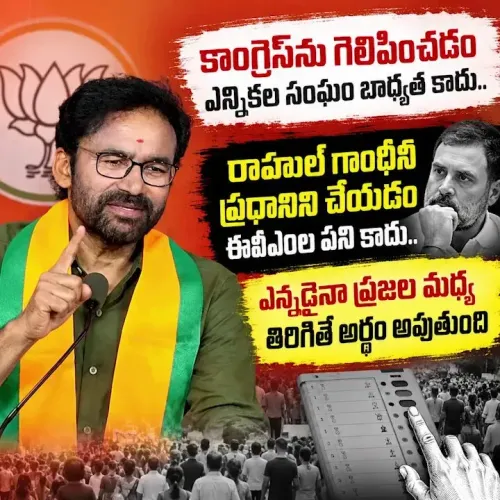
When the ballot box delivers a verdict, some leaders accept it — and some, argues Union Coal and Mines Minister G. Kishan Reddy, reach for the language of anarchy. On Friday, October 16, 2026, the BJP Telangana state president fired a sharp salvo on X, targeting opposition figures he accused of using 'Regime Change' rhetoric not to serve voters but to seize power by destabilising the country.
Posting in Hindi, Reddy wrote: 'जब जनता चुनावों में नकार देती है, तब कुछ बेलगाम और सिरफिरे नेताओं की हताशा अराजकता का रूप ले लेती है' — 'When the public rejects them in elections, the desperation of some unruly and reckless leaders takes the form of anarchy.' He charged that the use of terms like 'Regime Change' made it clear the real agenda was not electoral reform or youth welfare but a 'conspiracy to spread anarchy and grab power.'
Modi's Mandate Argument at the Centre
Reddy anchored his attack in a direct quote from Prime Minister Narendra Modi, whom he credited with stating 'with complete precision' that in a democracy, power is not earned through shortcuts — it is earned by winning the hearts of the people. That line has been a recurring motif in BJP political communication since 2014, used consistently to frame extra-parliamentary protest movements as illegitimate challenges to a popular mandate.
The invocation is deliberate. By placing Modi's words at the moral centre of his post, Reddy casts the ruling coalition as the defender of electoral process — and the unnamed opposition as its subverter.
The 'Regime Change' Charge in Indian Political Discourse
The phrase 'Regime Change' carries specific weight in current political rhetoric. Borrowed from international geopolitical vocabulary, its appearance in domestic opposition discourse has drawn recurring fire from the ruling party, which frames it as evidence of an agenda driven by foreign-influenced destabilisation rather than genuine democratic grievance.
Reddy's post fits a well-established pattern in Indian post-poll politics: after electoral defeats, the ruling party moves quickly to delegitimise opposition street movements by branding them as anti-democratic. His closing line was unambiguous — 'the public will give them a fitting reply' — signalling that the BJP intends to make this narrative a live issue heading into the next electoral cycle.
Telangana and the Stakes for BJP's Southern Push
As BJP Telangana president, Reddy has personal political skin in this game. Telangana remains one of the key southern states where the party has been working to expand its footprint, making post-poll narrative battles particularly consequential for the organisation's ground-level credibility.
His dual role — as a central cabinet minister and a state party chief — gives the statement a layered read: it is simultaneously a national ideological position and a local political signal to cadre that the party will not cede the narrative space to rivals licking their electoral wounds.
In Indian democracy's long argument about how power should and should not be won, the ruling party has now sharpened one side of that debate — and the opposition's response will set the next move on the board.
Point of View
The statement elevates a routine political dig into a principled position. The 'Regime Change' framing is particularly potent — it lets the ruling party paint domestic dissent with the brush of foreign interference without making a direct accusation. Watch whether opposition parties respond on the merits of the phrase or pivot to the underlying electoral grievances, because that choice will define the next round of this debate.
NationPress
16 Oct 2026
Frequently Asked Questions
What did G. Kishan Reddy say about 'Regime Change' in India?
Kishan Reddy accused certain opposition leaders of using the term 'Regime Change' not to push for electoral reform but to spread anarchy and seize power after losing elections, calling it a conspiracy against the country.
What did PM Modi say about democracy that Kishan Reddy quoted?
Reddy cited PM Narendra Modi's stated principle that in a democracy, political power is not obtained through shortcuts but by winning the hearts of the people through genuine public support.
Who is G. Kishan Reddy?
G. Kishan Reddy is the Union Minister of Coal and Mines in the Indian central government and also serves as the BJP president for Telangana state.
Why is the term 'Regime Change' controversial in Indian politics?
The phrase, borrowed from international geopolitical discourse, has been criticised by the ruling BJP as evidence of a foreign-influenced agenda aimed at destabilising India rather than engaging through legitimate democratic processes.
What is the BJP's position on opposition protests after election losses?
The BJP has consistently framed post-election opposition street movements as extra-parliamentary and illegitimate, arguing that the proper path to power in a democracy is through winning elections and public mandates.