What are the Achievements of the MahaYuti Government in Its First Year?
Click to start listening
Synopsis
As Maharashtra's MahaYuti government celebrates its first year, it pursues ambitious economic goals amid political challenges. Major infrastructure projects are underway, while controversies over reservation policies and coalition dynamics persist. Discover the government's key initiatives and the balancing act it must perform to fulfill its promises.
Key Takeaways
- Maharashtra aims for a trillion-dollar economy by 2030.
- Major infrastructure projects are being fast-tracked.
- Healthcare coverage expanded to 2,399 treatments.
- Political challenges include Maratha quota agitation and land deal controversies.
- Fiscal constraints require careful management of resources.
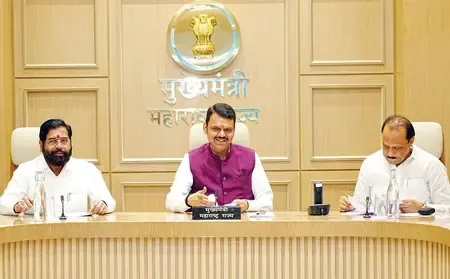
Mumbai, Dec 5 (NationPress) As the state aims to transform Maharashtra into a trillion-dollar economy by 2030, the MahaYuti government, led by Devendra Fadnavis, marks its first anniversary in office amid ongoing controversies regarding reservation policies and corruption claims. This year has been characterized by a vigorous drive towards rapid development, economic advancement, and swift administrative actions, all while navigating a politically unstable coalition environment and social pressures.
The administration has placed significant emphasis on accelerating urban and state infrastructure projects. Chief Minister Fadnavis has consistently articulated a vision centered on a decisive action framework and a commitment to effective implementation.
The Infrastructure War Room has been pivotal in resolving delays and enforcing strict timelines on longstanding projects. The government also introduced its Viksit Maharashtra 2047 vision document, aiming for a five trillion-dollar economy and establishing the state as the premier investment hub in the nation.
Efforts to enhance the ease of doing business have attracted global investments, with several policy reforms enacted across various sectors.
The cabinet sanctioned a government guarantee for a Rs 2,000 crore HUDCO loan for the Maharashtra State Road Development Corporation, facilitating land acquisition for the Virar-Alibaug Multi-Modal Corridor.
As the Navi Mumbai International Airport prepares to launch on December 25, plans for a proposed Third Mumbai have been solidified, featuring specialized clusters like an Edu City with international university campuses and an Innovation City.
The state is also counting on the Vadhavan port project, which requires a Rs 76,000 crore investment, with the Chief Minister asserting it will rank among the world’s top ten ports upon completion.
To bolster regional connectivity, an additional Rs 491 crore was allocated for converting the Nagpur-Nagbhid narrow-gauge line into broad gauge, enhancing links in Vidarbha.
In healthcare, the coverage of state health schemes has been expanded to include 2,399 treatments across 38 specialties. Financial assistance was approved for nine major diseases including heart and liver transplants, with aid ranging from Rs 9.5 lakh to Rs 22 lakh. Additionally, a one-time regularization for contract staff under the National Health Mission who have served for ten years was sanctioned. The government also established an Urban Health Commissionerate to enhance healthcare management in urban areas.
In terms of administrative reforms, amendments to the Maharashtra Land Revenue Code, 1966 were made, which included revisions to non-agricultural tax and conversion charges. The government has granted full legal validity to Digital 7/12 and other critical land records, supporting e-governance initiatives. New District and Additional Sessions Courts were approved in places like Ghodnadi-Shirur to strengthen the judicial framework.
The fisheries sector has been prioritized equally with agriculture, enabling it to receive necessary infrastructure support and concessions. The government has also moved to dissolve the state-owned asset reconstruction firm Maha ARC Ltd after the Reserve Bank of India declined to issue it an operational license.
Despite a strong mandate in the upcoming 2024 assembly elections, the BJP-Shiv Sena-NCP coalition finds itself in a position requiring a careful balancing act. The government has faced scrutiny regarding cooperation among coalition partners, while the Opposition remains consistently confrontational.
Controversies surrounding land deals, particularly Pune land transactions, and law and order issues stemming from the Beed sarpanch murder case, have kept the government on the defensive. The Chief Minister's announcement of performance audits for ministers signals an intention to bolster accountability.
One of the most pressing challenges has been the Maratha quota agitation, led by Manoj Jarange, alongside resistance from segments of the OBC community. This has necessitated the formation of cabinet sub-committees to address these demands, showcasing the delicate social dynamics at play.
Criticism has also arisen over delays in delivering on certain campaign promises, including a comprehensive state-wide farm loan waiver and increased monthly assistance under schemes like the Ladki Bahin Yojana. While striving to fulfill pre-election commitments, the government must navigate a challenging fiscal landscape, with public debt exceeding Rs 9.30 lakh crore, a revenue deficit of Rs 45,891 crore, and a fiscal deficit of Rs 1,36,325 crore.
(Sanjay Jog can be reached at sanjay.j@ians.in)
Point of View
The MahaYuti government's first year in office represents a complex interplay of ambitious economic goals and political turbulence. While significant strides in infrastructure and health have been made, the challenges related to coalition governance and social issues cannot be overlooked. A balanced approach is essential for sustained progress.
NationPress
05/12/2025
Frequently Asked Questions
What are the major infrastructure projects initiated by the MahaYuti government?
The MahaYuti government has fast-tracked several key infrastructure projects, including the Virar-Alibaug Multi-Modal Corridor and the Navi Mumbai International Airport, set to open on December 25.
How has the government addressed healthcare improvements?
The government expanded coverage for state health schemes to 2,399 treatments across 38 specialties and introduced financial assistance for critical diseases.
What challenges does the MahaYuti government face currently?
The government is navigating political controversies, including land deal issues and the Maratha quota agitation, along with fiscal constraints.
What are the government's economic goals for the future?
The government aims to transform Maharashtra into a trillion-dollar economy by 2030, with an overarching vision outlined in the Viksit Maharashtra 2047 document.
How is the government handling coalition dynamics?
The MahaYuti government is working to maintain cooperation among coalition partners while addressing public concerns and opposition scrutiny.