Owaisi Accuses Akhilesh Yadav of Being Under BJP's Control
Synopsis
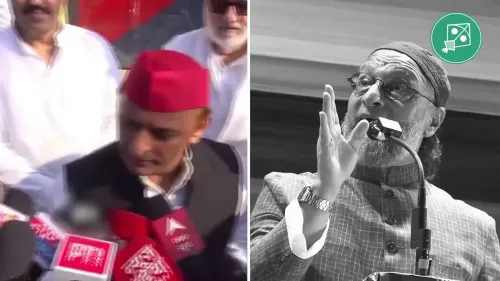
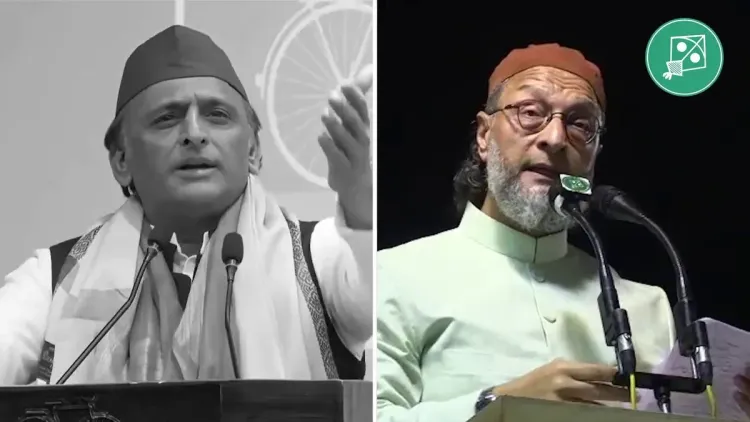
AIMIM president Asaduddin Owaisi sharply accused Samajwadi Party chief Akhilesh Yadav of being controlled by the BJP, using a pointed Hindi puppet metaphor in a November 15 post, intensifying opposition tensions ahead of the 2027 Uttar Pradesh assembly elections.
Key Takeaways
On November 15, 2026 , Asaduddin Owaisi publicly accused Akhilesh Yadav of being under BJP 's control.
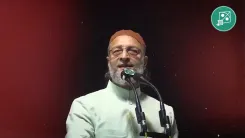
Owaisi used a Hindi dor (puppet-string) metaphor: 'Our strings are in Allah's hands, but Akhilesh's strings are certainly in BJP's hands.' The post was accompanied by a video, amplifying the specific charge against Akhilesh Yadav.
AIMIM and SP have competed separately in UP since at least the 2022 assembly elections , with mutual vote-splitting accusations.
The exchange raises stakes around potential seat-sharing talks ahead of the 2027 Uttar Pradesh assembly elections .
The attack signals to minority voters that AIMIM views SP as an unreliable opposition partner.
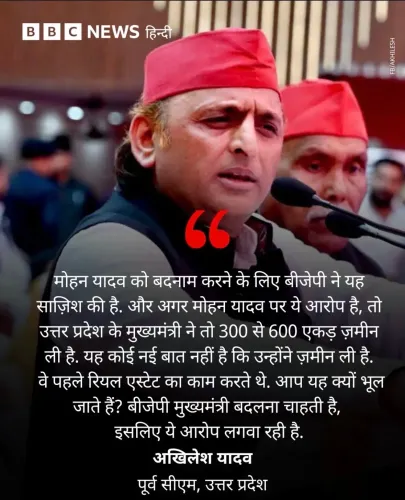
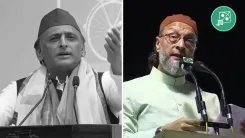
AIMIM president Asaduddin Owaisi threw a sharp dart at Samajwadi Party chief Akhilesh Yadav on Sunday, November 15, 2026, accusing him — in a pointed, rhyming jab — of dancing to the BJP's tune even as he positions himself as the principal opposition voice in Uttar Pradesh.
Posting on X, Owaisi wrote in Hindi: 'हमारी डोर अल्लाह के हाथ में है, लेकिन @yadavakhilesh की डोर ज़रूर @BJP4India के हाथ में है' — 'Our strings are in Allah's hands, but Akhilesh Yadav's strings are certainly in BJP's hands.' The play on the word dor (string, as in a puppet's string) is deliberate and biting.
A Rivalry That Never Fully Went Underground
AIMIM and the Samajwadi Party have long competed — sometimes bitterly — for overlapping constituencies of Muslim voters and marginalised communities across Uttar Pradesh. In the 2022 UP assembly elections, the two parties fielded separate candidates in several seats, drawing mutual accusations of splitting the anti-BJP vote. That wound, it appears, has not healed.
Owaisi's post is paired with a video — the specifics of which could not be independently verified — that presumably supplies the visual evidence he is pointing to. The charge itself, however, is familiar: that Akhilesh Yadav's opposition credentials are performative, and that the SP ultimately serves as a pressure valve that benefits the ruling party.
Why This Lands Hard With the 2027 UP Polls on the Horizon
With the 2027 Uttar Pradesh assembly elections beginning to cast a long shadow over state politics, every statement about alliances — or the absence of them — carries real electoral weight. The opposition arithmetic in UP is fragile: SP, AIMIM, Congress and smaller formations each control fragments of a vote share that, if unified, could seriously challenge the BJP. When Owaisi publicly labels Akhilesh a BJP proxy, he is not merely trading insults — he is signalling to Muslim and minority voters that SP is not a safe parking space for their mandate.
Rhetoric like this sharpens the pressure on both parties to clarify where they stand on any potential pre-poll seat-sharing arrangement. The 2027 contest will likely hinge on whether that consolidation happens — or whether competitive distrust keeps the opposition fragmented and BJP's path to a third consecutive term in Lucknow wide open.
Owaisi has built AIMIM's national identity around precisely this kind of confrontational clarity. Whether voters in UP find it persuasive — or see it as one more obstacle to unity — may shape the opening moves of the state's campaign season.
Point of View
AIMIM stakes a claim to being the more authentic opposition voice for Muslim voters in UP, a constituency both parties urgently need. The move also complicates any future alliance arithmetic: the louder AIMIM's public distrust of SP, the harder it becomes for either party to sign a credible joint ticket. With 2027 approaching, this rhetoric could prove either a shrewd differentiator or a self-defeating wedge that keeps the anti-BJP vote fractured.
NationPress
15 Nov 2026
Frequently Asked Questions
What did Owaisi say about Akhilesh Yadav on November 15 2026?
Owaisi posted on X that while his own strings are in Allah's hands, Akhilesh Yadav's strings are 'certainly in BJP's hands' — accusing the SP chief of being controlled by the ruling party.
Why does Owaisi criticise Akhilesh Yadav?
Owaisi and AIMIM have long accused Samajwadi Party of splitting opposition votes while ultimately benefiting BJP; the two parties have contested separately in Uttar Pradesh, including in the 2022 state elections.
What is AIMIM's presence in Uttar Pradesh?
AIMIM has fielded candidates in several UP assembly constituencies, particularly targeting seats with significant Muslim populations, though it has yet to win a large bloc of UP seats.
How does this affect the 2027 UP election opposition alliance?
Public accusations of this kind make formal seat-sharing between AIMIM and SP more difficult, potentially keeping the opposition fragmented and easing BJP's path to retaining power in Uttar Pradesh.
Is there evidence that Akhilesh Yadav is linked to BJP?
Owaisi's claim is a political allegation; no formal or verified link between Akhilesh Yadav's Samajwadi Party and BJP has been established. SP positions itself as a primary opposition party to BJP in UP.