Owaisi backs Chandrashekhar Azad for UP CM, cites rule of law
Synopsis
AIMIM president Asaduddin Owaisi publicly backed Bhim Army chief Chandrashekhar Azad as a future Uttar Pradesh Chief Minister on 15 November 2026, arguing his leadership would bring 'Rule by Law' over 'Rule by Gun' — a pointed jab at the state's incumbent government.
Key Takeaways
AIMIM president Asaduddin Owaisi posted on X on 15 November 2026 backing Chandrashekhar Azad as a future UP Chief Minister.
Owaisi framed the endorsement as a choice between 'Rule by Gun' and 'Rule by Law' in Uttar Pradesh .
Bhim Army , founded in 2015 , has built its base among Dalit communities in UP, particularly in the state's western districts.
UP sends 80 MPs to the Lok Sabha, making it the most electorally significant state in India.
The post signals a possible Dalit-Muslim political alignment ahead of the next UP assembly election cycle.
No formal alliance announcement has been made; this remains a public statement of solidarity.
A sharp political signal landed on Sunday, 15 November 2026, when AIMIM president Asaduddin Owaisi threw his public weight behind Bhim Army chief Chandrashekhar Azad as a future Chief Minister of Uttar Pradesh — framing the pitch not in caste arithmetic but in a stark contrast between guns and law.
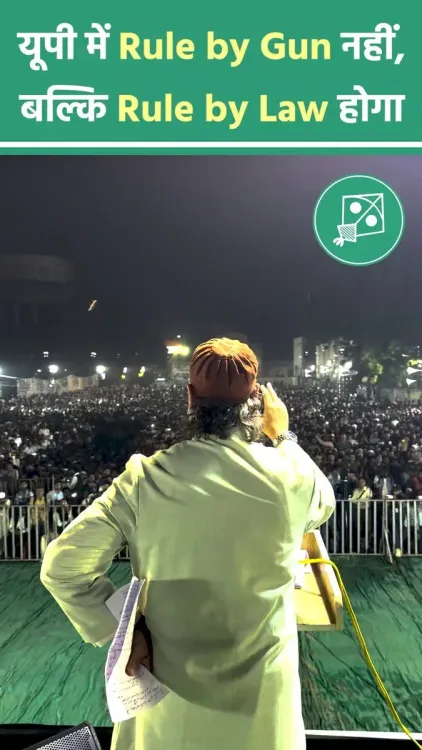
Posting on X, Owaisi wrote: 'जब @BhimArmyChief मुख्यमंत्री बनेंगे, तो यूपी में Rule by Gun नहीं, बल्कि Rule by Law होगा' — 'When Bhim Army Chief becomes Chief Minister, UP will have Rule by Law, not Rule by Gun.' The post accompanied a video, the contents of which could not be independently verified, but the message itself was unambiguous: a sitting Lok Sabha MP was publicly endorsing a Dalit activist-leader's claim to the country's most electorally consequential state.
Who is Chandrashekhar Azad — and why does UP matter?
Chandrashekhar Azad founded the Bhim Army in 2015 in western Uttar Pradesh, anchoring it in Dalit rights, access to education, and resistance to caste violence. Over a decade, the organisation evolved from local social mobilisation into an explicitly political vehicle, with Azad positioning himself as a credible electoral challenger in a state that sends 80 MPs to the Lok Sabha — more than any other.
Uttar Pradesh carries roughly 21 percent Scheduled Caste population, concentrated heavily in regions where Bhim Army built its grassroots presence. Add a substantial Muslim electorate — historically contested between multiple parties — and the alignment Owaisi is gesturing at represents a potential electoral coalition that UP's ruling establishment would have every reason to watch closely.
'Rule by Gun' — what the phrase targets
The 'Rule by Gun' formulation is a pointed rhetorical choice. Opposition voices in UP have for years raised concerns about alleged encounter killings and police excess under the current state government. Owaisi's framing — placing 'Rule by Law' as the alternative — plants the law-and-order debate squarely at the centre of the pitch for why Azad's leadership would represent a rupture, not continuity.
It is a familiar pattern in Indian state politics: leaders representing Muslim and Dalit constituencies signalling common ground ahead of an assembly cycle, with governance narratives doing the work that overt alliance announcements rarely survive. Whether Sunday's post hardens into an electoral arrangement, or remains a statement of solidarity, is now the question every UP political watcher will be asking.
Owaisi has been a consistent voice on minority rights and state accountability from his Hyderabad constituency, but his interventions in UP politics carry particular weight given AIMIM's attempts to build a base in the state. A public endorsement of Azad — a figure who commands loyalty among Jatav and other Dalit communities — signals that the opposition's search for a credible CM-face in Lucknow is very much alive.
Point of View
And Owaisi grafting it onto Azad's candidacy attempts to give that narrative a face. If the alignment gains traction, it would reshape the multi-cornered contest for the state's roughly 21 percent Dalit and sizable Muslim electorate. The key variable is whether Bhim Army's street-level mobilisation and AIMIM's urban Muslim presence can translate symbolic solidarity into coordinated votes.
NationPress
15 Nov 2026
Frequently Asked Questions
What did Owaisi say about Chandrashekhar Azad becoming UP CM?
On 15 November 2026, Owaisi posted on X that when Bhim Army chief Chandrashekhar Azad becomes Chief Minister of Uttar Pradesh, the state will have 'Rule by Law, not Rule by Gun' — a direct critique of the current state government's law-and-order record.
Who is Chandrashekhar Azad of Bhim Army?
Chandrashekhar Azad is the founder and chief of the Bhim Army, a Dalit rights organisation he established in 2015 in Uttar Pradesh. He has evolved into a political leader advocating for Scheduled Caste communities and social justice across northern India.
Is there a formal AIMIM and Bhim Army alliance for UP elections?
As of this post on 15 November 2026, no formal electoral alliance has been announced. Owaisi's statement is a public expression of support for Azad's leadership, which political observers are watching as a possible signal of future coordination.
What does 'Rule by Gun' mean in UP politics?
'Rule by Gun' is an opposition phrase referencing allegations of extrajudicial encounter killings and police high-handedness in Uttar Pradesh under the incumbent state government. Owaisi used it in contrast to 'Rule by Law' to frame Azad's candidacy as a governance alternative.
Why is Uttar Pradesh politically important for AIMIM and Bhim Army?
Uttar Pradesh is India's most populous state and sends 80 MPs to the Lok Sabha. It has a Scheduled Caste population of roughly 21 percent and a substantial Muslim electorate, making it a critical arena for both AIMIM, which has sought to expand beyond Hyderabad, and Bhim Army, which has its strongest grassroots presence there.