Anurag Thakur: 50 Cr Freed from Poverty, Naxalism Ended
Synopsis
BJP MP Anurag Thakur on Janjatiya Gaurav Divas declared lifting 50 crore from severe poverty and ending Naxalite-Maoist terror India's two greatest post-Independence achievements, calling both deeply connected to the lives of tribal communities.
Key Takeaways
Anurag Thakur posted on 15 November 2026 , calling two achievements — poverty reduction and LWE elimination — India's greatest since Independence.
He cited 50 crore people freed from severe poverty, a figure aligned with NITI Aayog Multidimensional Poverty Index trend data.
Both achievements are explicitly linked to the welfare of Scheduled Tribe communities in LWE-affected central and eastern India.
Ministry of Home Affairs data has consistently shown declining LWE violence and a shrinking 'red corridor' over the past decade.
Thakur's framing goes beyond official government language, asserting outright 'elimination' of Naxalism rather than 'containment.' The post appeared on Janjatiya Gaurav Divas , amplifying its political resonance ahead of state elections in tribal-heavy states.
Two milestones that BJP MP Anurag Thakur calls the greatest achievements of independent India — lifting 50 crore people out of severe poverty and ending Naxalite-Maoist terror — are, he argues, inseparable from the story of India's tribal communities.
Posting on Sunday, 15 November 2026, Thakur wrote: '50 करोड़ लोगों को भीषण गरीबी से मुक्ति और देश से नक्सलवाद और माओवादी आतंक का खात्मा' — 'Freeing 50 crore people from dire poverty and eliminating Naxalism and Maoist terror from the country' — before declaring both achievements among the largest since Independence, deeply tied to the welfare of tribal brothers and sisters.
Tribal heartlands at the centre of both claims
The two achievements Thakur cites are not coincidental pairing. The districts most scarred by Left Wing Extremism (LWE) — a belt running through Chhattisgarh, Jharkhand, Odisha, Maharashtra and Andhra Pradesh — have historically been home to India's densest Scheduled Tribe populations. For decades, these communities lived at the intersection of state neglect, Maoist mobilisation, and counter-insurgency operations, bearing the heaviest human cost of the conflict on all sides.
The BJP-led government has consistently framed its dual-track approach — escalated security operations alongside accelerated development spending — as a programme of tribal emancipation rather than mere law enforcement. That framing is precisely what Thakur's post distils into a single, sharp political statement on Janjatiya Gaurav Divas, the national day commemorating tribal pride.
The security arc: declining LWE violence
Successive Ministry of Home Affairs annual reports have recorded a sustained decline in LWE-related incidents over the past decade — fewer casualties among civilians, security forces, and cadres alike, and a shrinking geographical footprint of active Maoist presence. What was once a 'red corridor' spanning scores of districts has, according to official data, contracted sharply, with several districts removed from the LWE-affected list entirely.
Thakur's claim of outright 'elimination' goes further than the government's own formal language, which typically speaks of 'significant weakening' or 'containment.' That distinction matters — isolated Maoist activity has continued to be reported — but the directional trend in official data broadly supports the narrative of a movement in steep decline.
The poverty number and what drives it
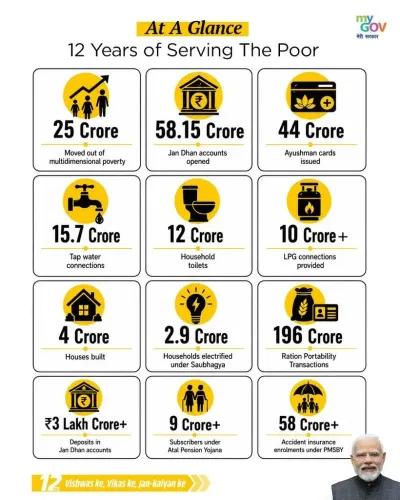
The figure of 50 crore people freed from severe poverty aligns with the trajectory of NITI Aayog's Multidimensional Poverty Index releases, which have shown dramatic reductions in deprivation across states, with tribal districts among the fastest-improving. The MPI tracks poverty not just by income but by access to nutrition, sanitation, clean fuel, housing, and schooling — dimensions where tribal households have historically scored worst.
It is precisely in those districts — where roads arrived alongside Pradhan Mantri Awas Yojana homes, Jal Jeevan Mission taps, and Jan Dhan accounts — that security conditions also improved most visibly, reinforcing the government's argument that development and peace are two sides of the same coin.
A political milestone framed for the history books
By placing these two achievements in the same breath and explicitly ranking them among post-Independence India's greatest, Thakur is doing something deliberate: elevating what are largely administrative and security outcomes into a civilisational narrative about justice for tribal India. It is an argument the BJP has sharpened ahead of state elections in LWE-sensitive states and one that places tribal welfare — long associated with the opposition's political identity — firmly inside the ruling party's claim to legacy.
The next NITI Aayog MPI update and the Home Ministry's annual LWE report will be the data points that either reinforce or complicate that claim.
Point of View
Fusing two of the BJP government's signature narratives — welfare delivery and security dominance — into a single tribal-justice frame. By ranking these outcomes above other post-Independence milestones, the BJP is contesting ownership of tribal identity politics, a space traditionally held by regional and left-leaning parties. The claim of outright Naxalism 'elimination' is bolder than the government's own operational language and will invite scrutiny from opposition parties and human-rights groups active in LWE-belt states. With NITI Aayog's next MPI release and the Home Ministry's annual LWE report both pending, the data battlefield for this narrative is about to become considerably more contested.
NationPress
15 Nov 2026
Frequently Asked Questions
What did Anurag Thakur say about 50 crore people and poverty?
Thakur claimed that freeing 50 crore people from severe poverty is one of India's greatest achievements since Independence, and he linked this directly to improvement in the lives of tribal communities living in historically underserved districts.
Has Naxalism been fully eliminated in India?
Official Ministry of Home Affairs data shows a significant and sustained decline in Left Wing Extremism incidents and a shrinking geographical footprint, but the government's own formal language typically uses 'weakening' or 'containment' rather than complete elimination. Isolated incidents have continued to be reported.
What is Janjatiya Gaurav Divas and why is it significant?
Janjatiya Gaurav Divas is observed on 15 November every year to honour the contributions and culture of India's tribal communities. The date marks the birth anniversary of tribal icon Birsa Munda and was instituted by the central government to give formal national recognition to tribal heritage.
What is the NITI Aayog Multidimensional Poverty Index?
The NITI Aayog Multidimensional Poverty Index (MPI) measures poverty across multiple dimensions including nutrition, health, education, sanitation, and housing — not just income. Successive MPI releases have shown sharp reductions in poverty across India, with tribal districts recording some of the fastest improvements.
Which states were most affected by Naxalism in India?
The Left Wing Extremism 'red corridor' historically covered tribal-dominated districts in Chhattisgarh, Jharkhand, Odisha, Maharashtra , and Andhra Pradesh . These states have also been the primary focus of both security operations and government development schemes targeting LWE-affected areas.