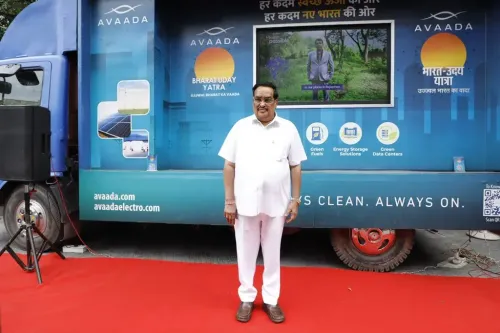
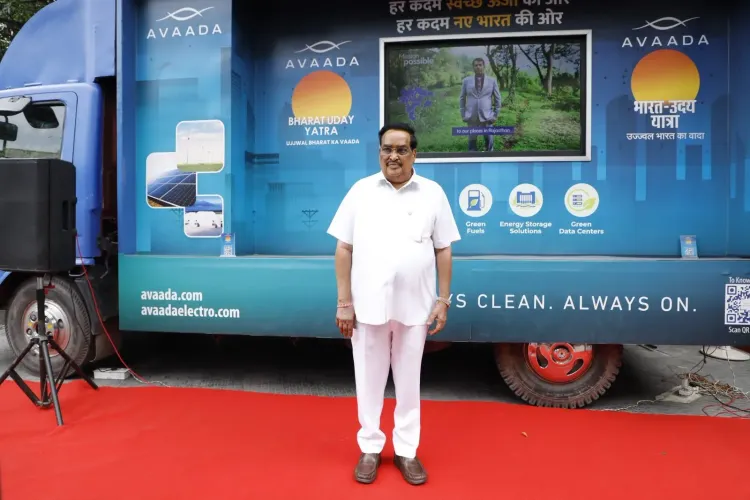
Jal Shakti Minister Paatil joins Awada Bharat Uday Yatra event
Synopsis
Union Jal Shakti Minister C. R. Paatil joined the Awada Bharat Uday Yatra on 16 June 2026, calling clean energy the foundation of a self-reliant India and linking renewable energy expansion to the Viksit Bharat 2047 vision under PM Modi's leadership.
Key Takeaways
Paatil , Union Jal Shakti Minister, participated in a special programme of the Awada Bharat Uday Yatra on 16 June 2026 .
He reaffirmed India's commitment to clean energy, green development, and Atmanirbhar Bharat under PM Modi's leadership.
The minister linked renewable energy and green technology directly to the Viksit Bharat 2047 vision of a developed India by the centenary of independence.
India's Panchamrit strategy targets 500 GW of non-fossil fuel capacity by 2030 and net-zero emissions by 2070 .
The event reflects a broader BJP strategy of carrying the Viksit Bharat narrative across multiple ministerial portfolios, not just energy or environment.
Union Jal Shakti Minister C. R. Paatil participated in a special programme of the 'Awada Bharat Uday Yatra' on Tuesday, 16 June 2026, using the occasion to reaffirm the government's commitment to clean energy, green development, and self-reliance as pillars of India's future.
Context
Paatil shared his participation on X, writing in Hindi that India is 'स्वच्छ ऊर्जा, हरित विकास और आत्मनिर्भरता के नए युग की ओर निरंतर अग्रसर है' — ('steadily advancing towards a new era of clean energy, green development, and self-reliance'). He credited the 'visionary leadership' of Prime Minister Narendra Modi for steering this direction. The post was accompanied by four images from the event.
The minister described clean energy not merely as a tool for environmental protection but as the 'strong foundation of a prosperous, secure, and self-reliant India for future generations.' His remarks framed renewable energy and green technology as central to the Viksit Bharat 2047 vision — the government's overarching goal of making India a fully developed nation by the centenary of its independence.
Policy Backdrop
The Viksit Bharat 2047 framework has become the organising principle behind a wide range of central government programmes, weaving together infrastructure, technology, and energy security into a single national narrative. Renewable energy sits at its core: at COP26 in Glasgow in 2021, India committed to the Panchamrit strategy, which includes achieving 500 GW of non-fossil fuel electricity capacity by 2030 and reaching net-zero emissions by 2070.
The Atmanirbhar Bharat ('self-reliant India') framework, launched in 2020, has since been extended to the energy sector, with domestic manufacturing of solar panels, wind turbines, and green hydrogen technologies positioned as both an economic and a strategic priority. Paatil's remarks at the Awada Bharat Uday Yatra echo this integration of green growth with national self-sufficiency.
Stakeholders and Impact
India's renewable energy sector — spanning solar, wind, and emerging green hydrogen — stands as a direct beneficiary of sustained political messaging at this level. Consistent ministerial endorsement signals policy continuity to domestic and international investors eyeing India's clean energy transition. For ordinary citizens, the framing connects household energy access and affordability to the larger goal of reducing fossil fuel import dependence.
The event, described as part of the Awada Bharat Uday Yatra, appears designed to build grassroots awareness around the government's development agenda. Senior ministers participating in such programmes lend institutional weight to what are otherwise public outreach exercises.
What's Next
Observers will watch whether the government's renewable capacity targets receive additional budgetary support in the upcoming Union Budget cycle, and how India positions itself at the next Conference of Parties (COP) summit. Paatil's participation underscores that the clean energy message is being carried across ministerial portfolios — not confined to the power or environment ministries alone — as the 2047 deadline draws politically closer.
Point of View
Ensuring the Viksit Bharat 2047 narrative is not siloed within any single ministry. By invoking clean energy and Atmanirbhar Bharat in the same breath, the government continues to fuse climate ambition with economic nationalism — a framing that plays well both domestically and in multilateral forums. The choice of a Jal Shakti minister to amplify a green energy message also signals an attempt to connect water security and energy transition as interlinked development challenges. As the 2047 deadline becomes a more tangible political horizon, expect this cross-portfolio messaging to intensify ahead of state and general election cycles.
NationPress
19 Sept 2026
Frequently Asked Questions
What is the Awada Bharat Uday Yatra?
The Awada Bharat Uday Yatra is a public outreach programme focused on India's development agenda, including clean energy and self-reliance goals. Senior ministers like C. R. Paatil have participated in its special events to amplify the government's Viksit Bharat 2047 vision.
What is Viksit Bharat 2047?
Viksit Bharat 2047 is the Indian government's official vision to make India a fully developed nation by 2047, the centenary of its independence. It encompasses goals across infrastructure, technology, energy, and economic self-reliance.
What did C. R. Paatil say about clean energy?
Paatil said clean energy is not merely a means of environmental protection but the 'strong foundation of a prosperous, secure, and self-reliant India for future generations.' He made these remarks at the Awada Bharat Uday Yatra on 16 June 2026.
What is India's renewable energy target by 2030?
Under the Panchamrit strategy announced at COP26 in Glasgow in 2021, India has committed to achieving 500 GW of non-fossil fuel electricity capacity by 2030 and reaching net-zero emissions by 2070.
What is the Atmanirbhar Bharat initiative?
Atmanirbhar Bharat, meaning 'self-reliant India,' is a framework launched in 2020 under Prime Minister Narendra Modi to boost domestic manufacturing and reduce import dependence across sectors, including renewable energy and green technology.