Pinarayi Vijayan accuses Congress of embracing Hindutva
Synopsis
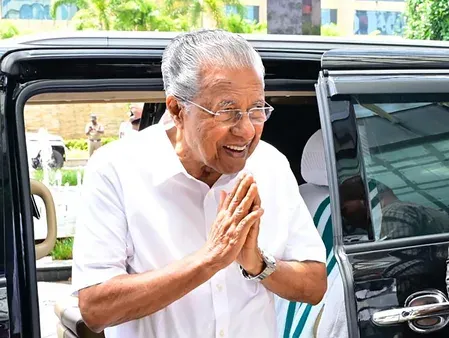
Kerala Chief Minister Pinarayi Vijayan on Independence Day 2026 accused the Congress party of abandoning its secular legacy by singing the full Vande Mataram at AICC headquarters and Congress-ruled states, calling it a capitulation to Sangh Parivar ideology that weakens secular opposition unity.
Key Takeaways
Kerala CM Pinarayi Vijayan posted the accusation on 15 August 2026 , Independence Day.
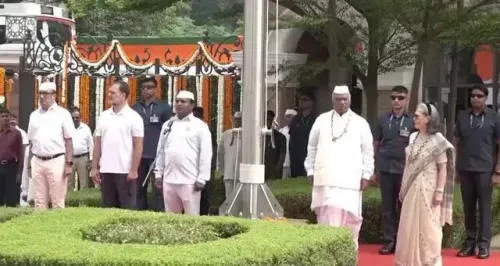
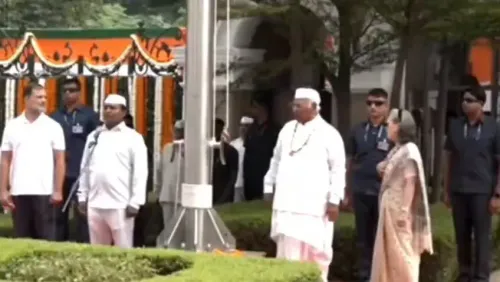
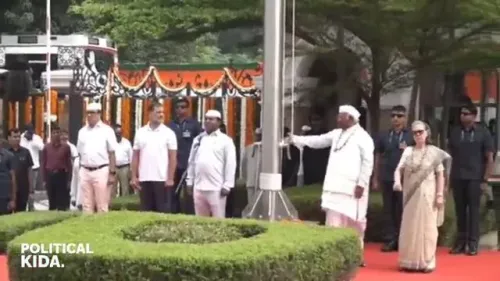
He alleged the full version of Vande Mataram was sung at the AICC headquarters and in Congress-ruled states , despite no legal obligation.
The Congress had resolved as early as 1937 to sing only the first two stanzas to accommodate minority sensitivities.
Vijayan described the move as 'capitulation to the Sangh Parivar ' and an 'ideological convergence' with RSS -backed Hindutva.
The criticism sharpens a decades-old CPI(M) charge of Congress practising 'soft Hindutva', now framed around the fragility of secular opposition unity.
On Independence Day, 15 August 2026, Kerala Chief Minister Pinarayi Vijayan launched a pointed ideological broadside — not at the ruling BJP, but at the Congress, accusing India's oldest opposition party of quietly abandoning its secular foundations and drifting toward the very Hindutva politics it claims to oppose.
The Vande Mataram flashpoint
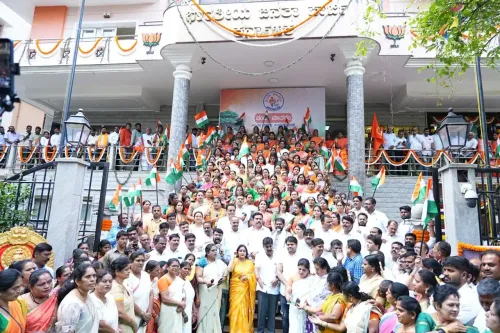
The trigger is specific: the full version of Vande Mataram was sung at Independence Day functions, including at the All India Congress Committee (AICC) headquarters and in Congress-governed states. Vijayan notes there is 'no legal obligation' to do so — a pointed reference to a long-standing convention. The Indian National Congress, as far back as 1937, resolved to sing only the first two stanzas of the song at its sessions, a deliberate accommodation of minority sensitivities. The Constituent Assembly adopted Vande Mataram as the national song in 1950 without mandating a full rendition for official use. Departing from that convention, Vijayan argues, is not a neutral cultural choice — it is an ideological signal.
CPI(M)'s decades-old charge, sharpened for 2026
This is not the first time the Communist Party of India (Marxist) has accused Congress of practising 'soft Hindutva'. The charge has surfaced repeatedly since the 1980s, each time national symbols become sites of cultural contestation. What gives the 2026 iteration its edge is the political context: opposition unity against the BJP and its ideological parent, the Rashtriya Swayamsevak Sangh (RSS), is an active and fragile project. Vijayan does not mince words — he calls Congress's move a 'capitulation to the Sangh Parivar', the umbrella of RSS-affiliated groups including the BJP, VHP, and Bajrang Dal.
Why the timing cuts deep
Independence Day is precisely the kind of moment when symbols carry outsized weight — and when departures from convention are hardest to explain away as accidental. Vijayan's framing is deliberate: if secular forces cannot hold the line on their own historical positions, he argues, the 'united struggle against communalism' loses its coherence. The accusation lands as a direct challenge to Congress's identity as the anchor of secular opposition politics in India.
Point of View
Specific act (the full Vande Mataram rendition) rather than vague rhetoric, he makes it harder for Congress to dismiss. The move also serves a domestic Kerala audience: CPI(M) has long distinguished itself from Congress by holding a harder secular line, and reminding that base of the distinction ahead of any election cycle is strategically useful. Whether Congress responds, and how, will determine whether this remains a one-day headline or opens a deeper fault line in opposition politics.
NationPress
15 Aug 2026
Frequently Asked Questions
Why did Pinarayi Vijayan criticise Congress on Independence Day 2026?
Vijayan accused Congress of embracing Hindutva by singing the full version of Vande Mataram at its AICC headquarters and in Congress-ruled states on Independence Day, arguing this represented an ideological shift toward RSS-backed politics.
Is there a law requiring the full Vande Mataram to be sung at official events?
No. Vijayan explicitly noted there is no legal obligation to sing the full version. The Congress itself resolved in 1937 to use only the first two stanzas to respect minority sensitivities, a convention that continued through the Constituent Assembly era.
What is the Sangh Parivar that Vijayan refers to?
The Sangh Parivar is the umbrella of organisations affiliated with the RSS, including the BJP, VHP, and Bajrang Dal, all of which advance Hindutva ideology in Indian politics.
Has CPI(M) accused Congress of soft Hindutva before?
Yes. CPI(M) leaders have repeatedly levelled this charge since the 1980s, particularly when national symbols or festivals become sites of cultural and ideological signalling, and the criticism intensifies ahead of election cycles.
What does this mean for opposition unity against the BJP?
Vijayan argued that Congress's move weakens the united secular front against communalism. The accusation risks deepening tensions within the broader opposition grouping at a time when coordinated resistance to the BJP is considered politically essential.