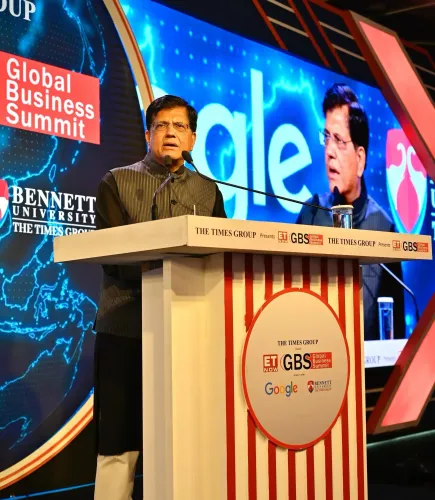
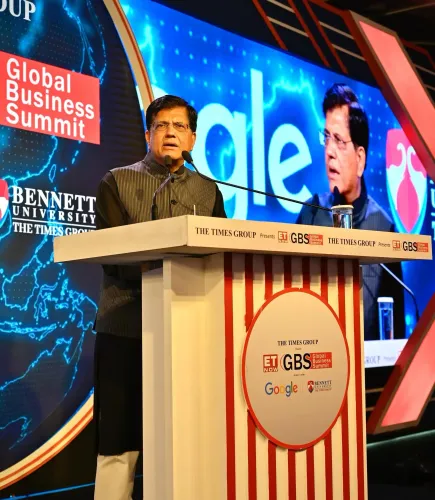
Piyush Goyal: India leads intangible investment growth

Synopsis
The WIPO-Luiss Business School World Intangible Investment Report 2026 ranks India as the fastest-growing nation in intangible investment among the 15 largest economies, with $78.2 billion recorded in 2023 at 7.9% growth. Commerce Minister Piyush Goyal cited sustained reforms, Digital India and Startup India as key drivers.
Key Takeaways
The World Intangible Investment Report 2026 by WIPO and Luiss Business School ranks India first in intangible investment growth among the world's 15 largest economies .
India's intangible investment reached $78.2 billion in 2023 , growing at 7.9% — ahead of its tangible investment growth in the same year.
Key intangible categories driving growth include software, R&D, intellectual property and organisational capabilities .
Flagship programmes — Startup India (2016) , Digital India (2015) , Make in India (2014) and the National IP Rights Policy (2016) — underpin the structural shift.
Commerce Minister Piyush Goyal attributed the gains to PM Narendra Modi 's leadership and India's young innovator and entrepreneur base.
India's next Global Innovation Index ranking and forthcoming Union Budget R&D allocations will be key indicators to watch.
Union Commerce and Industry Minister Piyush Goyal on Thursday, 9 July 2026 highlighted a landmark finding from the World Intangible Investment Report 2026, jointly published by the World Intellectual Property Organization (WIPO) and Luiss Business School, which positions India as the fastest-growing nation in intangible investment among the world's 15 largest economies.
Context
The World Intangible Investment Report 2026 — a joint publication by WIPO, the United Nations agency overseeing global intellectual property metrics, and Luiss Business School, an Italian academic institution — tracks intangible capital formation across major economies. According to the report, India's intangible investment reached $78.2 billion in 2023, registering 7.9% growth that outpaced the country's tangible investment in the same period. The report specifically flags software, research and development, intellectual property, and organisational capabilities as the primary drivers of this expansion.
Minister Goyal shared the report's findings on X (formerly Twitter), writing that India is 'powering the next era of innovation-led growth' and that the report 'reaffirms India's emergence as a global innovation powerhouse.' He credited the gains to Prime Minister Narendra Modi's leadership, citing 'sustained reforms, digital transformation and support for startups.'
Policy Backdrop
India's rise in intangible investment is anchored in a cluster of flagship programmes launched since 2014. The Make in India programme (2014) and Digital India initiative (2015) expanded digital infrastructure and attracted technology-sector investment. The Startup India initiative (2016) eased regulatory burdens and expanded funding pathways for early-stage companies, while the National Intellectual Property Rights Policy (2016) modernised IP administration and commercialisation frameworks.
Together, these reforms have accelerated a structural shift from tangible capital — factories, machinery, physical assets — toward intangible capital: software platforms, data ecosystems, branded products and human organisational know-how. This mirrors a broader global revaluation of knowledge assets as primary growth drivers in large economies, a trend WIPO has been tracking across successive editions of its intangible investment series.
Stakeholders and Impact
The report's findings carry direct implications for India's startup ecosystem, which now numbers among the world's largest, and for innovators and entrepreneurs building software, deep-tech and IP-intensive businesses. A rising intangible investment base strengthens India's negotiating position in WIPO forums and in bilateral trade talks on services and intellectual property, areas where the Commerce Ministry plays a central role.
For the broader economy, intangible investment growth signals improving productivity potential: software and R&D outlays compound over time into exportable products, licensed technologies and scalable platforms. India's young demographic — the 'energy and aspirations of our young innovators, entrepreneurs and creators,' as Goyal described them — remains the structural engine behind this capital formation.
What's Next
Analysts and policymakers will watch India's ranking in the next Global Innovation Index, also published by WIPO, for corroborating signals. Any fresh R&D outlay announcements in the forthcoming Union Budget will be closely tracked as an indicator of whether fiscal policy continues to reinforce the intangible investment momentum the report documents. India's sustained lead in intangible growth, if maintained, could reshape how multilateral bodies and foreign investors price the country's long-term economic trajectory.
Point of View
The Commerce Ministry strengthens its hand in ongoing IP and services trade negotiations. The post fits a consistent BJP government pattern of deploying third-party global rankings — from the World Bank's Ease of Doing Business to the Global Innovation Index — as policy validation tools. The emphasis on 'young innovators and entrepreneurs' also signals that the government intends to keep Startup India and Digital India at the centre of its pre-Budget economic narrative. If the momentum holds through the next Global Innovation Index cycle, India's positioning as a knowledge economy will become harder for sceptics to contest on data grounds alone.
NationPress
9 Jul 2026
Frequently Asked Questions
What is the World Intangible Investment Report 2026?
It is a joint publication by the World Intellectual Property Organization (WIPO) and Luiss Business School that tracks intangible capital formation — including software, R&D, intellectual property and organisational capabilities — across the world's major economies.
How much did India invest in intangible assets in 2023?
According to the report cited by Minister Goyal, India's intangible investment reached $78.2 billion in 2023 , growing at 7.9% — the fastest rate among the 15 largest economies and ahead of India's own tangible investment growth.
Which government schemes contributed to India's intangible investment growth?
Key initiatives include Startup India (2016) , Digital India (2015) , Make in India (2014) and the National Intellectual Property Rights Policy (2016) , which together eased regulations, expanded digital infrastructure and modernised IP administration.
What does intangible investment mean for India's economy?
Intangible investment — in software, R&D, IP and organisational know-how — compounds into exportable products, licensed technologies and scalable platforms, improving long-term productivity and supporting India's position in global services and IP trade negotiations.
What should we watch next regarding India's innovation rankings?
Analysts are tracking India's score in the next Global Innovation Index published by WIPO, as well as any R&D outlay announcements in the forthcoming Union Budget , which will indicate whether fiscal policy continues to reinforce the intangible investment trend.