PM Modi Congratulates IPhO 2025 Gold Medallists from India
Synopsis
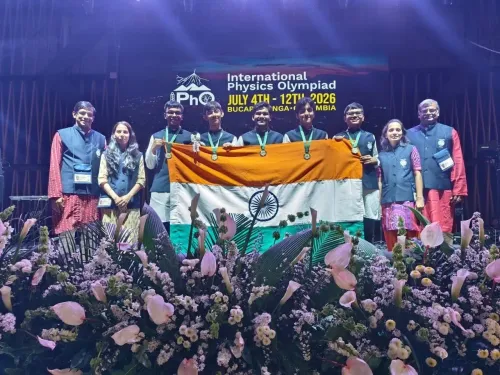
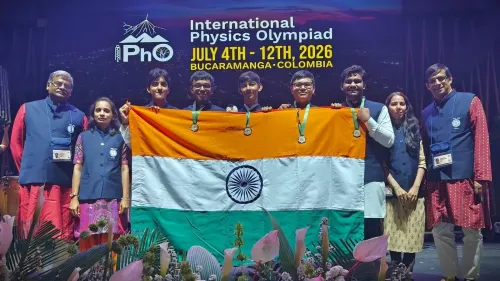
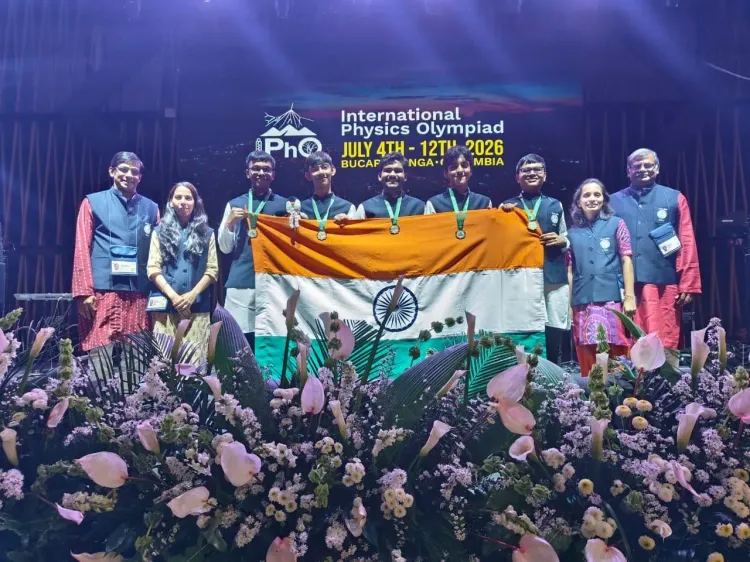
Prime Minister Narendra Modi congratulated five Indian students — Kanishk Jain, Riddhesh Anant Bendale, Rishit Garg, Shresth Suraiya and Svarit Joshi — for winning gold medals at the 56th International Physics Olympiad held in Bucaramanga, calling it an outstanding performance.
Key Takeaways
Five Indian students — Kanishk Jain , Riddhesh Anant Bendale , Rishit Garg , Shresth Suraiya , and Svarit Joshi — won gold medals at the 56th IPhO 2026 .
The competition was held in Bucaramanga , with India fielding a full five-member team.
Prime Minister Modi personally named all five medallists in a congratulatory post on 13 July 2026 .
The International Physics Olympiad , founded in 1967 , is the premier pre-university physics competition globally.
India's olympiad pipeline is run through bodies such as the Indian Association of Physics Teachers , with multi-stage national selection.
The achievement aligns with goals under the National Education Policy 2020 to strengthen school-level science and innovation culture.
Prime Minister Narendra Modi on Monday, 13 July 2026 congratulated five Indian students who won gold medals at the 56th International Physics Olympiad (IPhO) 2025, held in Bucaramanga, praising their achievement as 'an outstanding performance by our youngsters.'
What the Prime Minister Said
In a post on X, Modi named all five members of the winning Indian contingent: Kanishk Jain, Riddhesh Anant Bendale, Rishit Garg, Shresth Suraiya, and Svarit Joshi. The Prime Minister extended congratulations to the team for securing gold medals, calling their result a source of national pride.
The International Physics Olympiad is one of the most prestigious pre-university science competitions in the world, testing students on advanced theory and experimental physics. India has participated in the event for several decades and has steadily built a reputation for strong performances on the international stage.
Context
The IPhO, established in 1967, brings together national teams of high school students who compete in rigorous written and practical examinations. Each country may field a team of up to five students. A gold medal at the IPhO places a student among the top performers globally in pre-university physics.
India's selection and training pipeline for the olympiad is managed through established bodies including the Indian Association of Physics Teachers, which runs multi-stage national screening and intensive coaching programmes. The five students named by Prime Minister Modi represent the outcome of that competitive process.
Policy Backdrop
Public recognition of olympiad achievers by Prime Minister Modi fits a consistent pattern of using high-profile platforms to spotlight student success in science, technology, engineering, and mathematics. This approach is aligned with goals outlined in the National Education Policy 2020, which emphasised strengthening school-level science education and fostering a culture of innovation and experiential learning from an early age.
Government messaging around such achievements is also intended to encourage wider participation in competitive science at the school level and to signal India's ambitions to improve its global standing in science and research indicators.
Stakeholders and Impact
The five gold medallists — Kanishk Jain, Riddhesh Anant Bendale, Rishit Garg, Shresth Suraiya, and Svarit Joshi — are expected to receive significant institutional attention, with many past IPhO participants going on to pursue careers at leading research institutions and universities in India and abroad.
Science educators and school administrators who run olympiad preparation programmes are likely to highlight the result as validation of India's grassroots talent-identification infrastructure. For students currently in the preparation pipeline, the achievement provides a visible benchmark.
What's Next
The result is expected to feed into discussions around investment in national science olympiad training infrastructure, including funding for residential coaching camps and access to laboratory facilities. Selection cycles for the next edition of the IPhO will begin through the national screening process in the coming academic year.
India's consistent medal haul at international science olympiads is increasingly cited in policy circles as evidence that early identification and structured mentorship can produce world-class scientific talent — a model that policymakers may look to expand under the broader framework of the National Education Policy 2020.
Point of View
The post personalises national success in a way that resonates with parents, educators, and aspirants across the country. This pattern of recognition serves a dual purpose: it rewards excellence and simultaneously reinforces the government's claim that policy investments in education — particularly the National Education Policy 2020 — are producing measurable results. The timing and consistency of such posts suggest a calibrated effort to position India as an emerging science power at the school level, well before university or research outcomes become visible.
NationPress
13 Jul 2026
Frequently Asked Questions
Who won gold medals for India at IPhO 2026?
Kanishk Jain , Riddhesh Anant Bendale , Rishit Garg , Shresth Suraiya , and Svarit Joshi won gold medals for India at the 56th International Physics Olympiad 2026 held in Bucaramanga .
Where was the 56th International Physics Olympiad held?
The 56th International Physics Olympiad (IPhO) 2026 was held in Bucaramanga , as confirmed in Prime Minister Modi 's congratulatory post on 13 July 2026 .
What is the International Physics Olympiad?
The International Physics Olympiad (IPhO) is an annual pre-university science competition established in 1967 . National teams of up to five high school students compete in advanced theory and experimental physics examinations.
How does India select its IPhO team?
India's IPhO team is selected through a multi-stage national screening and training process managed by bodies including the Indian Association of Physics Teachers , involving written examinations and intensive residential coaching camps.
What did PM Modi say about India's IPhO 2026 result?
Prime Minister Modi called it 'an outstanding performance by our youngsters' and personally congratulated all five gold medallists by name in a post on X on 13 July 2026 .