PM Modi Invokes Sanskrit Verse on Selfless Service and Welfare
Synopsis
Prime Minister Narendra Modi on 10 July 2026 posted a Hindi message and Sanskrit verse on X, framing selfless action as humanity's greatest strength and reaffirming his government's resolve to improve every citizen's life through service and dedication.
Key Takeaways
Prime Minister Narendra Modi posted on X on 10 July 2026 in Hindi, calling selfless action humanity's greatest strength.
He quoted a Sanskrit verse advocating action for the well-being of all beings as the root of all fulfilment.
The post continues a pattern of Modi integrating classical Indian philosophy into his governance communication since 2014 .
The message aligns with flagship welfare programmes such as Swachh Bharat Abhiyan , Ayushman Bharat , and Antyodaya initiatives.
The post was accompanied by a video; observers are watching for a possible forthcoming welfare announcement or Mann Ki Baat broadcast.
Prime Minister Narendra Modi on Friday, 10 July 2026, shared a message on X rooting the idea of selfless service in ancient Indian thought, reaffirming his administration's commitment to improving the lives of every citizen through dedication and welfare-driven governance.
In the post, written in Hindi, Modi stated: 'निःस्वार्थ कर्म ही मानवता की सबसे बड़ी शक्ति है' — 'Selfless action is the greatest strength of humanity.' He added that his government moves forward with the resolve to improve every person's life through the spirit of service and dedication.
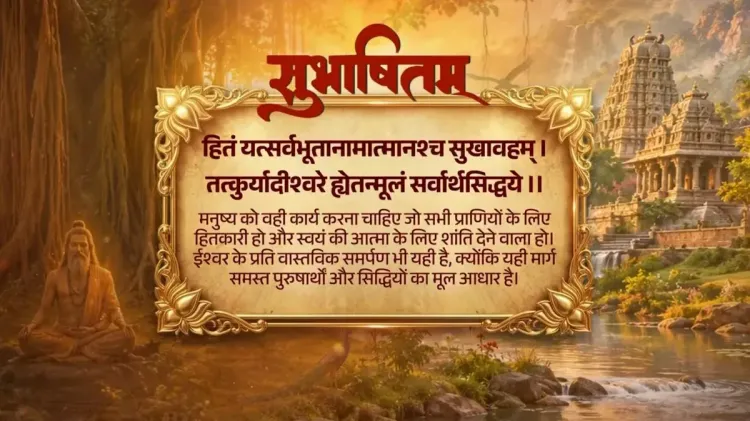
The Prime Minister also quoted a Sanskrit verse: 'हितं यत्सर्वभूतानामात्मानश्च सुखावहम् । तत्कुर्यादीश्वरे ह्येतन्मूलं सर्वार्थसिद्धये ।।' — roughly translated: 'That which is beneficial to all beings and brings happiness to oneself — one should do that in devotion to the divine, for it is the root of the fulfilment of all purposes.'
Context
Modi has long used his social media presence to blend cultural and philosophical references with governance messaging. Posts of this nature are a consistent feature of his communication style, drawing on Sanskrit literature, classical texts, and the concept of seva (selfless service) to frame public policy as a moral endeavour.
The verse cited belongs to the tradition of classical Indian ethics that links individual action to collective welfare — a theme Modi has returned to repeatedly since assuming office in 2014.
Policy Backdrop
Since 2014, the Bharatiya Janata Party (BJP)-led government has launched a series of welfare programmes — including Swachh Bharat Abhiyan, Pradhan Mantri Jan Dhan Yojana, Ayushman Bharat, and Antyodaya-focused initiatives — all framed around the idea of inclusive service to the poorest and most marginalised sections of society.
The invocation of selfless action and universal welfare in the post echoes the philosophical underpinning the administration has consistently cited for these programmes. The concept of sarva bhuta hita — well-being of all beings — is presented as both a spiritual ideal and a governance principle.
Stakeholders and Impact
The message is addressed broadly to Indian citizens and public servants, reinforcing an ethos of duty-driven service that the government expects to permeate its administrative machinery. Such messaging is particularly significant in the context of ongoing welfare delivery at the grassroots level.
By anchoring governance in classical Indian thought, Modi also speaks to a cultural constituency that values the integration of tradition with modern statecraft. The post accompanies a video, the specific contents of which could not be independently verified at the time of publication.
What's Next
Observers will watch for whether this post precedes a formal welfare scheme announcement, an address to citizens, or the next edition of Mann Ki Baat — Modi's monthly radio programme that frequently draws on similar themes of service and collective progress. The philosophical framing suggests the message may set the tone for a forthcoming policy communication or public engagement.
As the government continues to position welfare delivery as an expression of nishkama karma — action without attachment to personal reward — the integration of ancient Indian ethics into everyday governance communication looks set to remain a defining feature of the Modi administration's public outreach.
Point of View
The Prime Minister reinforces the administration's self-image as a vehicle of selfless public service rather than partisan politics. This style of messaging has proven effective in building a cultural consensus around welfare delivery, and its recurrence suggests it remains central to the government's outreach strategy heading into the second half of 2026. The accompanying video may signal a concrete policy follow-through, making this post worth tracking beyond its philosophical surface.
NationPress
10 Jul 2026
Frequently Asked Questions
What did PM Modi post on X on 10 July 2026?
PM Modi posted a Hindi message stating that selfless action is humanity's greatest strength, accompanied by a Sanskrit verse on the well-being of all beings and a video.
What does the Sanskrit verse quoted by Modi mean?
The verse translates roughly as: 'That which is beneficial to all beings and brings happiness to oneself — one should do that in devotion to the divine, for it is the root of the fulfilment of all purposes.'
Why does Modi frequently quote Sanskrit verses on social media?
Modi regularly integrates Sanskrit literature and classical Indian thought into his public communication to frame governance as a moral and cultural duty, a style consistent with his administration since 2014.
Which welfare schemes are associated with Modi's selfless service philosophy?
Flagship programmes including Swachh Bharat Abhiyan, Pradhan Mantri Jan Dhan Yojana, Ayushman Bharat, and Antyodaya-focused initiatives have all been framed around the principle of inclusive service to the poor.
Is this post linked to a specific policy announcement?
No specific announcement has been confirmed. Observers are monitoring whether the post precedes a welfare scheme update or a Mann Ki Baat broadcast.