PM Modi Cites Sanskrit Verse on Humility and Public Service
Synopsis
Prime Minister Narendra Modi on 10 June 2026 shared a Hindi message and a Sanskrit verse on good governance, stating that public service, humility, and dedication are the true measures of a ruler's worth — reinforcing his long-standing 'Minimum Government, Maximum Governance' philosophy.
Key Takeaways
PM Modi posted on 10 June 2026 that public service is the greatest test of good governance.
He quoted a Sanskrit verse from classical rajdharma literature describing a humble, people-devoted ruler as one who attains true prosperity.
The post is consistent with Modi's practice since 2014 of linking ancient Indian texts to contemporary administration.
The message reinforces the government's 'Minimum Government, Maximum Governance' framework articulated over the past decade.
Good Governance Day , observed on 25 December each year, was instituted in 2014 to embed citizen-centric values in public administration.
No new scheme or policy was announced; the post carries normative and symbolic significance for public servants and citizens alike.
Prime Minister Narendra Modi on Wednesday, 10 June 2026 shared a message on social media invoking the principles of humility, dedication, and duty as the true measures of good governance, anchoring his post in a classical Sanskrit verse from ancient Indian political thought.
Context
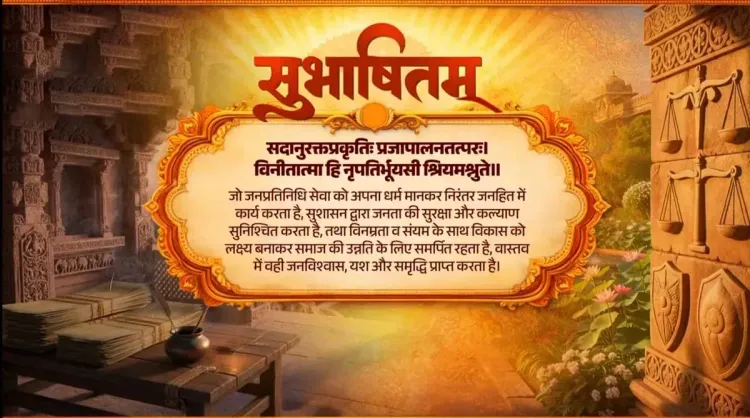
Writing in Hindi, PM Modi stated: 'जनसेवा ही सुशासन की सबसे बड़ी कसौटी है' — 'Public service is the greatest test of good governance.' He added that a person who works continuously with humility, dedication, and a sense of duty is the one who earns public trust.
The Prime Minister then quoted a Sanskrit shloka: 'सदानुरक्तप्रकृतिः प्रजापालनतत्परः। विनीतात्मा हि नृपतिर्भूयसी श्रियमश्नुते॥' — roughly translated: 'A ruler who is always beloved of his people, ever devoted to their welfare, and humble in spirit, attains the greatest prosperity and glory.' The verse is drawn from classical Sanskrit literature on rajdharma, the ethical code of kingship and statecraft.
Policy Backdrop
Modi has periodically shared Sanskrit verses on rajdharma and seva (service) since assuming office in 2014, consistently linking ancient texts to the demands of contemporary administration. This practice forms part of a broader philosophical framework the government has articulated as 'Minimum Government, Maximum Governance' — a slogan that has guided administrative reform efforts over the past decade.
Good Governance Day was institutionalised on 25 December 2014 to honour former Prime Minister Atal Bihari Vajpayee and to reinforce the idea of efficient, citizen-centric public administration. Modi's recurring invocations of classical texts on social media are consistent with this framing, positioning ethical statecraft not as a modern innovation but as a principle rooted in India's civilisational heritage.
Stakeholders and Impact
The message is addressed broadly to Indian citizens and implicitly to public servants and elected officials across the country. By foregrounding humility and duty over power or political authority, the post reinforces a normative standard against which governance — at every level — can be assessed.
Such statements from the Prime Minister carry symbolic weight in a country where over 1.4 billion people engage with government services daily, from rural panchayats to central ministries. They also signal to the administrative machinery — the Indian Administrative Service and allied services — the values the leadership expects to see reflected in day-to-day conduct.
What's Next
While the post does not announce a specific scheme or policy, Modi's recurring emphasis on governance ethics is watched closely ahead of parliamentary sessions and planning exercises by bodies such as NITI Aayog. Administrative reform proposals and citizen-service delivery benchmarks are areas where such philosophical statements have historically preceded concrete policy announcements.
The invocation of classical rajdharma literature also continues a longer cultural project of situating modern Indian governance within the country's ancient intellectual traditions — a theme that is likely to persist as India advances its domestic reform agenda and its profile on the global stage.
Point of View
Decade-long effort to frame Indian governance within a civilisational rather than purely technocratic register. By pairing a plain Hindi statement on public service with an ancient shloka, the Prime Minister signals that ethical statecraft is not a contemporary import but an indigenous inheritance. This rhetorical strategy simultaneously speaks to a mass audience familiar with devotional and classical idioms and to a bureaucratic class expected to internalise those values. At a time when administrative reform and service-delivery remain live political issues, such statements set a public benchmark — however symbolic — against which the government's own performance will inevitably be measured.
NationPress
24 Oct 2026
Frequently Asked Questions
What did PM Modi post on 10 June 2026?
PM Modi shared a message in Hindi stating that public service is the greatest test of good governance, paired with a Sanskrit verse emphasising that a humble ruler devoted to the welfare of the people attains true greatness.
What is the Sanskrit verse PM Modi quoted about?
The verse — 'सदानुरक्तप्रकृतिः प्रजापालनतत्परः। विनीतात्मा हि नृपतिर्भूयसी श्रियमश्नुते॥' — comes from classical Indian literature on rajdharma and describes a ruler who is beloved of his people, devoted to their welfare, and humble in spirit as one who attains the greatest prosperity.
What is Good Governance Day in India?
Good Governance Day is observed on 25 December each year, instituted in 2014 to honour former Prime Minister Atal Bihari Vajpayee and to promote efficient, citizen-centric administration across government.
What does 'Minimum Government, Maximum Governance' mean?
'Minimum Government, Maximum Governance' is a policy philosophy articulated by PM Modi since 2014 , emphasising reduced bureaucratic red tape, streamlined processes, and a greater focus on delivering services directly and efficiently to citizens.
Does PM Modi regularly quote Sanskrit texts on governance?
Yes. Since assuming office in 2014 , PM Modi has periodically shared Sanskrit verses related to rajdharma and seva on social media, consistently connecting ancient Indian political thought to the principles he advocates for modern public administration.