PM Modi shares Sanskrit shloka on knowledge and human welfare
Synopsis
Prime Minister Narendra Modi on 26 May 2026 shared a Sanskrit verse from Advaita tradition alongside a Hindi message asserting that true knowledge must serve the welfare of the nation, society, and all humanity — continuing his sustained practice of weaving classical Indian philosophy into public governance messaging.
Key Takeaways
Prime Minister Narendra Modi posted a philosophical message in Hindi and Sanskrit on 26 May 2026 .
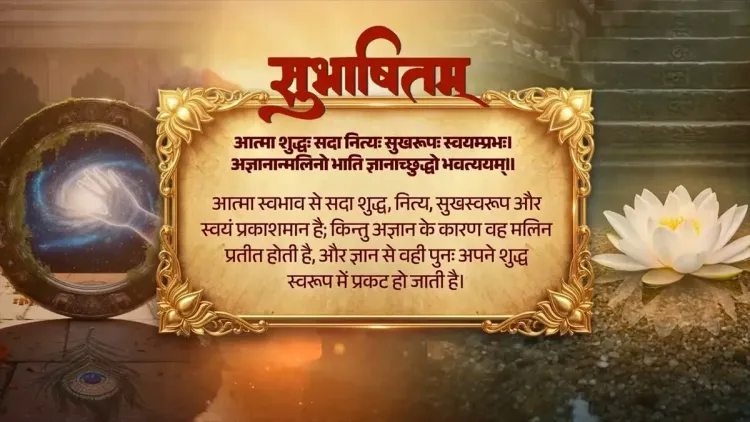
The post states that 'true knowledge paves the way for the welfare of the nation, society, and all of humanity.' A Sanskrit shloka from Advaita Vedanta tradition was included, describing the soul as pure, eternal, and self-luminous — obscured by ignorance and restored by knowledge.
The post aligns with the National Education Policy 2020 's integration of Indian Knowledge Systems into curricula.
PM Modi has regularly invoked Sanskrit texts and concepts such as Vasudhaiva Kutumbakam in both domestic and international forums since 2014 .
Students, educators, and institutions implementing NEP 2020 are the primary stakeholders of this cultural-philosophical messaging.
Prime Minister Narendra Modi posted a philosophical reflection on Tuesday, 26 May 2026, sharing a Sanskrit verse alongside a message linking true knowledge to the welfare of the nation, society, and all of humanity. The post, made in Hindi and Sanskrit, continues his long-established practice of weaving classical Indian thought into public discourse.
In the post, PM Modi wrote: 'सच्चा ज्ञान देश, समाज और समस्त मानवता के कल्याण का मार्ग प्रशस्त करता है' — 'True knowledge paves the way for the welfare of the nation, society, and all of humanity.' He added that it is essential for our knowledge and our actions to become a source of inspiration for all of humankind.
The post also carried a Sanskrit shloka rooted in Advaita philosophical tradition: 'आत्मा शुद्धः सदा नित्यः सुखरूपः स्वयम्प्रभः। अज्ञानान्मलिनो भाति ज्ञानाच्छुद्धो भवत्ययम्।।' — broadly rendered as: 'The soul is pure, eternal, of the nature of bliss, and self-luminous. It appears tainted by ignorance; through knowledge it becomes pure again.'
Context
PM Modi has consistently used his social media presence to share Sanskrit verses, philosophical maxims, and references to classical Indian texts. This practice predates his tenure as Prime Minister and has intensified since 2014, with posts drawing from sources ranging from the Upanishads to Thirukkural, reflecting an effort to bring India's textual heritage into everyday public conversation.
The specific shloka shared on 26 May belongs to a body of Advaita Vedanta thought that emphasises the intrinsic purity of the self and the liberating power of knowledge over ignorance — themes that resonate with both classical scholarship and contemporary motivational discourse in India.
Policy Backdrop
The philosophical emphasis in the post aligns with the National Education Policy (NEP) 2020, which formally integrated Indian Knowledge Systems (IKS) into school and university curricula. The policy mandates that ancient disciplines — including logic, linguistics, mathematics, and philosophy — be taught alongside modern subjects, with the explicit goal of reviving classical learning traditions.
Since 2014, the government has also invoked concepts such as Vasudhaiva Kutumbakam ('the world is one family') in international forums, including during India's G20 Presidency in 2023, to frame Indian philosophy as a contribution to global problem-solving. The current post's emphasis on knowledge benefiting 'all of humanity' echoes that consistent diplomatic and cultural messaging.
Stakeholders and Impact
Students and educators are the most direct stakeholders of the government's push to mainstream classical Indian thought. Under NEP 2020 implementation, universities have been encouraged to establish Indian Knowledge Systems departments, and Sanskrit enrolment has seen institutional support at both school and higher-education levels.
More broadly, posts of this nature contribute to a cultural policy signal — reinforcing the value placed on ancient texts and philosophical inquiry as living resources rather than archival curiosities. For the wider public, they function as a form of soft cultural outreach by the country's highest elected office.
What's Next
Further phases of NEP 2020 implementation are expected to deepen the integration of Indian Knowledge Systems modules across central universities and affiliated institutions. Parliamentary and ministerial statements referencing ancient texts in policy debates have grown more frequent, and this trend is likely to continue as the government advances its cultural heritage agenda.
Whether this post is tied to a specific occasion or initiative remains unconfirmed; however, it reinforces a pattern in which the Prime Minister's messaging on knowledge, culture, and universal welfare consistently accompanies broader policy and diplomatic efforts to position India's classical traditions at the centre of its national identity.
Point of View
Decade-long communications strategy that fuses classical Indian thought with governance identity. By pairing a Sanskrit Advaita shloka with a universalist welfare message, the post simultaneously speaks to a domestic audience steeped in Vedantic tradition and to an international audience familiar with India's 'one family' framing at forums like the G20. The timing, amid ongoing NEP 2020 rollout, reinforces the policy signal that ancient knowledge systems are instruments of contemporary nation-building, not merely cultural ornaments. Analysts will note how consistently this messaging bridges the spiritual and the political without crossing into explicit partisanship.
NationPress
10 Oct 2026
Frequently Asked Questions
What Sanskrit shloka did PM Modi share on 26 May 2026?
PM Modi shared a verse from Advaita Vedanta tradition stating that the soul is pure, eternal, blissful, and self-luminous, appearing tainted only through ignorance and restored to purity through knowledge.
What did PM Modi say about knowledge and humanity in his post?
He said that true knowledge paves the way for the welfare of the nation, society, and all of humanity, and that our knowledge and actions must become a source of inspiration for all humankind.
How does PM Modi's Sanskrit post connect to Indian education policy?
The emphasis on classical knowledge aligns with the National Education Policy 2020, which formally integrated Indian Knowledge Systems — including philosophy and Sanskrit — into school and university curricula.
Why does PM Modi frequently post Sanskrit shlokas on social media?
Since 2014, PM Modi has consistently used Sanskrit verses and classical Indian philosophy in public communication to reinforce cultural heritage as a pillar of governance and to connect ancient wisdom with contemporary national and global challenges.
What is the meaning of the Advaita shloka PM Modi quoted?
The shloka conveys that the self is inherently pure and eternal but appears impure due to ignorance; the attainment of knowledge removes that ignorance and restores the self to its natural purity — a central idea in Advaita Vedanta philosophy.