Giriraj Singh calls for balanced population on World Population Day
Synopsis
Union Textiles Minister Giriraj Singh marked World Population Day on 11 July 2026 by calling for a balanced population as the foundation of India's prosperous future, echoing the central government's shift toward awareness-driven demographic messaging over coercive targets.
Key Takeaways
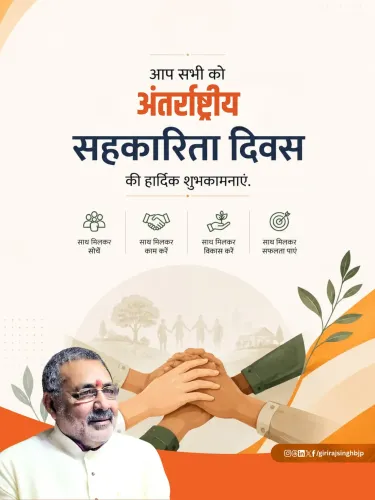
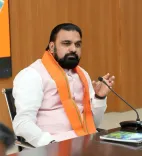
Giriraj Singh , Union Textiles Minister and BJP MP from Begusarai, Bihar , posted a World Population Day message on 11 July 2026 .
He called on all citizens to resolve to build an 'aware and responsible society' on the occasion.
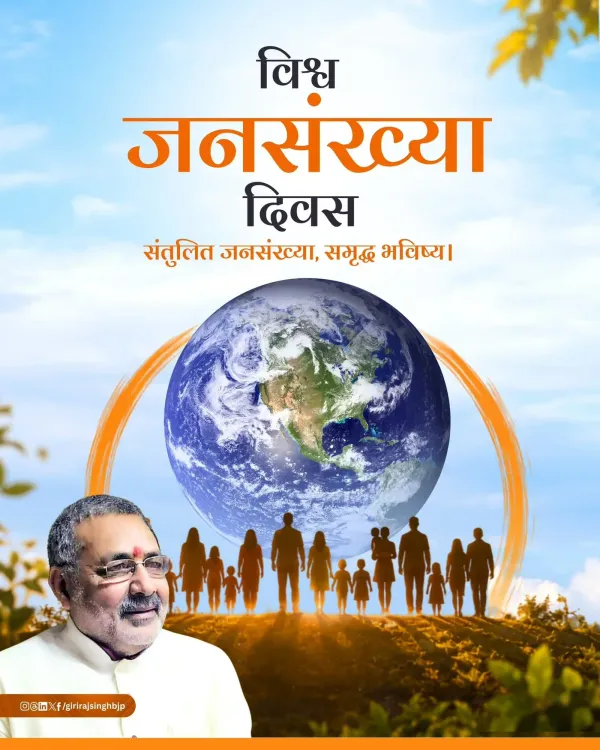
His message carried the tagline 'संतुलित जनसंख्या, समृद्ध भविष्य' — 'Balanced population, prosperous future.' India's National Population Policy 2000 targets population stabilisation by 2045 through voluntary, rights-based measures.
India's national Total Fertility Rate has fallen below the replacement level of 2.1 , though regional disparities persist.
The next Census results and upcoming Union Budget allocations for family welfare schemes are key milestones to watch.
Union Textiles Minister Giriraj Singh on Saturday, 11 July 2026, marked World Population Day with a call on all citizens to commit to building an aware and responsible society, stressing that a balanced population is the foundation of a bright, prosperous, and happy future for India.
Posting in Hindi on X, the senior BJP leader and Lok Sabha MP from Begusarai, Bihar, wrote: 'इस विश्व जनसंख्या दिवस पर आइए हम सभी एक जागरूक और जिम्मेदार समाज के निर्माण का संकल्प लें' — 'On this World Population Day, let us all resolve to build an aware and responsible society.' He added that a balanced population is the strong foundation of the country's bright, prosperous, and happy future, signing off with the phrase 'संतुलित जनसंख्या, समृद्ध भविष्य' — 'Balanced population, prosperous future.'
Context
World Population Day is observed every year on 11 July to focus global attention on population issues and their links to sustainable development. The day was established following the symbolic milestone of the world's population reaching five billion in 1987. In 2026, the observance comes as India consolidates its position as the world's most populous nation, a demographic reality with significant implications for economic planning, resource allocation, and social welfare.
Singh's message joins a chorus of statements from central government leaders on the occasion, reflecting a broader shift in official discourse — away from alarmist population-control framing and toward the language of 'balance,' awareness, and responsibility.
Policy Backdrop
India's foundational framework on this subject remains the National Population Policy 2000, which set out voluntary measures and reproductive health services as the primary tools for achieving population stabilisation by 2045. The policy explicitly rejected coercive measures, instead targeting replacement-level fertility through education, access to contraception, and maternal health programmes.
Several states, including Bihar — the constituency Singh represents — have at various points discussed incentive-linked two-child norms, though no such measure has been adopted at the central level. Central government messaging in recent years has increasingly emphasised balanced demographic growth as a support for economic and social goals, rather than raw numerical reduction.
India's ongoing fertility transition has seen the Total Fertility Rate (TFR) fall below the replacement level of 2.1 nationally, even as regional variations persist, with some northern and eastern states still recording higher fertility than the national average.
Stakeholders and Impact
The framing of 'balanced population' carries significance for multiple groups. Women's health organisations and reproductive rights advocates have long urged that population discourse remain centred on individual rights, quality healthcare, and education — particularly for women and girls — rather than numerical targets. State family welfare departments implement centrally sponsored schemes on the ground and are sensitive to shifts in political messaging that can influence local programme priorities.
For Bihar specifically, population dynamics intersect with development indicators including literacy, infant mortality, and per-capita income — all areas where the state continues to work toward improvement. Singh's emphasis on an 'aware and responsible society' aligns with the broader consensus that education and awareness, rather than mandates, are the most effective levers.
What's Next
Attention will now turn to the release of India's long-awaited next Census results, which are expected to provide the most granular data yet on the country's demographic profile and regional fertility patterns. Any revisions to centrally sponsored family welfare and maternal health schemes in upcoming Union Budgets will be closely watched by state governments and civil society alike. The tenor of World Population Day messaging from senior ministers may also signal the direction of future policy communication as India navigates the dual challenge of a youthful demographic dividend in some regions and an ageing population in others.
Point of View
But its language is telling. By choosing 'balanced population' over older formulations like 'population control,' he aligns with the central government's deliberate rebranding of demographic discourse — one that seeks to sidestep the coercive connotations of past campaigns while still signalling concern about population dynamics. For a senior BJP leader from Bihar, a state that remains central to debates about demographic pressure and development, the statement carries a degree of political subtext even if it stops well short of a policy announcement. The message is best read as part of a broader pattern in which the ruling party uses observance days to reinforce its governance narrative, with World Population Day serving as a recurring opportunity to frame demographic management as a civic and moral responsibility rather than a state-imposed obligation.
NationPress
9 Oct 2026
Frequently Asked Questions
What did Giriraj Singh say on World Population Day 2026?
Giriraj Singh called on all citizens to resolve to build an aware and responsible society, saying that a balanced population is the strong foundation of India's bright, prosperous, and happy future.
What is World Population Day and when is it observed?
World Population Day is an annual global observance held on 11 July each year to highlight population issues and their connection to sustainable development. It was established after the world's population reached five billion in 1987.
What is India's National Population Policy?
India's National Population Policy 2000 is the country's framework for achieving population stabilisation by 2045 through voluntary measures, reproductive health services, and education — without coercive controls.
Is India's population still growing rapidly?
India's national Total Fertility Rate has fallen below the replacement level of 2.1 , indicating a significant fertility transition, though regional variations mean some states still record higher fertility rates than the national average.
Why does Bihar feature in India's population debate?
Bihar has historically recorded higher fertility rates and lower development indicators compared to the national average, making it a focal point in discussions about the links between population dynamics, education, and economic growth.