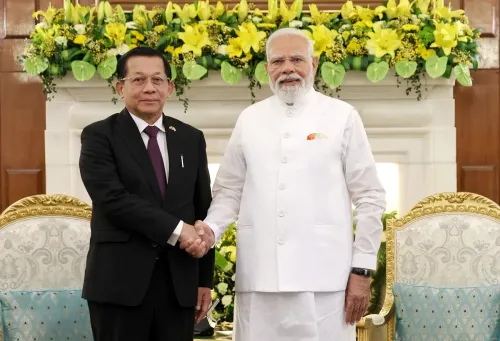
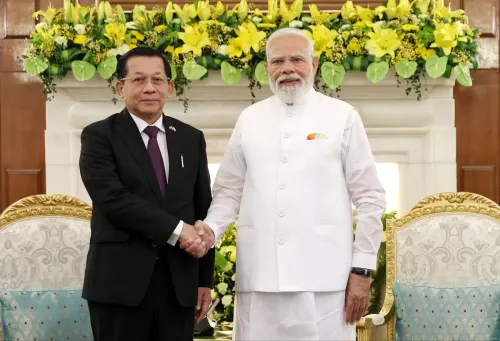
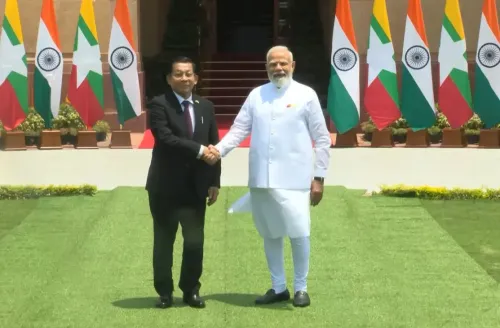
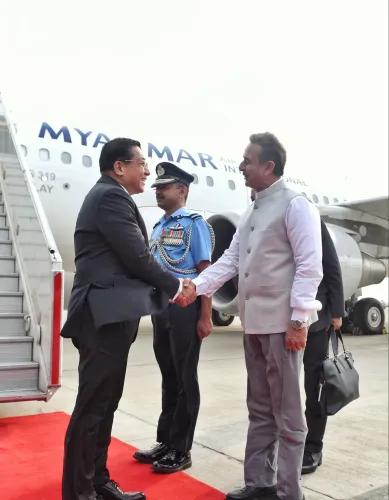
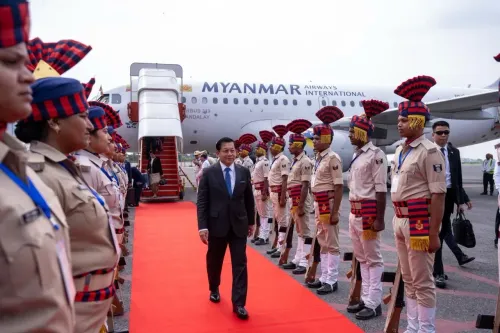
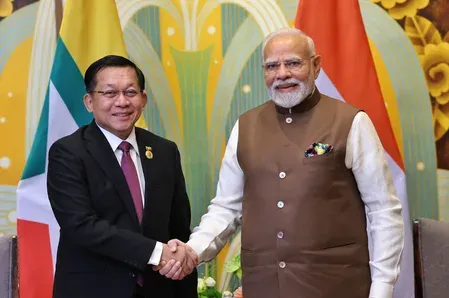
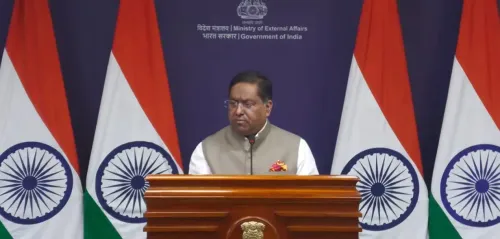
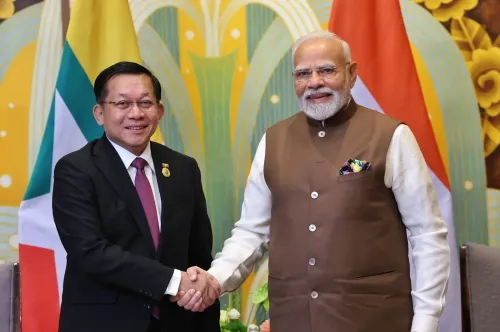
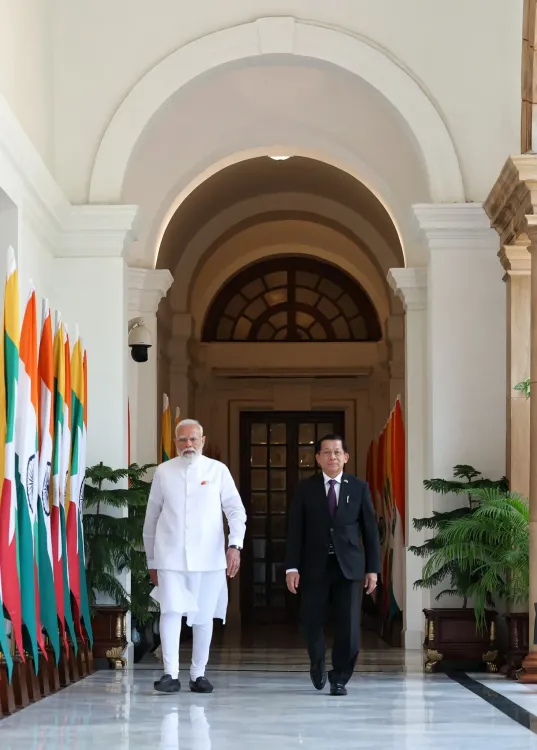
PM Modi meets Myanmar President U Min Aung Hlaing in New Delhi
Synopsis
Prime Minister Narendra Modi held bilateral talks with Myanmar President U Min Aung Hlaing on June 1, 2026, hailing India as the President's first foreign destination and welcoming his visit to Bodh Gaya as a symbol of shared Buddhist heritage and deepening bilateral ties.
Key Takeaways
Prime Minister Narendra Modi met Myanmar President U Min Aung Hlaing on June 1, 2026 and described the talks as productive.
India was chosen as the President's first foreign destination, which Modi called an honour.
The President began his India visit at Bodh Gaya in Bihar , invoking shared Buddhist heritage as a diplomatic touchstone.
The meeting falls within India's Act East Policy framework, which treats Myanmar as a gateway to ASEAN .
Key infrastructure projects — the Kaladan Multimodal Project and the IMT Trilateral Highway — remain in focus as markers of bilateral progress.
India's engagement reflects a calibrated strategy of maintaining ties with Naypyidaw to counter Chinese influence despite Western diplomatic pressure.
Prime Minister Narendra Modi held a bilateral meeting with Myanmar President U Min Aung Hlaing on Monday, June 1, 2026, describing the talks as productive and welcoming the visit as an expression of strong bilateral ties. India has been honoured by the choice, Modi noted, adding that the President began his trip from the sacred Buddhist site of Bodh Gaya in Bihar.
Context
In a post on X, Modi wrote: 'Had a productive meeting with President U Min Aung Hlaing of Myanmar. We in India are honoured that he has chosen India for his first foreign visit as President. Equally gladdening is the fact that he began the visit from Bodh Gaya, with the blessings of Lord Buddha.' The choice of Bodh Gaya — the site of the Buddha's enlightenment — as the starting point of the visit carries significant symbolic weight, invoking the deep Buddhist heritage shared between the two nations. The two leaders went on to review the full spectrum of bilateral relations.
Policy Backdrop
India's Act East Policy, upgraded from the earlier Look East framework in 2014, has consistently placed Myanmar at the centre of India's connectivity and security agenda with Southeast Asia. New Delhi has pursued the Kaladan Multimodal Transit Transport Project and the India-Myanmar-Thailand Trilateral Highway as flagship infrastructure corridors designed to link India's northeastern states to the broader ASEAN region through Myanmar. Buddhist diplomacy has been a recurring soft-power instrument in this relationship, with India's Buddhist Tourist Circuit and the International Buddhist Conclave initiatives actively leveraged to deepen people-to-people ties with Myanmar, Sri Lanka, and other nations of Buddhist heritage.
India's engagement with Myanmar's military-led administration reflects a calibrated balancing act: maintaining security cooperation to counter cross-border insurgencies while simultaneously working to limit the deepening of Chinese influence along a strategically sensitive frontier on the Bay of Bengal. Western governments have imposed sanctions on Naypyidaw since the 2021 military takeover, but New Delhi has maintained diplomatic channels, guided by its neighbourhood-first doctrine.
Stakeholders and Impact
India's northeastern border states — including Manipur, Mizoram, Nagaland, and Arunachal Pradesh — share a long land boundary with Myanmar and stand to gain most directly from improved bilateral relations, particularly in trade connectivity and border security. Buddhist pilgrimage communities across India and Myanmar also have a direct stake in the cultural diplomacy dimension of the visit, as enhanced ties tend to ease pilgrimage access and promote religious tourism along established circuits. For India more broadly, a stable and cooperative Myanmar is essential to the success of the Act East Policy and the country's ambitions as a regional connectivity hub.
What's Next
Observers will watch closely for concrete deliverables emerging from the discussions, particularly any updates on the long-delayed Kaladan project and the IMT Trilateral Highway, both of which have faced implementation challenges. The bilateral momentum could also find expression at multilateral platforms such as BIMSTEC or forthcoming ASEAN-India summits, where Myanmar's participation and India's facilitation role remain consequential. The visit signals that New Delhi intends to keep its eastern neighbourhood diplomacy active regardless of geopolitical headwinds.
Point of View
Complementing harder security and infrastructure interests. By publicly highlighting Bodh Gaya as the starting point, Modi frames the engagement in civilisational terms — a deliberate counterpoint to China's transactional influence in Naypyidaw. The meeting reinforces New Delhi's neighbourhood-first doctrine at a moment when Myanmar remains diplomatically isolated from much of the Western world, giving India a degree of strategic leverage it is clearly keen to consolidate. Progress on stalled connectivity projects will be the real test of whether this diplomatic warmth translates into durable policy outcomes.
NationPress
16 Oct 2026
Frequently Asked Questions
Why did Myanmar President U Min Aung Hlaing visit India?
Myanmar President U Min Aung Hlaing chose India as the destination for his first foreign visit as President, meeting Prime Minister Narendra Modi for bilateral talks on June 1, 2026, and beginning the trip at the Buddhist pilgrimage site of Bodh Gaya in Bihar.
What is the significance of Bodh Gaya in India-Myanmar relations?
Bodh Gaya, the site of the Buddha's enlightenment in Bihar, holds deep religious significance for Myanmar, a predominantly Buddhist nation. India has used Buddhist heritage sites as a soft-power tool to strengthen people-to-people ties with Myanmar and other Buddhist-majority countries in the region.
What is India's Act East Policy and how does Myanmar fit in?
India's Act East Policy, launched in 2014, prioritises connectivity, trade, and security cooperation with Southeast Asian nations. Myanmar is central to this framework as a land bridge to ASEAN, with projects like the Kaladan Multimodal Transit Transport Project and the India-Myanmar-Thailand Trilateral Highway as key pillars.
What projects are at stake in India-Myanmar bilateral talks?
The most closely watched projects are the Kaladan Multimodal Transit Transport Project and the India-Myanmar-Thailand Trilateral Highway, both of which aim to connect India's northeastern states to Southeast Asia but have faced significant implementation delays.
How does India balance its relationship with Myanmar amid Western sanctions?
India has maintained diplomatic and economic engagement with Myanmar's military-led government despite Western sanctions imposed after the 2021 coup, guided by its neighbourhood-first doctrine and the strategic imperative of limiting Chinese influence along its eastern border.