How NHM-Backed Polyhouse Farming is Revolutionizing Farmers' Income and Job Creation in Pilibhit

Synopsis
Discover how polyhouse farming, backed by the NHM, is transforming the agricultural landscape in Pilibhit, Uttar Pradesh. This innovative approach is boosting farmers' incomes and creating abundant rural job opportunities.
Key Takeaways
Polyhouse farming enhances crop quality and yield.
Supports farmers' income through advanced techniques.
Financial assistance is available under the NHM .
Encourages the cultivation of high-value crops.
Boosts rural employment and economic activity.
Pilibhit (Uttar Pradesh), March 10 (NationPress) The innovative practice of polyhouse farming, backed by the National Horticulture Mission (NHM), is significantly transforming the agricultural landscape for farmers in Pilibhit district, Uttar Pradesh. This modern approach is not only enhancing farmers' income but also generating new job opportunities in the rural sector.
This initiative embodies Prime Minister Narendra Modi’s vision of providing employment for all and boosting farmers’ profits through the adoption of advanced agricultural methods and high-value crops.
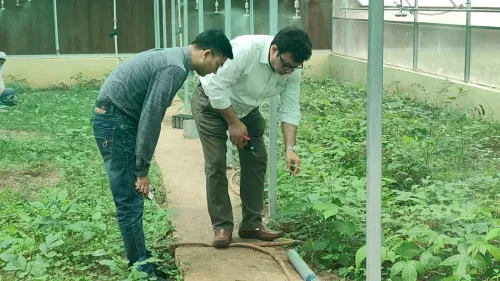
The momentum towards contemporary farming techniques in Pilibhit is largely attributed to Mahavir Singh, a polyhouse expert from Saharanpur. He has been instrumental in guiding farmers to transition from traditional farming to technologically advanced polyhouse cultivation.
During the Covid-19 pandemic, Mahavir Singh began educating local farmers in Pilibhit about innovative polyhouse techniques. Under his mentorship, they have started producing lucrative crops like dragon fruit, strawberries, and red and yellow capsicum, which yield significantly higher returns than standard crops.
“Polyhouse farming enables farmers to regulate temperature and safeguard their crops, thereby enhancing both yield and quality,” he remarked.
Farmers in the area report that this modern approach has resulted in increased profits and better market prices.
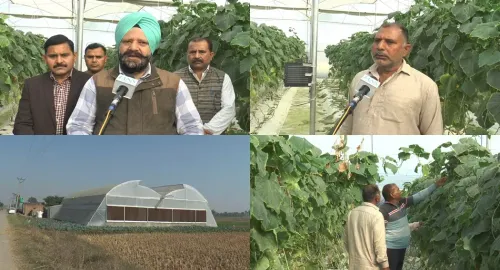
Namchandra Verma, a forward-thinking farmer, stated that growing vegetables in polyhouses has dramatically elevated farmers’ earnings compared to conventional open-field agriculture.
Officials from the Horticulture Department have indicated that farmers are being encouraged to set up polyhouses with financial backing from the NHM scheme.
Initiated in 2005-06, the NHM is a Centrally Sponsored Scheme focused on the comprehensive development of India’s horticulture sector, encompassing fruits, vegetables, spices, and flowers. It advocates cluster-based development, enhances post-harvest management, and provides farmers with quality planting materials to boost productivity and income, with up to 85 percent funding from the Central government.
“Farmers can receive subsidies of around 50 percent for establishing polyhouses. Off-season crops such as capsicum and tomatoes can be cultivated inside these structures, which are not readily available in open fields during that time,” said Rameshwar Dayal, the In-charge District Horticulture Officer.
He added that the off-season benefit allows these vegetables to command higher prices in the market, consequently increasing farmers’ income.
The success of polyhouse farming in Pilibhit is motivating more farmers to embrace this technology. For instance, local farmer Ayush Agarwal earned nearly Rs 29 lakh from just one acre of land last year by selling capsicum grown in a polyhouse.
As more farmers adopt these modern agricultural techniques, polyhouse farming is becoming a beacon of hope for the farming community in Pilibhit, enhancing rural livelihoods and stimulating economic growth in the region.
Point of View
The shift towards polyhouse farming in Pilibhit under the NHM is a commendable effort to uplift farmers' economic status and revitalize rural employment. This initiative exemplifies the government's commitment to modernizing agriculture and enhancing livelihoods.
NationPress
7 Oct 2026
Frequently Asked Questions
What is polyhouse farming?
Polyhouse farming is an advanced agricultural technique that involves growing plants in controlled environments, allowing for better yield and quality.
How does NHM support farmers?
The National Horticulture Mission provides financial assistance and subsidies for setting up polyhouses and promotes advanced farming techniques.
What crops are commonly grown in polyhouses?
Common crops include dragon fruit, strawberries, capsicum, tomatoes, and other high-value vegetables.
What are the benefits of polyhouse farming?
Benefits include increased crop yield, better market prices, and enhanced income for farmers compared to traditional farming.
How much funding does NHM provide for polyhouses?
Farmers can receive subsidies of up to 50% for establishing polyhouses, with additional support for other horticultural developments.