Pradhan marks 12 years of Make in India
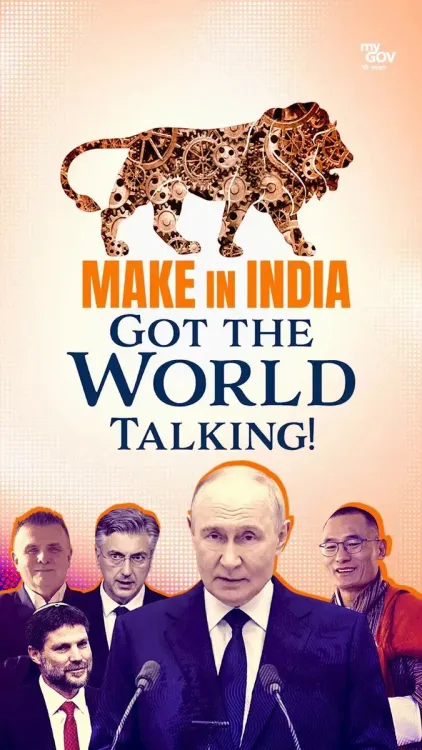
Synopsis
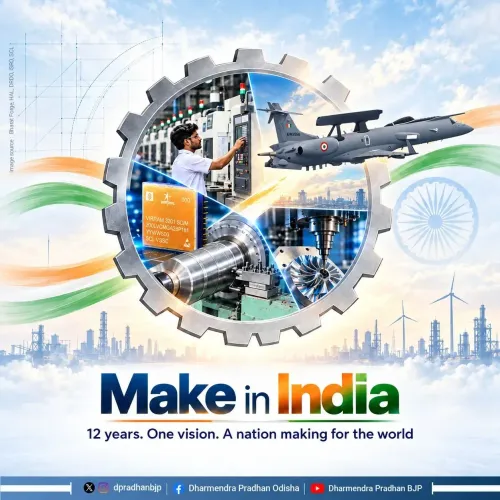
Union Education Minister Dharmendra Pradhan marked the 12th anniversary of Prime Minister Modi's Make in India initiative on 25 September 2026, reaffirming the government's manufacturing-first agenda with a video post declaring India's global production ambitions.
Key Takeaways
Make in India was launched by Prime Minister Narendra Modi on 25 September 2014 , completing 12 years in 2026.
Union Education Minister Dharmendra Pradhan marked the anniversary on X , calling it 'Made in India.
Made for the world.' The initiative targeted sectors including automobiles, electronics, defence, and pharmaceuticals alongside ease-of-doing-business reforms.
Post-2020, Make in India was integrated into the Atmanirbhar Bharat framework, expanding into PLI schemes across 14 key sectors.
Stakeholders including MSMEs , foreign investors, and large manufacturers remain central to the policy's evolving architecture.
Twelve years ago, a single initiative rewired how the world thought about Indian manufacturing. On 25 September 2026, Union Education Minister Dharmendra Pradhan marked the anniversary of Make in India with a crisp, flag-forward salute: 'Made in India. Made for the world.'
From a 2014 launch to a 12-year milestone
Prime Minister Narendra Modi unveiled the Make in India initiative on 25 September 2014, with a single, audacious goal — transform India into a global manufacturing hub. The lion-emblazoned campaign targeted sectors from automobiles and electronics to defence and pharmaceuticals, coupling a domestic production push with sweeping ease-of-doing-business reforms.
Pradhan, a senior BJP leader who previously served as Union Petroleum Minister, has been among the initiative's most vocal champions across government roles. His post — three lines, one tricolour, a decade-plus of intent compressed into a hashtag — captures the mood of a government that has made manufacturing self-reliance a cornerstone of its identity.
Atmanirbhar Bharat: Make in India's second chapter
The original campaign did not operate in isolation for long. After 2020, it was woven into the broader Atmanirbhar Bharat ('Self-Reliant India') framework — a pandemic-era economic doctrine that extended the manufacturing-first logic into supply-chain resilience, import substitution, and production-linked incentive (PLI) schemes across 14 key sectors.
The result: Make in India evolved from a branding exercise into a multi-layered policy architecture touching MSMEs, foreign investors, and large-scale industrial players alike.
What the anniversary signals
Anniversary posts from cabinet ministers carry a function beyond nostalgia — they are public reaffirmations of policy continuity, a signal to investors and industry that the framework remains live and backed at the highest level. Pradhan's post, attached to a video, reinforces that message as the government heads toward the next round of economic planning cycles.
The sharper questions now centre on outcomes: manufacturing's share of GDP, FDI inflow trajectories, and job creation numbers. Those figures, tracked through annual economic surveys and budget documents, will ultimately determine whether the 12-year story is one of transformation or aspiration.
Twelve years in, the slogan has not changed. The standard for measuring it certainly has.
Point of View
Coming from the Education portfolio, underscores how deeply the initiative has been internalised across the BJP's senior leadership — not just in commerce or industry ministries. The fusion of Make in India with Atmanirbhar Bharat after 2020 was strategically significant, giving the original campaign renewed institutional weight. The anniversary now sets up a natural accountability moment: the government's credibility on manufacturing will increasingly be tested against hard data on GDP share and FDI, not slogans.
NationPress
25 Sept 2026
Frequently Asked Questions
When was Make in India launched?
Make in India was launched by Prime Minister Narendra Modi on 25 September 2014 , marking its 12th anniversary in 2026.
What is the goal of Make in India?
The initiative aims to transform India into a global manufacturing hub by encouraging domestic production, attracting foreign investment, and improving ease of doing business across sectors like electronics, defence, and automobiles.
What is the connection between Make in India and Atmanirbhar Bharat?
After 2020, Make in India was integrated into the broader Atmanirbhar Bharat ('Self-Reliant India') framework, which extended its logic into supply-chain resilience and production-linked incentive (PLI) schemes across 14 key sectors.
Why did Dharmendra Pradhan post about Make in India?
Dharmendra Pradhan , a senior BJP leader and Union Education Minister, marked the initiative's 12th anniversary on 25 September 2026, reaffirming the government's commitment to its manufacturing-first economic vision.
Who benefits from the Make in India initiative?
The initiative's primary stakeholders include the manufacturing sector at large, MSMEs , and foreign investors , as well as large industrial players incentivised through PLI schemes and ease-of-business reforms.