Pradhan at NISER's 15th Graduation: India's Science Ambitions
Synopsis
Union Education Minister Dharmendra Pradhan joined the Vice President, Odisha Governor, Chief Minister and Union MoS Jitendra Singh at NISER's 15th Graduation Ceremony in Bhubaneswar, calling for the institute to evolve into a world-class multidisciplinary research hub and citing rising women's STEM enrolment as a sign of India's expanding scientific talent pool.
Key Takeaways
Dharmendra Pradhan attended NISER's 15th Graduation Ceremony in Bhubaneswar on 9 July 2026 .
The event was also attended by Vice President Jagdeep Dhankhar , Odisha Governor Hari Babu Kambhampati , CM Mohan Majhi and Union MoS Jitendra Singh .
NISER's permanent campus was dedicated to the nation by PM Modi in 2016 ; the institute was established in 2007 under the Department of Atomic Energy .
Pradhan called for NISER to become a globally-renowned multidisciplinary research institute driving innovation for India and the world.
Women now account for 43% of STEM enrolments nationally , according to the figure cited by the minister.
India's improved standing on the Global Innovation Index was linked by Pradhan to the role of institutions like NISER.
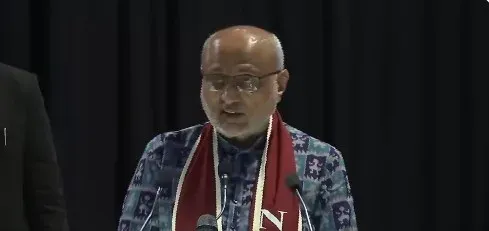
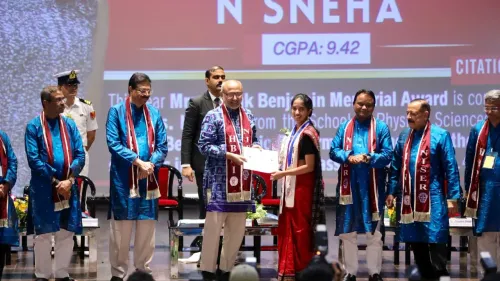
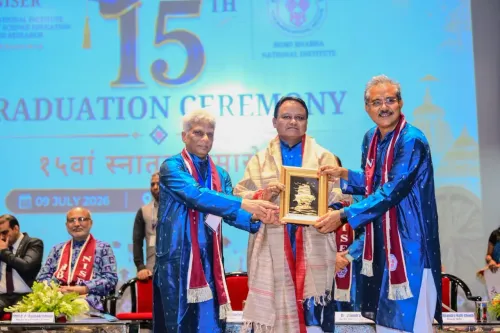
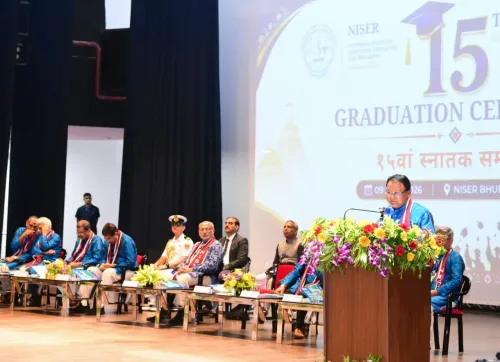
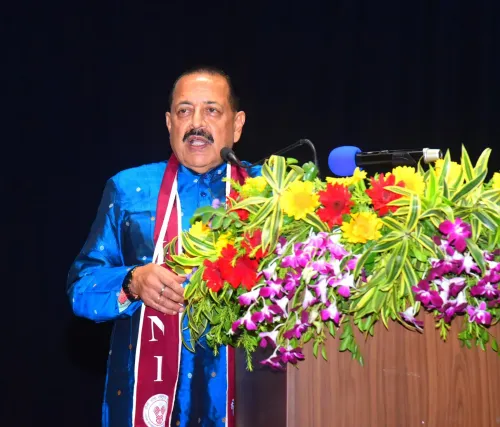
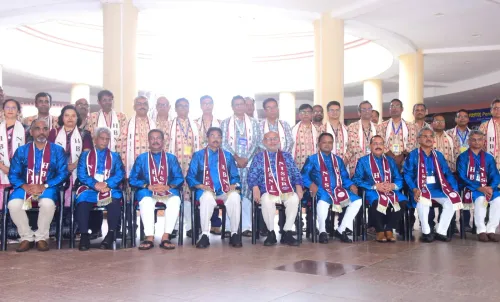
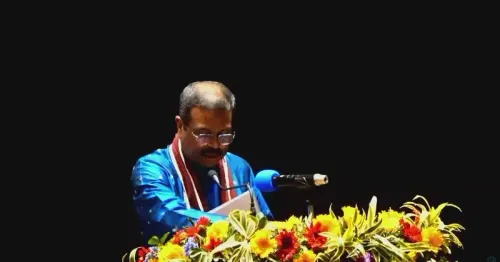
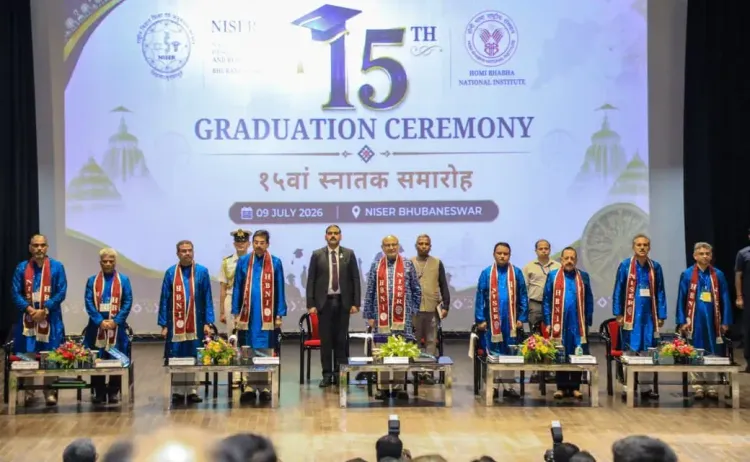
Union Education Minister Dharmendra Pradhan attended the 15th Graduation Ceremony of the National Institute of Science Education and Research (NISER) in Bhubaneswar, Odisha, on 9 July 2026, alongside Vice President Jagdeep Dhankhar, Odisha Governor Hari Babu Kambhampati, Chief Minister Mohan Majhi, and Union Minister of State for Science and Technology Jitendra Singh.
Addressing the gathering of eminent scientists, faculty, students and parents, Pradhan described NISER as a reflection of India's scientific aspirations in action. He recalled that the institute's permanent campus was dedicated to the nation by Prime Minister Narendra Modi in 2016 and noted its rapid emergence as a premier centre for science education and research.
Context
NISER was established in 2007 by the Department of Atomic Energy as an institute of national importance for basic sciences, modelled on the integrated five-year BS-MS programme. Its Bhubaneswar campus, inaugurated by PM Modi in 2016, has since grown into one of India's foremost destinations for foundational science. The graduation ceremony marked the institute's 15th convocation, a milestone that underscored the maturing of its academic pipeline.
Pradhan highlighted the ambition for NISER to evolve into a 'globally-renowned multidisciplinary research institute that drives innovation, nurtures scientific excellence and contributes solutions for both India and the world.' The aspiration positions NISER alongside elite international science institutions rather than merely domestic peers.
Policy Backdrop
NISER's growth sits within a deliberate policy architecture. The National Education Policy 2020 explicitly promotes multidisciplinary education and research across higher education, providing a framework that institutions like NISER are expected to anchor. India has simultaneously expanded its network of dedicated science institutes — including the Indian Institutes of Science Education and Research (IISERs) — to strengthen basic research and build a deeper scientific talent pool.
Pradhan also pointed to India's Global Innovation Index standing, stating that the country's journey toward a knowledge-based society and improved ranking on the index 'will be shaped by institutions like NISER.' India has steadily climbed the index in recent years, and policymakers have identified elite research institutions as a key lever for further gains.
Women in STEM and the Talent Ecosystem
A notable data point cited by the minister was the rising participation of women in STEM fields, which he said now accounts for 43% of STEM enrolments nationally. Pradhan described this as 'the growing strength of India's scientific ecosystem and the expanding talent pool that will power this transformation.' The figure, if borne out by official survey data, would represent a significant shift in a domain historically skewed toward male participation.
The presence of Union MoS Jitendra Singh — who oversees the Department of Science and Technology — alongside the Education Minister signals coordinated inter-ministerial attention to science institution-building, a pattern consistent with the government's push to align education, research and innovation policy under a common strategic direction.
What's Next
The immediate marker to watch is whether NISER receives a formal upgrade in its mandate or additional funding to pursue its multidisciplinary ambitions, potentially through the National Research Foundation framework that was legislated in 2023 to channel greater resources into research institutions. The next release of the All India Survey on Higher Education will also be a key data point to verify the women-in-STEM enrolment trend Pradhan cited. Globally, NISER's aspiration to benchmark itself against top-tier international research universities will depend on faculty recruitment, research output and international collaboration agreements in the years ahead.
Point of View
The state's Governor and Chief Minister, and a science-portfolio minister — is a deliberate signal that the Centre views elite science institutions as central to its innovation and geopolitical ambitions, not merely academic milestones. The invocation of the Global Innovation Index frames domestic institution-building as a ranking competition, a rhetorical move consistent with the government's broader tendency to benchmark India's progress against international indices. Citing the 43% women-in-STEM figure serves a dual purpose: it advances the gender-parity narrative while projecting a talent-pool story to global research partners. The call to evolve NISER into a 'globally-renowned multidisciplinary institute' aligns with the National Research Foundation's mandate and may foreshadow enhanced funding or an expanded statutory role for NISER in the near term.
NationPress
8 Oct 2026
Frequently Asked Questions
What is NISER and where is it located?
NISER, the National Institute of Science Education and Research, is an autonomous institute of national importance established in 2007 under the Department of Atomic Energy. It is located in Bhubaneswar, Odisha , and offers integrated science education and research programmes.
Who inaugurated the NISER campus?
Prime Minister Narendra Modi dedicated the permanent NISER campus to the nation in 2016 .
What did Dharmendra Pradhan say at the NISER graduation ceremony?
Pradhan called NISER a reflection of India's scientific aspirations and said the next milestone is for it to evolve into a globally-renowned multidisciplinary research institute. He also highlighted that women now account for 43% of STEM enrolments nationally .
What is India's Global Innovation Index ranking and why does NISER matter?
India has been steadily climbing the Global Innovation Index in recent years. Pradhan stated that India's journey toward a knowledge-based society and a better GII standing 'will be shaped by institutions like NISER,' underscoring the strategic role of elite science institutes.
How many women are enrolled in STEM in India?
According to the figure cited by Union Education Minister Dharmendra Pradhan at the NISER graduation, women now account for 43% of STEM enrolments nationally , reflecting growing gender parity in India's scientific ecosystem.