Pradhan Slams Kharge Over Remarks on PM Modi's Late Father
Synopsis
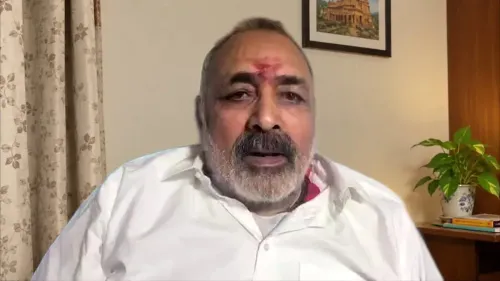
Union Education Minister Dharmendra Pradhan on October 25 publicly denounced Congress president Mallikarjun Kharge for alleged remarks about PM Modi's late father, saying the opposition has abandoned policy debate for personal attacks and warning that public trust cannot be won by disrespecting the people's mandate.
Key Takeaways
Dharmendra Pradhan posted on X on October 25, 2026 condemning Congress president Mallikarjun Kharge for alleged remarks about PM Modi 's late father.
Pradhan called the remarks a violation of democratic decency, especially serious coming from the office of a national party president.
He linked the episode to an earlier alleged comment targeting PM Modi 's late mother, framing both as a pattern of personal attacks rather than isolated incidents.
The minister asked directly whether Congress has exhausted policy arguments against the Prime Minister.
BJP 's core counter-narrative: the public's affection for PM Modi is driving Congress's desperation, but the people's mandate cannot be overturned by insults.
Congress responses and potential parliamentary fallout are expected to follow.
A sharp political clash erupted on Sunday, October 25, 2026, after Union Education Minister Dharmendra Pradhan publicly condemned Congress President Mallikarjun Kharge for remarks allegedly made about Prime Minister Narendra Modi's late father — calling it a new low in a pattern of personal attacks that, he argued, exposes the opposition's inability to fight on policy ground.
What Pradhan said — and what triggered it
Posting in Hindi on X, Pradhan described Congress's hostility toward PM Modi as no secret — 'कांग्रेस पार्टी की नफरत जगजाहिर है' ('Congress party's hatred is well known') — and charged that Kharge's latest comment about the Prime Minister's deceased father crosses the line of democratic decency. 'The office that carries the responsibility of upholding democratic values and public decorum has been used to deploy such language — this is deeply unfortunate,' he wrote.
Pradhan did not stop at the current controversy. He recalled what he described as earlier objectionable remarks directed at PM Modi's late mother, framing Sunday's episode as part of a deliberate, repeating pattern rather than a one-off slip. The cumulative charge is pointed: that Congress leadership has systematically chosen to target the Prime Minister's family instead of contesting his government's record.
The 'issues vs insults' argument BJP is making
The minister's sharpest line was a direct question aimed at Kharge: 'Has Congress run out of issues and arguments to oppose the Prime Minister?' It is a framing the Bharatiya Janata Party has deployed consistently across electoral cycles — that the opposition defaults to personal attacks precisely when policy critique runs dry.
Pradhan closed with a direct address to the Congress president: the public's affection for PM Modi is fuelling Congress's desperation, but 'the people's trust is larger than Congress's frustration, and popular support can never be won by disrespecting the public's mandate.' The language is combative, but the argument is a political-messaging classic — cast the attacker as the one lacking ideas, and cast the attacked as a symbol of the voters' own choice.
A pattern the research flags as recurring
Indian politics has seen this cycle play out repeatedly: BJP accuses Congress of abandoning policy debate for personal rhetoric; Congress counters that BJP is deploying victim politics to deflect scrutiny. The exchange typically peaks around Parliament sessions and election campaigns, when both sides need sharply differentiated narratives. Responses from Congress spokespersons are expected, and the episode may surface in parliamentary proceedings.
Whether the Kharge remarks were as characterised remains unverified, and Congress's own framing of the episode will shape how far this particular exchange travels. But the BJP's rapid, coordinated pushback — through a senior cabinet minister — signals that the party intends to press the political cost of the statement hard.
In a democracy where the line between legitimate opposition and personal affront is perpetually contested, how both parties narrate this moment may matter more than the moment itself.
Point of View
The BJP frames Congress's opposition as emotionally driven and morally bankrupt rather than substantively grounded. This plays into a long-running BJP meta-narrative — that the opposition attacks the man because it cannot attack the record. For Congress, the risk is that the controversy drowns its own messaging; for BJP, the gain is a sympathetic victim frame around its most electorally potent figure. The exchange signals that both parties are in a high-intensity rhetorical mode likely tied to upcoming legislative or electoral cycles.
NationPress
25 Oct 2026
Frequently Asked Questions
What did Dharmendra Pradhan say about Mallikarjun Kharge?
Pradhan condemned Kharge for allegedly making an indecent remark about PM Modi's late father, calling it a reflection of Congress's declining credibility and growing desperation. He posted on X on October 25, 2026, urging that political opposition must not cross the line of democratic decency.
What were Kharge's alleged remarks about PM Modi's father?
The exact wording of Kharge's alleged remarks has not been independently verified. Pradhan's post describes them as 'indecent' and says they concern PM Modi's late father, but the original statement's full context was not available at the time of this report.
Has there been a similar controversy involving PM Modi's mother?
Pradhan referenced earlier objectionable comments allegedly directed at PM Modi's late mother, framing Sunday's episode as part of a repeating pattern of personal attacks by Congress against the Prime Minister's family.
Why is BJP accusing Congress of running out of issues?
BJP's recurring argument is that when the opposition resorts to personal attacks on a leader's family instead of critiquing policies, it signals a lack of substantive political arguments. Pradhan made this charge explicit by asking whether Congress has exhausted its policy-based opposition.
What could happen next after Pradhan's statement?
Congress spokespersons are expected to respond and reframe the controversy. The exchange may also be raised during the upcoming parliamentary session, making it a flashpoint in the broader BJP-Congress debate over political conduct and democratic norms.