Pralhad Joshi: 13,186 new MBBS seats approved for 2026-27

Synopsis
Union Minister Pralhad Joshi announced approval of 13,186 new MBBS seats for 2026-27, raising India's national intake to 1,40,214 across 836 medical colleges. Karnataka leads with 1,650 new seats, bringing its total to 15,745 — the country's highest.
Key Takeaways
13,186 new MBBS seats approved for the 2026-27 academic year by the Union government.
National MBBS intake now stands at a record 1,40,214 seats across 836 medical colleges .
Karnataka leads all states with 1,650 new seats , taking its total to 15,745 .
India's MBBS intake has nearly tripled since 2014 , when it stood at roughly 51,000 seats .
The National Medical Commission , established under the 2019 NMC Act , is the statutory body overseeing seat approvals.
Faculty recruitment and hospital-bed readiness remain the key challenges before the new session begins.
India's medical education system just got a significant shot in the arm. Union Minister Pralhad Joshi announced on Tuesday, 29 September 2026 that 13,186 new MBBS seats have been approved for the 2026-27 academic year, pushing the national intake to a record 1,40,214 seats spread across 836 medical colleges — a milestone that sets the stage for a new generation of Indian doctors.
Karnataka claims the largest single-year addition
Of the states receiving new seats, Karnataka stands out as the biggest gainer. The southern state has been allocated 1,650 new MBBS seats in this round, lifting its cumulative total to 15,745 — the highest in the country according to Joshi's post. Karnataka's strong showing is no accident: the state hosts one of India's densest networks of government and private medical colleges, and has consistently led absorption capacity in prior expansion cycles.
Joshi, himself a senior BJP leader from Karnataka, described the development as 'another step towards expanding opportunities for our youth and building a stronger healthcare ecosystem under PM Shri Narendra Modi ji's leadership.'
From 51,000 to 1.4 lakh — a decade of doubling down
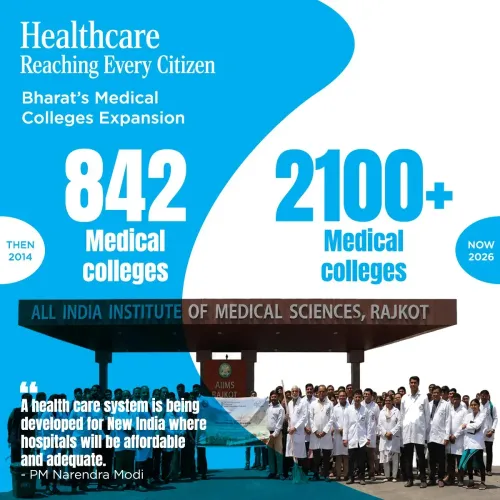
The scale of today's announcement only makes sense against a longer arc. When the Modi government took office in 2014, India's total MBBS intake hovered around 51,000 seats. By 2023, successive approvals had pushed that figure past the one-lakh mark. The new approval takes the national tally to 1,40,214 — nearly three times the 2014 baseline in just over a decade.
A critical institutional enabler of this acceleration was the National Medical Commission Act, 2019, which replaced the older Medical Council of India with the National Medical Commission (NMC). The NMC streamlined seat-approval processes and tightened infrastructure norms, making it faster — and, in principle, more accountable — for states to add capacity. New seats still require matching commitments on hospital beds, faculty, and equipment before the NMC greenlights them.
Why the doctor-population gap still drives urgency
India's push to multiply medical seats is fundamentally a response to a stubborn structural deficit. The country's doctor-population ratio has long trailed World Health Organization benchmarks, with rural and tier-2 districts the hardest hit. Expanding MBBS intake is one lever; the government has also used the creation of new AIIMS campuses and district-level medical colleges as complementary instruments.
The question policymakers are now watching: whether state governments — and Karnataka in particular — can translate approved seats into fully functional classrooms and clinical rotations before the 2026-27 session begins. Faculty recruitment and hospital-bed expansion remain the two pinch points that have historically slowed real-world delivery even after formal approval.
With 1,40,214 seats now on the books and Karnataka alone crossing the 15,000-seat threshold, the pressure is on states to convert approvals into enrolled, trained doctors — because the number on a government order only matters the day a student walks into a ward.
Point of View
Measurable metric of governance delivery — one that simultaneously addresses the doctor-population deficit and generates political goodwill among aspirational youth. Karnataka's outsized allocation is consistent with its existing college ecosystem, but it also shines a spotlight on a state heading into a competitive political cycle. The real test of this policy arc will be infrastructure conversion: approved seats that go unfilled due to faculty shortages or inadequate hospital beds would undercut the headline number and hand critics a concrete accountability target ahead of the 2027 budget cycle.
NationPress
29 Sept 2026
Frequently Asked Questions
How many new MBBS seats were approved for 2026-27 in India?
13,186 new MBBS seats were approved for the 2026-27 academic year, as announced by Union Minister Pralhad Joshi on 29 September 2026 .
What is the total number of MBBS seats in India after the 2026-27 approval?
The national MBBS intake now stands at 1,40,214 seats across 836 medical colleges following the latest round of approvals.
Which state got the most new MBBS seats in 2026-27?
Karnataka received the highest allocation with 1,650 new MBBS seats , raising its state total to 15,745 — the largest in the country.
Which body approves new MBBS seats in India?
The National Medical Commission (NMC) , established under the National Medical Commission Act, 2019 , is the statutory regulator that approves new MBBS seats and medical colleges across India.
How much has India's MBBS intake grown since 2014?
India's MBBS intake has grown from roughly 51,000 seats in 2014 to 1,40,214 seats in 2026 — nearly three times the original capacity in just over a decade.