Pralhad Joshi hails doubling of medical colleges under Modi
Synopsis
Union Minister Pralhad Joshi marked twelve years of the Modi government by highlighting that India's medical colleges have more than doubled — from 387 in 2014 to over 842 — crediting regulatory reform, central schemes, and the Viksit Bharat vision for the expansion.
Key Takeaways
India's medical colleges grew from 387 in 2014 to over 842 by June 2026 , according to Minister Pralhad Joshi .
The expansion is attributed to the National Medical Commission Act of 2019 , which replaced the Medical Council of India and eased college approval norms.
The Pradhan Mantri Swasthya Suraksha Yojana , scaled up from 2015, funded new AIIMS campuses and upgraded state medical colleges.
The post was made under #12YearsOfSwasthBharat , marking a decade-plus of the Modi government's healthcare push.
Medical students and rural patients are the primary intended beneficiaries of the increased college count and seat availability.
Quality oversight by the National Medical Commission and state-level rollout of new colleges remain key issues to watch.
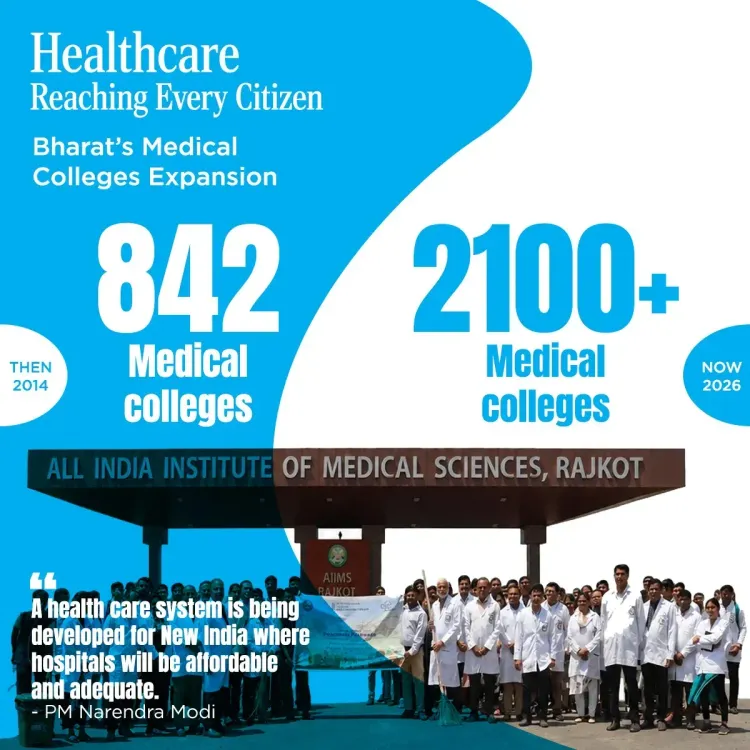
Union Consumer Affairs Minister Pralhad Joshi on Sunday, June 14, 2026, credited the leadership of Prime Minister Narendra Modi for what he described as a historic expansion of India's healthcare infrastructure, highlighting that the number of medical colleges has grown from 387 in 2014 to over 842 today — more than doubling in a decade.
Context
Posting on X under the hashtags #ViksitBharat and #12YearsOfSwasthBharat, Joshi wrote that 'every new medical college is a step towards accessible healthcare, empowered medical professionals and a healthier Viksit Bharat.' The post marks twelve years of the Modi government's stated push to expand medical education and healthcare access across the country.
The minister framed the college count as evidence of an 'unprecedented growth' that is 'creating a stronger healthcare ecosystem' and 'ensuring quality healthcare reaches every corner of the nation.' The messaging aligns with the ruling party's broader narrative tying infrastructure milestones to the Viksit Bharat 2047 vision of a developed India.
Policy Backdrop
The expansion of medical colleges since 2014 has been driven by a combination of regulatory reform and central funding. The National Medical Commission Act of 2019 replaced the older Medical Council of India, easing norms for establishing new institutions and standardising oversight of medical education quality.
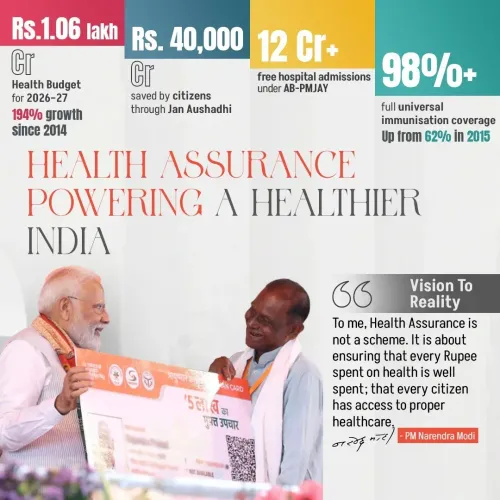
On the funding side, the Pradhan Mantri Swasthya Suraksha Yojana was scaled up from 2015 onward, sanctioning multiple new All India Institutes of Medical Sciences (AIIMS) and upgrading state government medical colleges to address regional imbalances. The Ayushman Bharat programme, launched in 2018, complemented this by expanding health and wellness centres alongside secondary and tertiary care facilities.
Together, these measures were designed to raise India's doctor-to-population ratio, long cited as a critical gap in the country's public health system.
Stakeholders and Impact
The most direct beneficiaries of this expansion are medical students, who now have access to a significantly larger pool of college seats across public and private institutions. For aspirants from smaller towns and rural areas, the geographic spread of new colleges reduces dependence on a handful of metro-based institutions.
For rural patients, the long-term dividend is an increase in the number of trained doctors who can be deployed through government schemes and rural postings. Critics and policy analysts, however, have noted that the quality of infrastructure and faculty at newly established colleges — particularly private ones — remains a subject of ongoing regulatory scrutiny by the National Medical Commission.
What's Next
Attention will turn to whether the National Medical Commission updates minimum standards and seat allocations to keep pace with the pace of college approvals. State governments, which manage a large share of government medical colleges, will be watched for the rollout timelines of newly sanctioned institutions and the graduation of their first batches of doctors.
As the Viksit Bharat 2047 deadline approaches, healthcare workforce data — including doctor density and specialist availability in tier-2 and tier-3 cities — is likely to become a key metric in political and policy debates around India's development trajectory.
Point of View
Using sectoral data points to build a governance-performance narrative ahead of future electoral cycles. The choice of healthcare — a domain with direct, personal salience for voters — signals the party's intent to claim credit for structural reforms that may not be immediately visible to ordinary citizens. The framing under 'Viksit Bharat' ties a specific policy milestone to a long-horizon national aspiration, making it harder for critics to contest on short-term grounds alone. However, the gap between college quantity and verifiable quality outcomes — faculty strength, infrastructure, patient load — remains the most credible line of scrutiny for opposition voices and independent analysts.
NationPress
14 Sept 2026
Frequently Asked Questions
How many medical colleges does India have in 2026?
According to Union Minister Pralhad Joshi's post on June 14, 2026, India has over 842 medical colleges, up from 387 in 2014 when the Modi government came to power.
What is the #12YearsOfSwasthBharat hashtag about?
The hashtag #12YearsOfSwasthBharat marks twelve years of the Narendra Modi government's healthcare and medical education expansion initiatives, used by BJP leaders to highlight policy milestones.
Which scheme helped expand medical colleges in India after 2014?
The Pradhan Mantri Swasthya Suraksha Yojana, scaled up from 2015, sanctioned new AIIMS campuses and upgraded state medical colleges. The National Medical Commission Act of 2019 also eased regulatory norms for opening new institutions.
What is the National Medical Commission and what does it do?
The National Medical Commission is a statutory body established in 2019 under the National Medical Commission Act, replacing the Medical Council of India. It regulates medical education standards, approves new colleges, and oversees quality benchmarks for medical institutions across India.
What is Viksit Bharat and how does healthcare fit into it?
Viksit Bharat is the Modi government's vision of India becoming a developed nation by 2047. Healthcare workforce expansion — including more medical colleges and trained doctors — is positioned as one of the foundational pillars of this long-term national development goal.