Pralhad Joshi: Cabinet clears NIPU-2026 to boost urea output
Synopsis
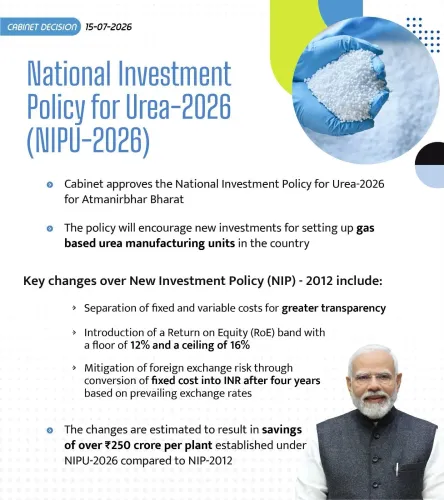
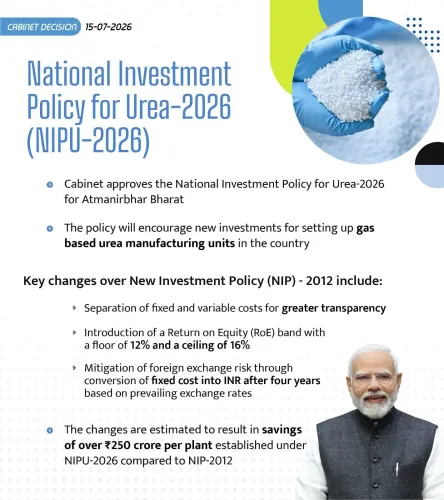
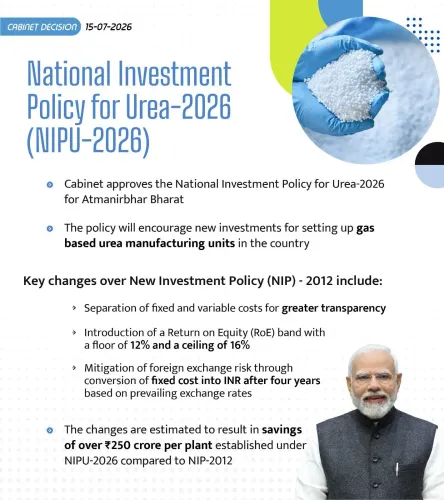
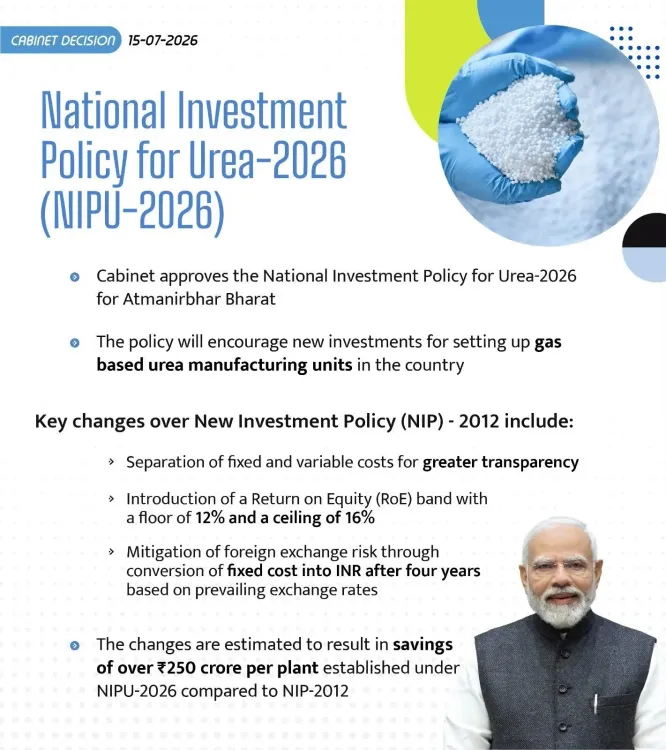
The Union Cabinet has approved the National Investment Policy for Urea-2026 (NIPU-2026) to attract fresh investment in gas-based urea production, aiming to cut India's heavy reliance on imported fertilizer and secure supply for farmers under the Atmanirbhar Bharat framework.
Key Takeaways
The Union Cabinet approved the National Investment Policy for Urea-2026 (NIPU-2026) on 15 July 2026 .
The policy targets fresh investment in gas-based urea manufacturing to expand domestic production capacity.
India currently imports an estimated 30-40 per cent of its annual urea requirement, exposing farmers to global price volatility.
NIPU-2026 is positioned as an extension of the Atmanirbhar Bharat self-reliance campaign launched in May 2020.
The policy continues a lineage that includes the New Urea Policy of 2015 and the revival of closed plants at Gorakhpur, Sindri and Barauni .
Full Cabinet-notified guidelines, investor commitments and production targets are awaited as the next concrete milestones.
Union Consumer Affairs Minister Pralhad Joshi announced on Wednesday, 15 July 2026 that the Union Cabinet, led by Prime Minister Narendra Modi, has approved the National Investment Policy for Urea-2026 (NIPU-2026), a targeted scheme to attract fresh investment in gas-based urea manufacturing and reduce India's dependence on imported fertilizer.
Context
Joshi said the policy would 'boost domestic production, reduce import dependence, ensure a reliable supply of urea for farmers and strengthen India's journey towards Atmanirbhar Bharat.' The Cabinet decision was framed as a continuation of the government's broader self-reliance agenda, which spans energy, defence, electronics and agricultural inputs.
India has historically imported between 30 and 40 per cent of its annual urea requirement, leaving farmers exposed to global price swings and burdening the Union government with a sizeable fertilizer subsidy bill. NIPU-2026 is designed to close that gap by making gas-based domestic production economically attractive for both public-sector and private investors.
Policy Backdrop
The announcement builds on a decade-long policy arc. The New Urea Policy of 2015 first linked production incentives to import parity prices to draw fresh capital into the sector. Around the same period, the Cabinet approved the revival of three closed public-sector urea plants at Gorakhpur, Sindri and Barauni, signalling sustained political will to expand domestic capacity.
The Atmanirbhar Bharat campaign, launched in May 2020, elevated fertilizer self-sufficiency to a national priority by framing import dependence as a strategic vulnerability. NIPU-2026 is the latest instrument in that lineage, using investment incentives rather than direct capacity mandates to crowd in private and public capital.
Stakeholders and Impact
The most immediate beneficiaries are Indian farmers, who depend on subsidised urea as a primary nitrogen fertilizer for staple crops including wheat, rice and sugarcane. A reliable domestic supply chain insulates them from the kind of global price spikes that followed supply disruptions in 2021-22.
Fertilizer public-sector undertakings and private manufacturers stand to gain from the investment incentives embedded in the policy, though the specific financial architecture — subsidy linkage, capital grants, or production-linked incentives — will be detailed in the Cabinet-notified guidelines. The Union government's own subsidy expenditure is expected to moderate over the medium term if domestic output rises to displace imports.
What's Next
Analysts and industry stakeholders will watch for the full text of the Cabinet-notified NIPU-2026 guidelines, which are expected to specify production targets, eligibility criteria for investors and the timeline for capacity addition. Investment commitments from both public and private players will be a key early indicator of the policy's traction.
The fertilizer subsidy allocation in the next Union Budget will also be closely tracked: a successful ramp-up in domestic urea output would allow the government to trim import-linked subsidy outflows, freeing fiscal space for other priorities. For now, the Cabinet decision marks the formal starting point of what the government is positioning as a structural shift in India's fertilizer economy.
Point of View
Fertilizer self-sufficiency carries a dual political dividend: it insulates farmers from import-price volatility ahead of election cycles and advances the Atmanirbhar Bharat brand. The real test will be whether the policy architecture is attractive enough to unlock private capital, which previous urea investment schemes struggled to mobilise at scale. The absence of specific financial details at announcement stage leaves that question open.
NationPress
15 Jul 2026
Frequently Asked Questions
What is the National Investment Policy for Urea-2026 (NIPU-2026)?
NIPU-2026 is a Union Cabinet-approved policy designed to attract fresh investment in gas-based urea manufacturing in India, with the goal of boosting domestic production and reducing the country's dependence on imported urea.
Why does India import so much urea?
India imports an estimated 30-40 per cent of its annual urea requirement because domestic production capacity has historically been insufficient to meet agricultural demand, leaving the country exposed to global price volatility and a large fertilizer subsidy burden.
How does NIPU-2026 relate to Atmanirbhar Bharat?
The Atmanirbhar Bharat campaign, launched in May 2020, set fertilizer self-sufficiency as a national priority. NIPU-2026 is the latest policy instrument under that framework, using investment incentives to reduce import dependence in the urea sector.
Which minister announced the NIPU-2026 Cabinet approval?
Union Consumer Affairs Minister Pralhad Joshi announced the Cabinet's approval of NIPU-2026 on 15 July 2026 via a post on X, attributing the decision to the leadership of Prime Minister Narendra Modi.
What happens next after the NIPU-2026 approval?
The government is expected to notify the full policy guidelines detailing investor eligibility, production targets and financial incentives. Investment commitments from public-sector fertilizer units and private players, as well as the fertilizer subsidy allocation in the next Union Budget, will be key indicators of the policy's impact.