Pralhad Joshi Pays Tribute to Karnataka Unifier Aluru Venkata Rao
Synopsis
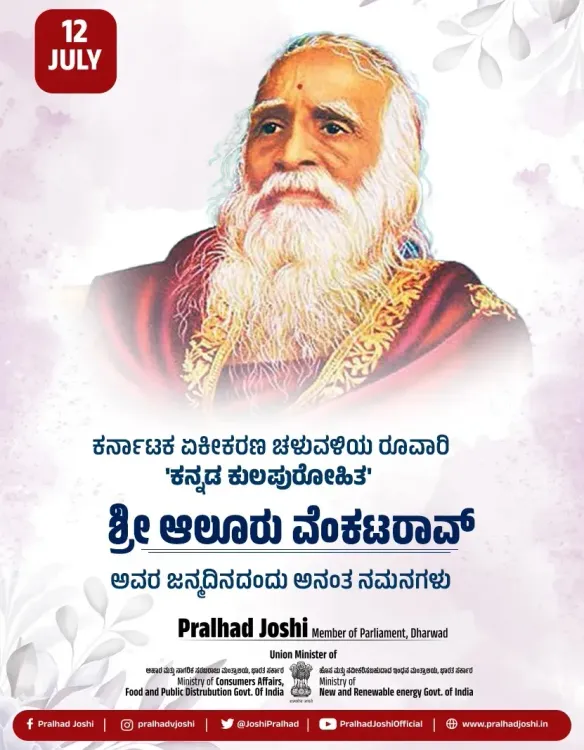
Union Minister Pralhad Joshi marked the birth anniversary of Aluru Venkata Rao, the 'Kannada Kulapurohita' and chief architect of the Karnataka unification movement, calling his contributions to Kannada language, culture and identity 'unparalleled' and a lasting inspiration.
Key Takeaways
Union Consumer Affairs Minister Pralhad Joshi posted a Kannada-language tribute to Aluru Venkata Rao on 12 July 2026 , the latter's birth anniversary.
Aluru Venkata Rao ( 1880–1964 ) is titled 'Kannada Kulapurohita' and is widely regarded as the father of the Karnataka unification movement.
His advocacy contributed directly to the States Reorganisation Act of 1956 , which created the unified Kannada-speaking state, initially named Mysore and renamed Karnataka in 1973 .
Joshi described Venkata Rao's intellectual thinking and service to 'land and language' as a 'perpetual inspiration' to all Kannadigas.
The tribute aligns with a broader pattern of ruling-party leaders from linguistically conscious states marking regional cultural anniversaries to affirm local identity.
The next major milestone for Ekikarana legacy observances is Karnataka Rajyotsava on 1 November .
Union Consumer Affairs Minister Pralhad Joshi on Sunday, 12 July 2026 paid tribute to Aluru Venkata Rao, the pioneering architect of Karnataka's unification movement, on the occasion of the latter's birth anniversary, hailing his contributions to Kannada language, culture and regional identity.
Posting in Kannada on X, Joshi wrote: 'ಕರ್ನಾಟಕ ಏಕೀಕರಣದ ಪ್ರಮುಖ ರೂವಾರಿ, ಕನ್ನಡ ಕುಲಪುರೋಹಿತ ಆಲೂರು ವೆಂಕಟರಾವ್ ಅವರಿಗೆ ಶತ ಶತ ನಮನಗಳು' — translated: 'Hundreds of salutations to Aluru Venkata Rao, the chief architect of Karnataka's unification and the 'Kannada Kulapurohita'.' He added that Venkata Rao's 'intellectual thinking and service to the land and language will always be an inspiration to all of us.'
Context
Aluru Venkata Rao (1880–1964) was a Kannada writer, historian and activist widely regarded as the father of the Karnataka unification movement. His title 'Kannada Kulapurohita' — roughly 'the high priest of the Kannada community' — reflects the reverence he commands among Kannadigas. His seminal work Karnataka Gatha Vaibhava (1917) is considered a foundational text in articulating a distinct Kannada cultural and political identity.
Venkata Rao spent decades rallying Kannada-speaking communities spread across British India and multiple princely states, arguing that linguistic and cultural kinship demanded a single, unified administrative unit. His advocacy, along with that of fellow activists, laid the intellectual groundwork for what became the Ekikarana movement.
Policy Backdrop
The Ekikarana movement of the early twentieth century directly influenced the States Reorganisation Act of 1956, which consolidated Kannada-speaking territories from the former Mysore state, Hyderabad, Bombay and Madras provinces into a single state — initially called Mysore and renamed Karnataka in 1973. Venkata Rao did not live to see the full fruition of the movement he helped seed, but his writings and organisational efforts are credited as its ideological spine.
The Karnataka Rajyotsava, celebrated every year on 1 November, marks the formation of the unified state and routinely invokes the legacy of Ekikarana leaders including Venkata Rao. State and central government figures across party lines observe his birth anniversary as an occasion to reaffirm commitment to Kannada identity.
Stakeholders and Impact
The tribute carries significance for Kannadigas and Kannada language activists, for whom Aluru Venkata Rao remains a touchstone figure. Joshi, a senior BJP leader representing Dharwad in Karnataka, has consistently used social media to mark the birth and death anniversaries of regional cultural icons — a practice that reinforces local identity credentials within a national party framework.
For the broader Kannada-speaking diaspora and literary community, such acknowledgements from Union ministers signal that the cultural legacy of the unification movement retains political salience at the national level, not only in state politics.
What's Next
Attention will turn to Karnataka Rajyotsava on 1 November, when tributes to Ekikarana leaders traditionally peak and state authorities announce cultural or educational initiatives in their honour. Any proposals by the Karnataka government or central institutions to institutionalise Aluru Venkata Rao memorials, include his works in school curricula, or name public infrastructure after him would be the most concrete policy follow-through of such commemorations. Joshi's post keeps the conversation around the unification movement's legacy alive in the national public discourse ahead of that annual milestone.
Point of View
Culture and identity' rather than political separatism, Joshi places the unification movement safely within the constitutional mainstream. The gesture also keeps Joshi visible among Kannada-speaking voters ahead of the Karnataka Rajyotsava season. Over time, such consistent social-media commemorations by senior central ministers can build soft pressure on state governments to institutionalise memorials or curriculum changes — turning symbolic tribute into policy conversation.
NationPress
12 Jul 2026
Frequently Asked Questions
Who was Aluru Venkata Rao and why is he called Kannada Kulapurohita?
Aluru Venkata Rao ( 1880–1964 ) was a Kannada writer, historian and activist who led the campaign to unify all Kannada-speaking territories under a single state. The title 'Kannada Kulapurohita' — meaning 'high priest of the Kannada community' — was conferred on him in recognition of his lifelong service to Kannada language and culture.
What was the Karnataka unification movement or Ekikarana movement?
The Ekikarana movement was a decades-long campaign, gaining momentum in the early twentieth century, to consolidate Kannada-speaking regions spread across British Indian provinces and princely states into one administrative unit. It culminated in the States Reorganisation Act of 1956 , which created the unified Mysore state , later renamed Karnataka in 1973 .
Why did Pralhad Joshi post a tribute to Aluru Venkata Rao?
Pralhad Joshi posted the tribute on 12 July 2026 to mark Aluru Venkata Rao's birth anniversary , calling his contributions to Kannada language, culture and identity 'unparalleled' and a 'perpetual inspiration.'
When is Karnataka Rajyotsava and how does it relate to Aluru Venkata Rao?
Karnataka Rajyotsava is celebrated on 1 November each year, marking the formation of the unified Karnataka state in 1956 . Aluru Venkata Rao is among the most celebrated figures of the Ekikarana movement that made the state's formation possible, and his legacy is prominently invoked during Rajyotsava commemorations.
What is Pralhad Joshi's connection to Karnataka?
Pralhad Joshi is a senior BJP leader from Dharwad, Karnataka , and currently serves as the Union Minister of Consumer Affairs, Food and Public Distribution, and Minister of New and Renewable Energy. He regularly marks Karnataka cultural and historical anniversaries on social media.