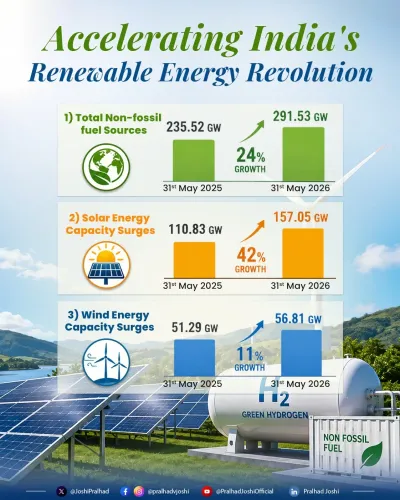
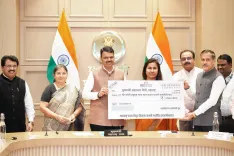
Pralhad Joshi: Renewables Could Save India $240bn in Imports
Synopsis
Union Minister Pralhad Joshi highlights an IEA projection that renewable energy expansion could save India nearly $240 billion in coal and gas imports by 2030, framing the transition as a cornerstone of Aatmanirbhar Bharat and national economic resilience.
Key Takeaways
The IEA estimates expanding renewables could save India nearly $240 billion in coal and natural gas import costs by 2030 .
Minister Pralhad Joshi linked the savings to the Aatmanirbhar Bharat self-reliance agenda, emphasising foreign exchange conservation.
India committed to 500 GW of non-fossil electricity capacity by 2030 under its Panchamrit pledges at COP26 in 2021.
The National Solar Mission , launched in 2010 with a 20 GW target, underpins a renewable policy lineage now backed by PLI manufacturing incentives.
IEA Executive Director Fatih Birol was directly tagged in the post, signalling India's intent to amplify the projection on the global stage.
A $240 billion windfall — not from a new discovery, but from energy India will no longer have to buy abroad. Union Consumer Affairs and New and Renewable Energy Minister Pralhad Joshi on Friday, 6 November 2026, cited an International Energy Agency (IEA) estimate to argue that India's accelerating renewable transition is as much an economic security story as a climate one.
The $240 billion import-savings figure explained
The IEA projection, flagged by Minister Joshi and addressed to IEA Executive Director Fatih Birol, holds that expanding renewable energy could spare India nearly $240 billion in coal and natural gas import bills by 2030. The logic is straightforward: every gigawatt of solar or wind capacity that displaces a thermal plant is a gigawatt-worth of imported fuel that stays out of India's import ledger. For a country that runs a structurally large energy trade deficit, the arithmetic is hard to argue with.
Minister Joshi framed this directly through the lens of Aatmanirbhar Bharat — Prime Minister Narendra Modi's self-reliance programme launched in 2020 — describing renewables as 'reducing import dependence, conserving foreign exchange and building a cleaner, more self-reliant energy future.'
India's renewable ambitions: from Panchamrit to PLI
The policy thread runs back years. India's National Solar Mission, launched in 2010, began with a modest 20 GW solar target before being revised sharply upward. At COP26 in 2021, Prime Minister Modi announced the Panchamrit commitments — including a headline pledge of 500 GW of non-fossil electricity capacity by 2030. Domestic manufacturing incentives under Production-Linked Incentive (PLI) schemes have since been deployed to build a supply chain that can underwrite that target without excessive reliance on imported components.
The result is a policy architecture that links climate diplomacy, industrial strategy, and import substitution into a single narrative — exactly the narrative Minister Joshi is amplifying.
Energy security as the new growth engine
What gives Joshi's post its edge is the pivot from green idealism to hard economics. India's exposure to global fossil fuel price shocks — most acutely felt after the 2022 surge in coal and gas prices — made energy import dependence a live fiscal risk, not merely an environmental concern. Renewable capacity, in this framing, is a hedge. Build enough of it, and global commodity cycles stop dictating India's import bill.
The minister called this 'the power of Aatmanirbhar Bharat,' positioning the clean-energy push as a continuation of the broader self-reliance agenda rather than a standalone environmental project. That framing matters: it roots climate action inside a development argument that plays across the political spectrum.
India's next renewable capacity milestone will be the real test of whether the $240 billion projection stays within reach — but the direction of travel, at least, is unmistakable.
Point of View
The BJP government is executing a deliberate reframe: clean energy is no longer sold primarily as an environmental obligation but as a fiscal and strategic imperative, easier to defend in a growth-focused political discourse. The Aatmanirbhar Bharat hook is especially telling — it ties the energy agenda to a mass-resonance programme already embedded in the government's brand. Flagging the IEA projection internationally, with Fatih Birol tagged, also serves as credibility-laundering: a Western multilateral body validating India's economic rationale for the energy transition carries more heft than domestic self-promotion alone. The real policy test, however, remains capacity delivery — whether the 500 GW non-fossil target stays on track will determine how durable this narrative proves to be.
NationPress
6 Nov 2026
Frequently Asked Questions
How much could renewable energy save India on fossil fuel imports by 2030?
The IEA estimates that expanding renewable energy could save India nearly $240 billion in coal and natural gas imports by 2030, by displacing the need for imported fuels with domestically generated clean power.
What is Aatmanirbhar Bharat and how does it relate to energy?
Aatmanirbhar Bharat is India's self-reliance programme launched in 2020. In the energy context, it covers reducing dependence on imported coal and gas, conserving foreign exchange, and building domestic renewable manufacturing capacity through initiatives like PLI schemes.
What is India's renewable energy target for 2030?
India committed at COP26 in 2021 to achieve 500 GW of non-fossil electricity capacity by 2030 as part of its Panchamrit climate pledges.
Who is Fatih Birol and why was he tagged in Pralhad Joshi's post?
Fatih Birol is the Executive Director of the International Energy Agency. Minister Joshi tagged him because the $240 billion import-savings figure originates from IEA analysis, and the tag signals India's desire to highlight the projection to the global energy policy community.
What is India's National Solar Mission?
India's National Solar Mission was launched in 2010 with an initial target of 20 GW of solar capacity. It has since been revised upward significantly and forms the foundational policy framework for India's large-scale solar deployment.